

A missing or failing tooth can change small moments in a big way. You may find yourself chewing on one side, covering your smile in photos, or wondering whether that cracked tooth is going to hold up through one more meal. Many people searching for a dentist near me or dental implants near me in Bellaire are dealing with exactly that mix of worry, discomfort, and uncertainty.
Modern implants and crowns are designed to solve that problem as one complete system. Instead of just filling a visible space, they replace the part under the gums and the part you see when you smile. That’s why this treatment often feels so natural once it’s finished.
- Your Guide to Implants and Crowns in Bellaire and Houston
- More Than a Gap The Health Impact of a Missing Tooth
- How Dental Implants and Crowns Restore Your Full Smile
- Your Implant and Crown Treatment Journey with Dr Boren
- Are Implants and Crowns Right for You
- The Lasting Benefits of a Secure and Natural Smile
- Caring for Your Dental Implants and Crowns
- Common Questions About Implants and Crowns
Your Guide to Implants and Crowns in Bellaire and Houston
If you're looking for a lasting way to replace a missing tooth, you're not alone. The need for dependable tooth replacement is significant, with over 178 million Americans missing at least one tooth, and dental implants restored with crowns show a 90 to 95 percent success rate at ten years according to dental implant statistics.

A common Bellaire scenario goes like this. Someone has an old crown that keeps coming loose, or a tooth that cracked years after a root canal. At first, the goal is simple: stop the pain and get through the week. Then the bigger question shows up. What will restore the tooth in a way that feels stable, looks natural, and doesn’t keep creating new problems?
That’s where implants and crowns make sense. The implant replaces the missing root. The crown replaces the visible tooth. Together, they create a restoration that can look, feel, and function much closer to a natural tooth than many patients expect.
For people comparing options in Bellaire, West University, and Houston, it also helps to understand where implants fit within restorative dentistry. A filling repairs a smaller area. A crown protects a damaged tooth. An implant and crown rebuild a tooth that can’t be saved or is already gone.
Why local clarity matters
Patients usually aren't starting with technical questions. They're asking practical ones. Will this hurt? How long will it take? Will it look obvious? Can I eat normally again?
Those are fair questions, and they deserve plain answers. Good dental education should feel as clear as the treatment plan itself. That same principle shows up in how practices communicate online. If you're curious how trustworthy dental offices help patients find accurate information, these local dental SEO strategies offer a useful look at how education and visibility connect.
A strong implant crown should do two jobs at once. Restore function and restore confidence.
More Than a Gap The Health Impact of a Missing Tooth
A missing tooth isn't only a cosmetic issue. The visible gap is just the part you notice first. Under the surface, your mouth starts adapting almost immediately.
When a natural tooth is present, its root helps stimulate the jawbone. Once that root is gone, the bone in that area no longer gets the same signal. Over time, the body may begin to shrink that unused bone. Patients often describe this as feeling like the area has changed shape, even if they can't see it right away.
What changes after tooth loss
Tooth loss is common. It affects over 150 million Americans, and 26 percent of seniors aged 65 and older have eight or fewer teeth. The same source notes projections that 17 to 23 percent of adults with missing teeth will have implants by 2026, which reflects how many people are looking for a stable answer to this problem through dental implant demand statistics.
The health effects often happen in a chain:
- Bone support changes and the ridge under the missing tooth may become thinner.
- Neighboring teeth can drift into the open space.
- The bite may shift so chewing feels uneven.
- Opposing teeth may over-erupt because they no longer meet normal resistance.
That’s why a single missing tooth can gradually affect more than one area of your mouth.
Why chewing can feel “off”
Think of your bite like a zipper. Each tooth helps the others line up and share force. Remove one tooth, and the pattern becomes less stable. You might start chewing on one side, avoiding crunchy foods, or feeling pressure on nearby teeth.
This also explains why some people search for a dentist in Bellaire, TX after losing a tooth and say, “It’s not just the gap. My whole mouth feels different.” That feeling is real. Your teeth, jaw joints, and chewing muscles are designed to work as a group.
Leaving a missing tooth untreated doesn't always hurt right away. But changes in bite, bone, and tooth position can build slowly and make later treatment more complicated.
Why timing matters
Treatment doesn’t need to feel rushed, but it should be thoughtful. If a tooth is failing because of fracture, infection, or severe damage, your dentist may discuss whether it can be saved or whether tooth extraction followed by replacement is the healthier path.
Patients sometimes wait because the missing tooth is in the back and “doesn’t show.” The problem is that back teeth do much of the heavy chewing work. Replacing them can protect comfort and balance across the whole mouth, not just appearance.
How Dental Implants and Crowns Restore Your Full Smile
The easiest way to understand implants and crowns is to think of them as a three-part rebuild. You’re not just getting a new tooth-shaped cap. You’re rebuilding support from the foundation up.
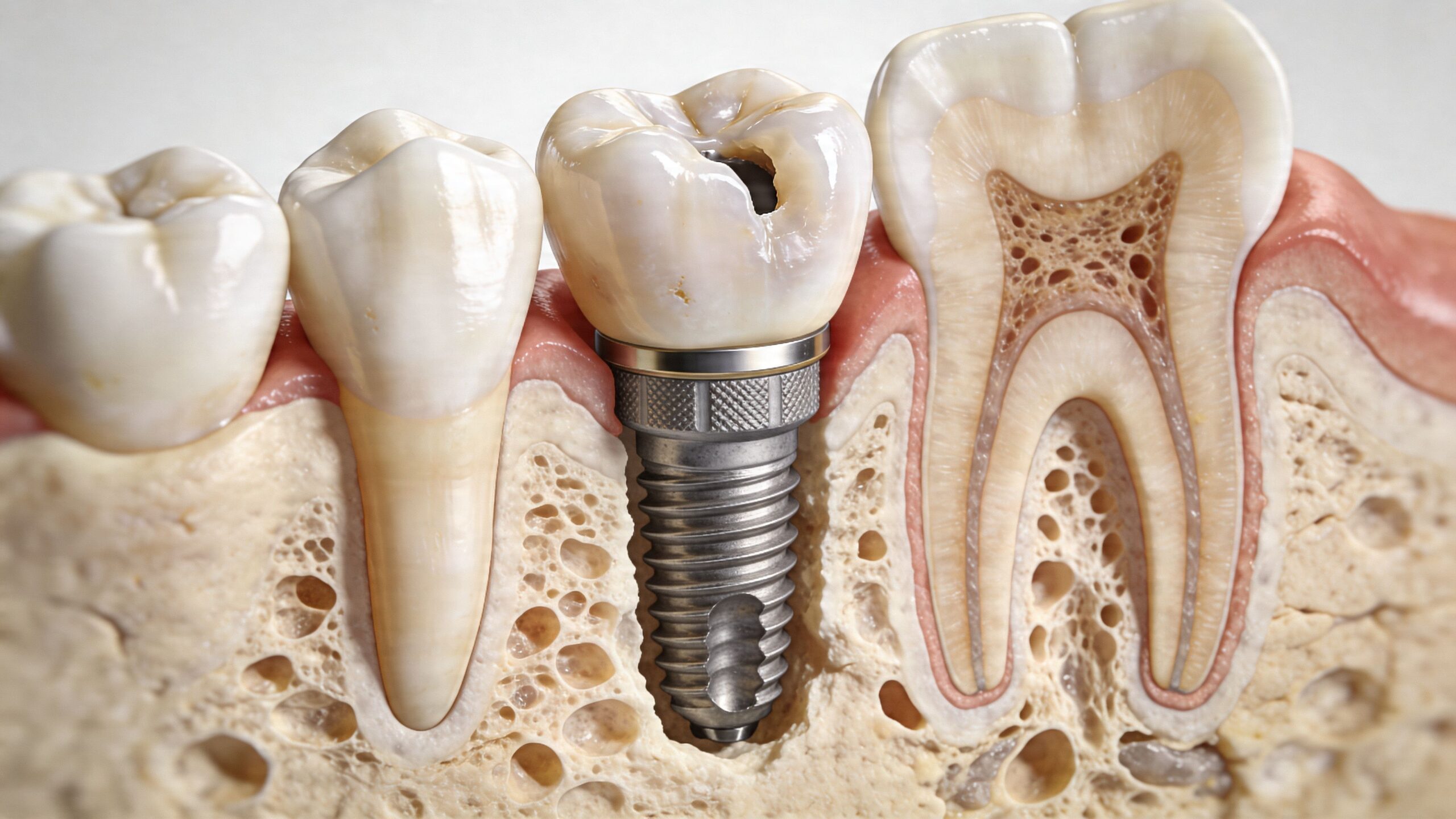
The three parts that work together
An implant-supported tooth usually has these pieces:
The implant
This is the small post placed in the jawbone where the missing root used to be. It acts as the new anchor.The abutment
This is the connector. It joins the implant below the gums to the crown above the gums.The crown
This is the part you see. It’s shaped and shaded to blend with the rest of your smile.
A simple analogy helps. If you've ever hung a shelf in drywall, you know the visible screw isn't enough by itself. It needs a secure anchor in the wall. In the same way, a crown needs a stable implant under it. Without that foundation, you don't get the same support.
Why the crown matters so much
Patients often focus on the implant because it sounds surgical, but the crown is what restores your everyday experience. It affects how the tooth looks, how it meets the opposing teeth, and how comfortably you bite into food.
Material choice matters here. According to implant crown material guidance from Glidewell, zirconia-based crowns can exceed 1,000 MPa in flexural strength, which is one reason they’re often chosen when durability is a priority and reducing the risk of chipping or fracture matters.
For patients who want a deeper look at materials, shades, and aesthetics, this guide to the best dental crown material can help make the options easier to compare.
How restorative and cosmetic goals overlap
This treatment lives in both restorative dentistry and cosmetic dentistry. Restorative work is about replacing what was lost and making the bite healthy again. Cosmetic work is about shape, proportion, translucency, and a natural appearance.
A good implant crown should do both. It should feel stable enough for chewing and look quiet enough that no one notices it.
Here’s a short visual overview of how the pieces come together in the mouth.
What patients usually find surprising
Several things tend to surprise first-time implant patients:
- It’s one system, not two separate treatments. The implant and crown are planned together.
- The result is meant to look integrated, not like a removable add-on.
- The goal is normal function. You should be able to smile and chew without constantly thinking about the tooth.
Practical rule: The visible crown gets the attention, but the long-term success depends on careful planning of the support underneath it.
That planning includes where the implant sits, how the gum tissue frames the final tooth, and how the bite contacts are adjusted so the crown carries force properly.
Your Implant and Crown Treatment Journey with Dr Boren
You come in with a missing tooth and one big question. How do an implant and a crown turn into something that feels like your own tooth again?
The answer is easier to follow when you see the process as a series of planned stages. Each visit has a job. One step builds on the one before it, much like building a house. First the foundation goes in, then the support piece, then the visible part that looks and works like a tooth.

Step one starts with planning
Your first visit is a planning visit. Dr. Boren checks the teeth, gums, bite, and the amount of room available for the replacement tooth. Digital x-rays show the bone and surrounding structures below the gums, and some cases benefit from 3D imaging for a more precise map of the area.
If the tooth is still present but cannot be saved predictably, the conversation may include removing it first. If the tooth is already missing, the focus shifts to bone support, gum shape, and how the new tooth will fit with the teeth around it.
Comfort is part of the plan from the start. Some patients feel better once they understand each step. Others feel nervous as soon as they hear the word implant. Local anesthetic, pacing, and sedation options can be discussed when needed, so the process feels manageable.
The implant placement visit
The implant placement appointment puts the foundation into the jawbone. After the area is numb, the site is prepared and the implant is placed with careful attention to depth, angle, and position. Those details matter because the final crown has to come through the gums in the right spot and meet the bite correctly.
One technical term you may hear is Crown Height Space, or CHS. According to the ICOI consensus report on Crown Height Space, implant-supported crowns generally perform best when this space is in an appropriate range, because too much height can increase stress on the implant. A simple way to understand it is this. A taller tooth above a smaller base can work like a longer lever, which puts more force on the support underneath.
That is why measurements matter so much before treatment ever begins.
Healing is active, even when nothing looks different
After placement, the bone needs time to bond to the implant. Patients sometimes call this the waiting phase, but your body is doing active repair during this period.
In some cases, you may wear a temporary tooth while the area heals. In others, the site is left undisturbed so the implant can stay protected. The goal is the same either way. Keep the area healthy, protect the gums, and give the implant the stable conditions it needs to bond with the bone.
Some of the most important implant work happens after the surgical visit, when the body secures the implant in place.
Finishing the visible tooth
Once healing is far enough along, the top part of the system is completed. An abutment connects the implant to the final crown, and the crown is designed to match your bite, your smile, and the surrounding teeth.
This is the point where patients often feel the whole plan click into place. The implant is the root replacement under the gums. The crown is the part you see and chew with above the gums. Together, they function as one coordinated solution rather than two unrelated parts.
Details matter here. In a front tooth, shape, edge contour, and color blending are especially important. In a back tooth, strength and bite balance often guide more of the design. Charles E. Boren may use digital x-ray imaging, magnification, fiber optics, and minimally invasive techniques to improve fit, accuracy, and comfort during planning and restorative care.
What your visits usually feel like
Patients usually want to know what this feels like in real life.
For many people, it feels less dramatic than expected. The process is spread out over manageable appointments, and each visit has a clear purpose. You are not trying to get everything done in one long day.
A typical sequence includes:
- Consultation and records, where the condition of the tooth, bone, and gums is reviewed
- Placement day, where treatment is focused on one area and the mouth is kept numb
- Healing checks, where progress is monitored and questions can be answered
- Final crown delivery, when the replacement tooth is secured and adjusted for comfort
If you are dealing with a broken tooth or sudden pain, the first visit may start with an urgent evaluation. From there, Dr. Boren can determine whether the tooth can be restored or whether an implant and crown would be the healthier long-term replacement.
Are Implants and Crowns Right for You
Not every missing tooth should be treated the same way. Some people are strong candidates for implants right away. Others may need preparatory care, or they may be deciding between an implant, a bridge, or a removable partial denture.
Signs you may be a good candidate
Implants and crowns may be a good fit if you:
- Have a missing tooth or a tooth that can't be predictably saved
- Want a fixed option rather than something removable
- Have healthy gums or are willing to treat gum issues first
- Want to protect nearby teeth instead of relying on them for support
- Can commit to long-term home care and regular dental visits
Candidacy isn't based on one checklist item alone. It’s a combination of oral health, bone support, bite pattern, medical history, and your goals.
A side by side comparison
Some patients decide quickly once they see the options next to each other.
| Feature | Dental Implant with Crown | Traditional Dental Bridge | Removable Partial Denture |
|---|---|---|---|
| How it stays in place | Anchored in the jaw with an implant and topped with a crown | Attached to neighboring teeth | Rests on gums and may use clasps |
| Effect on nearby teeth | Usually does not require support from adjacent teeth | Neighboring teeth are often prepared to hold the bridge | May place pressure on teeth and soft tissue |
| Feel during chewing | Usually feels closest to a fixed tooth | Fixed, but support comes from other teeth | Can feel bulkier or less stable |
| Bone support where tooth is missing | Designed to replace the root area as well as the crown | Replaces the visible tooth space, not the root | Replaces the space above the gums, not the root |
| Daily care | Brush and clean carefully around the crown and gumline | Brush and clean beneath the bridge area | Remove and clean the appliance regularly |
| Best for | Patients wanting a long-term fixed replacement | Patients who are not choosing implant treatment | Patients needing a removable, lower-commitment option |
No option is “right” for everyone. The right choice is the one that fits your mouth, your priorities, and your treatment timeline.
Cost deserves an honest conversation
For many families, the biggest hesitation isn't fear of treatment. It's cost. Research discussed in this study on barriers to implant consideration found that low income was the primary barrier to choosing implants, with many patients selecting dentures because of the upfront expense.
That reality matters in daily practice. People don't refuse treatment because they don't care. Often, they're trying to make a responsible decision with real budget limits.
If cost is the main obstacle, ask about staging treatment, financing, or whether a temporary solution can bridge the gap while you plan for a long-term restoration.
Questions worth asking at your consultation
Bring practical questions. They often matter more than broad ones.
- Can my tooth still be saved, or is replacement the healthier choice?
- Would I need extraction before implant treatment?
- How visible will the final crown be when I smile?
- What would maintenance look like for me?
- Are there financing options if I want the fixed solution but need flexibility?
Patients searching for a cosmetic dentist near me sometimes assume implants are only about appearance. Patients searching for restorative care assume they’re only about function. In reality, they sit in the overlap of both.
The Lasting Benefits of a Secure and Natural Smile
The biggest benefit of implants and crowns isn't that they look advanced. It's that they let life feel normal again.
You can laugh without thinking about the gap. You can order something crunchy without immediately calculating which side of your mouth is safe. You can speak without the slight self-consciousness that sometimes follows tooth loss or a failing front tooth.
Benefits patients notice every day
A well-made implant crown can improve daily life in ways that are simple but meaningful:
- More confidence in conversation because the tooth looks like it belongs there
- More comfort while chewing because the bite feels balanced
- Less worry about movement compared with removable options
- A more complete smile that supports overall facial harmony
For patients seeking cosmetic dentistry in Bellaire, the appearance matters. Shade, contour, and proportion all affect whether the restoration disappears into the smile instead of standing out.

Why fixed teeth feel different
A removable appliance can restore appearance and some function. For many patients, though, a fixed solution changes their confidence because it doesn't need to be taken out and doesn't feel like something separate from the body.
That fixed feeling matters emotionally as much as physically. Patients often describe the final result with phrases like “it feels like my tooth again” or “I stopped thinking about it.” In dentistry, that’s a strong outcome. The restoration is doing its job so quietly that it fades into daily life.
The long view
Implants and crowns also support a broader goal. They help preserve the structure and rhythm of the mouth by restoring a complete biting system. That can make everything else feel steadier, from chewing to smiling to routine hygiene.
The best restorative work doesn't call attention to itself. It lets you eat, smile, and speak without planning around your teeth.
If you're choosing between a quick patch and a solution that aims for long-term stability, this is often where implants make the most sense.
Caring for Your Dental Implants and Crowns
One of the most reassuring things about implant care is that it isn't complicated. You don't need a completely different life after treatment. You need a consistent routine.
Your daily routine at home
Care for an implant-supported crown much like you care for a natural tooth, with extra attention to the area where the crown meets the gums.
- Brush thoroughly twice a day with a soft toothbrush.
- Clean between teeth daily using floss, implant-friendly flossing tools, or another method recommended by your dentist.
- Pay attention to the gumline because plaque tends to collect where the restoration meets the tissue.
- Use a water flosser if helpful for reaching around the implant area.
The crown itself can't get a cavity the way natural enamel can, but the surrounding gums and supporting tissues still need protection. Healthy tissue is part of what keeps the implant stable.
What to avoid
Don't use the restored tooth as a tool. Opening packages, chewing ice, or biting pens creates unnecessary stress. If you clench or grind, tell your dentist. A protective nightguard may be part of long-term care.
If something feels different, don't ignore it. A crown that feels high, food trapping around the area, gum tenderness, or any new mobility should be evaluated promptly.
Why follow-up visits matter
Regular checkups let your dentist examine the bite, tissue health, and condition of the crown over time. Professional cleanings are also important because implants need healthy surrounding gums to stay successful.
For many people in Bellaire and Houston, this is the part that feels surprisingly normal. Once healing is complete, the implant crown becomes part of regular dental care. It doesn't need special daily rituals. It needs the same kind of steady attention that protects the rest of your smile.
Common Questions About Implants and Crowns
Does getting a dental implant hurt
Most patients do well with local anesthetic, and many say the process was easier than they expected. The area is numbed during treatment, and post-procedure soreness is usually managed with the instructions your dentist provides. If you're anxious, ask whether sedation is appropriate for your situation.
How long do dental implants and crowns last
Longevity depends on planning, bite forces, home care, and regular maintenance. Implant treatment is chosen because it aims to be durable and stable over the long term. The implant and the crown are also different parts, which means they may not always follow the exact same maintenance timeline.
Can any dentist place an implant
Implant care requires diagnosis, technical planning, and coordination between the surgical and restorative parts of treatment. The most important question isn't whether implant placement is offered. It's whether your case is being planned carefully, with attention to bone support, bite, gum tissue, and the final crown position.
What are crowns made of
Crowns can be made from different materials depending on where the tooth is located, how much force it will handle, and the cosmetic goals. Tooth-colored ceramics are common because they blend well with natural teeth. In areas that need more strength, material selection becomes especially important.
Will my implant crown look fake
A well-designed crown shouldn't draw attention to itself. Shape, color, and gum contour all matter. Front teeth usually require more detailed aesthetic design, while back teeth place more emphasis on strength and chewing function.
What if I need an extraction first
That’s common. If a tooth is too damaged to save, extraction may be the first step in moving toward an implant-supported crown. The timing depends on the condition of the tooth, the surrounding bone, and the treatment plan your dentist recommends.
Is this only for cosmetic cases
No. Implants and crowns are often part of restorative dentistry, even when the result also improves appearance. The main goal is to restore health, function, and comfort. Looking natural is part of doing that well.
If you're looking for a dentist near me, a dentist in Bellaire, TX, or want to talk through whether implants and crowns make sense for your situation, getting a consultation is the most useful next step. It turns a general idea into a plan built around your mouth, your timeline, and your comfort.
If you're ready to replace a missing or failing tooth with a stable, natural-looking solution, schedule a consultation with Charles E. Boren. Patients in Bellaire, West University, and Houston can get clear answers about implants and crowns, comfort-focused care, and a treatment plan personalized to their smile.