

A sudden toothache has a way of taking over everything. You might be trying to get through work in Houston, getting kids settled in Bellaire, or heading to dinner in West University when a cracked tooth, swelling, or sharp jaw pain turns the day into a dental emergency.
In a dental emergency, the immediate priorities are clear: stopping the pain, getting a clear answer, and knowing if same-day treatment is possible. If you're searching for an emergency dentist same day appointment, the good news is that same-day care is often the right next step for urgent dental problems, especially when fast treatment can stabilize the issue before it gets worse.
- Your Guide to Emergency Dental Care in Bellaire and Houston
- Is It a Dental Emergency? When to Seek Immediate Care
- How to Secure Your Emergency Dentist Same Day Appointment
- At-Home Pain Management and Why to Avoid the ER
- What to Expect During Your Emergency Visit in Bellaire
- Comfort First Sedation Options for Anxious Patients
- Navigating Insurance and Costs for Your Urgent Care
Your Guide to Emergency Dental Care in Bellaire and Houston
A dental emergency can start in the middle of an ordinary Houston day. You bite down at lunch and feel a crack. A tooth that was sore last night becomes intense by morning. You wake up in Bellaire or West University with swelling in your cheek and know you need help now, not next week.
Pain is only part of it. Many patients also feel unsettled, embarrassed, or afraid of what treatment will involve. In my experience, that anxiety gets stronger when the problem is sudden and you do not know whether you will need an extraction, a root canal, or relief first and answers second.

Same-day emergency dental care has a straightforward job. Identify the source of pain, check for infection or damage, stabilize the area, and decide what can be treated immediately versus what should be completed after the tooth and surrounding tissue are calm. That plan often brings relief faster than waiting and hoping the problem settles on its own.
Practical rule: If the pain is keeping you from eating, sleeping, working, or thinking clearly, call the same day.
What local emergency care should provide
Access matters, but so does what happens once you arrive. A Bellaire emergency visit should move quickly from symptoms to diagnosis. Digital X-rays, careful bite evaluation, magnification, and minimally invasive treatment options help shorten that path and reduce guesswork when every hour feels long.
For Houston-area patients, another issue is easy to miss during an emergency. Not all urgent pain starts in the tooth itself. Some cases involve clenching, joint inflammation, or TMJ-related pain that can mimic a toothache, trigger headaches, or make it painful to open and close fully. That is one reason a rushed one-size-fits-all approach can miss the actual problem.
Anxiety deserves attention too. Patients in pain often tense their jaw, breathe shallowly, and expect the worst before the exam even begins. In a practice that offers sedation and treats TMJ concerns regularly, emergency care can be calmer, more targeted, and easier to tolerate for people who usually avoid the dentist until a problem becomes unavoidable.
Is It a Dental Emergency? When to Seek Immediate Care
Not every dental problem needs a same-day visit. Some do. The hard part is that pain doesn't always announce itself clearly. A chipped edge might be annoying but stable. A similar-looking fracture with nerve exposure can become an urgent problem fast.
A useful question is this. Is the issue causing severe pain, swelling, bleeding, visible damage, or a sudden change in how your teeth or jaw function? If the answer is yes, call for immediate care.
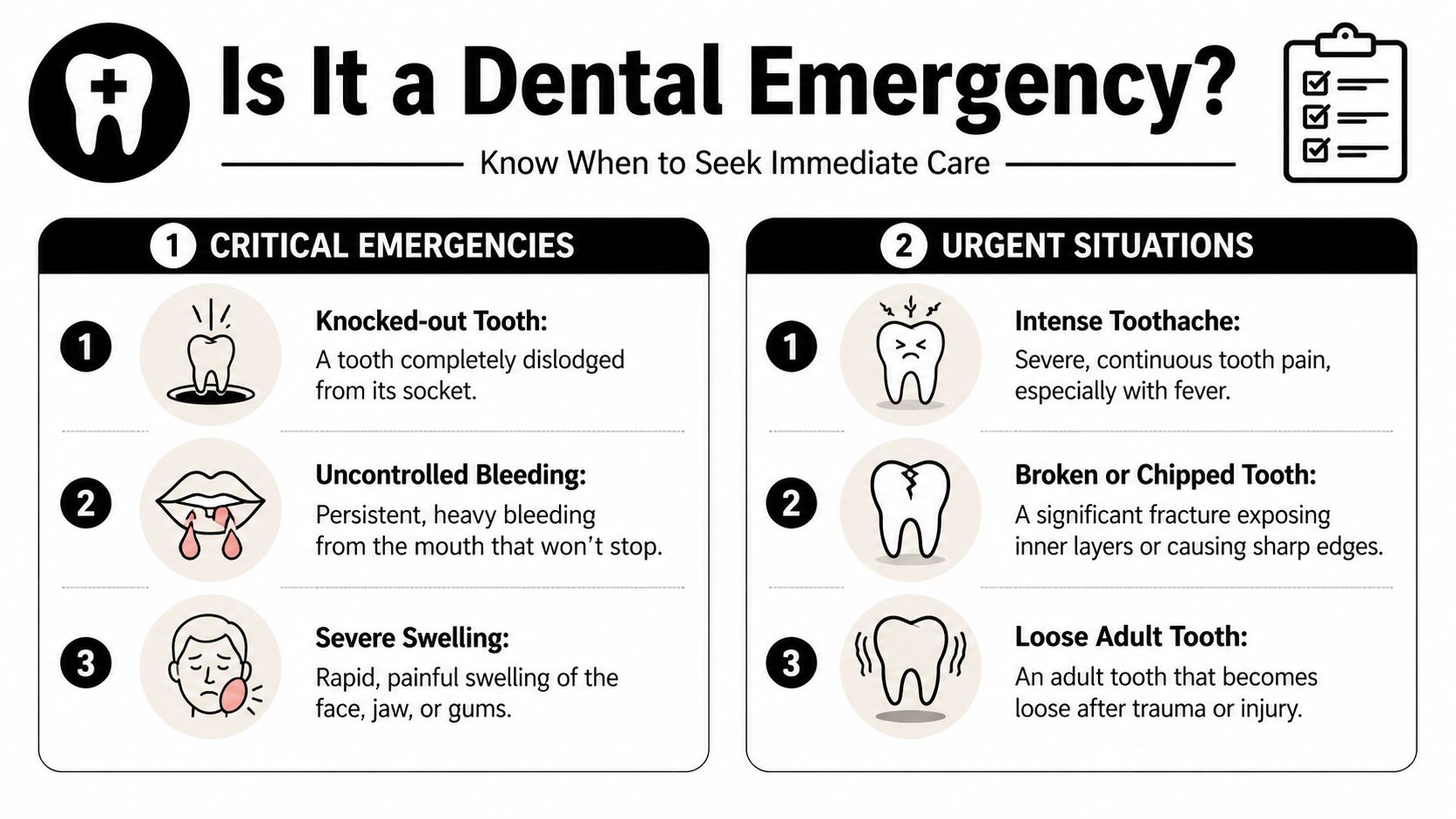
Problems that usually need urgent attention
These situations often justify an emergency dentist same day appointment:
- Severe tooth pain that doesn't let up, especially if it wakes you up or makes it hard to eat
- Facial or gum swelling, particularly when it seems to be spreading
- A knocked-out tooth or a tooth that has been displaced after trauma
- Uncontrolled bleeding from the mouth
- A broken tooth with sharp edges, exposed inner tooth structure, or significant pain
- A loose adult tooth after an injury
- Signs of infection, such as swelling, pressure, foul taste, or drainage
- A crown or filling loss when the exposed tooth is painful or vulnerable
Problems that fall into a gray area
Some symptoms confuse patients because they don't look dramatic, but they can still be urgent. Jaw pain is one of the biggest examples.
Many guides cover obvious emergencies like abscesses and fractured teeth, but they don't say much about TMJ flare-ups or migraine-linked jaw pain. A source discussing emergency dentistry notes that for patients with chronic TMJ disorder, a sudden severe flare can justify same-day evaluation because a bite analysis may help prevent escalation, as explained in this TMJ-related emergency overview.
That matters in real life. A patient may think, "It's just my jaw acting up," when the actual problem is acute muscle spasm, bite instability, clenching injury, or inflammation that needs prompt attention.
Sudden jaw pain that changes how you close, chew, or open your mouth shouldn't be brushed off just because no tooth is visibly broken.
When to call first and when to seek higher-level help
Call a dental office first for most toothaches, broken teeth, gum swelling, lost restorations, and TMJ pain. A dentist is equipped to evaluate the tooth, bite, soft tissue, and jaw in a way an urgent care clinic usually can't.
Seek emergency medical care immediately if you have trouble breathing, trouble swallowing, rapidly spreading swelling, or bleeding you can't control. Those symptoms move beyond routine dental urgency and need immediate medical attention.
A good rule for uncertain cases is simple. If you're debating it, call. Triage starts with a conversation, and that call can save time and protect the tooth.
How to Secure Your Emergency Dentist Same Day Appointment
When you're in pain, efficiency matters. The fastest way to get help is usually to call as soon as the office opens, or the moment the problem starts if the office has after-hours support. Don't wait to see whether the tooth "calms down" by the afternoon if swelling or sharp pain is already building.
Research on real-time scheduling found that 40% of dental appointments booked online are for the same day or the following day, which shows that urgent scheduling is a normal part of modern dental access, according to this online dental scheduling study.
What to say when you call
Your first few details help the front desk or clinical team decide how quickly you need to be seen. Be ready to explain:
What happened
Did a tooth break, did pain start suddenly, or did swelling appear overnight?Where it hurts
Front tooth, back tooth, upper jaw, lower jaw, one side of the face, or near the joint.What you're feeling
Throbbing, sharp pain, pressure, temperature sensitivity, swelling, bleeding, bad taste, or difficulty biting.Whether trauma was involved
Falls, sports injuries, chewing something hard, or clenching can change the urgency.What you've already tried
Ice, ibuprofen, rinsing, temporary dental material, or nothing yet.
What helps your appointment move faster
A few practical steps make same-day scheduling smoother:
- Keep your phone nearby so the office can call back quickly if a slot opens.
- Bring medications and insurance information if you have them.
- Save any broken tooth piece or crown and bring it with you.
- Use outside support if needed when phone coverage is important. For practices that need reliable front-desk response during busy periods, tools such as medical appointment scheduling services can help patients connect faster with a real scheduling workflow.
If you're more of a visual person, this short video gives a helpful overview of handling urgent dental issues before you're seen.
What doesn't work well
Waiting until pain becomes unbearable usually makes the day harder. So does understating your symptoms on the phone. If your face is swelling, say so. If you can't sleep from pain, say that too. Clear triage information helps the team prioritize true urgency.
At-Home Pain Management and Why to Avoid the ER
It is 10 p.m., your tooth is throbbing, and the side of your face feels hot and tight. In that moment, the goal is simple. Keep the problem calm, avoid making it worse, and get to a dentist as soon as possible.
Home care can reduce pain for a few hours. It does not fix the source of the problem. A cracked tooth, infected nerve, dislodged crown, or TMJ flare usually needs direct dental treatment if you want real relief.
Safe steps you can take right now
Use the least irritating, lowest-risk measures while you wait for your appointment:
- Hold a cold compress on the outside of the face for swelling or throbbing.
- Take an over-the-counter pain reliever as directed on the label if you normally can take it safely.
- Rinse gently with warm salt water if the gum feels irritated or food is trapped around the area.
- Apply steady gauze pressure if there is active bleeding in the mouth.
- Handle a knocked-out tooth by the crown only and keep it moist until you are seen.
- Stay on the other side when chewing and avoid hard, sticky, very hot, or very cold foods.
A few things cause problems fast. Do not put aspirin directly on the gum. Do not keep testing the tooth with your tongue or fingers. Do not place glue on a crown or broken tooth unless a dentist specifically told you what temporary material to use.
If anxiety is making the pain feel even worse, slow your breathing and focus on the next step only. Call. Get the appointment. Let the office know if fear of treatment is part of the emergency. In our Bellaire practice, that changes how we prepare the visit, especially for patients who may need sedation support or a gentler start.
Why the emergency room is often the wrong first stop
Hospital ERs are built for medical emergencies. They are the right choice for trouble breathing, heavy uncontrolled bleeding, serious facial injury, or swelling that is spreading and affecting your ability to swallow.
For toothaches, broken teeth, lost fillings, loose crowns, and many dental infections, the ER usually cannot provide the treatment that ends the pain. In many cases, the hospital can offer pain control, antibiotics when medically appropriate, or referral advice, but not a filling, root canal, crown repair, bite adjustment, or treatment for the actual tooth. That often means extra cost, extra waiting, and no real fix.
That is especially frustrating for patients in Houston, Bellaire, and West University who need to get back to work, school pickup, or get through the night. A same-day dental visit is usually the faster path to diagnosis and targeted treatment.
Dental office versus hospital ER
| Setting | Usually best for |
|---|---|
| Dental office | Tooth pain, broken teeth, lost fillings or crowns, abscess evaluation, TMJ flare-ups, bite problems |
| Hospital ER | Breathing difficulty, uncontrolled bleeding, serious facial trauma, severe spreading infection with medical risk |
Dental pain also has a strong anxiety component. Patients who already dislike dental treatment often wait too long, then head to the ER because it feels less intimidating. I understand that instinct. But if the source is dental, a dentist is the one who can diagnose it properly, use imaging if needed, and decide whether the fastest relief is a repair, drainage, bite adjustment, TMJ treatment, or sedation-supported care.
If you are stable and your symptoms point to a dental problem, call a dentist first. That usually gets you to the right treatment with fewer delays and a clearer plan.
What to Expect During Your Emergency Visit in Bellaire
Knowing what to expect from the appointment often brings comfort. Emergency dental visits are focused, practical, and built around one priority first: to get you comfortable enough to think clearly again.
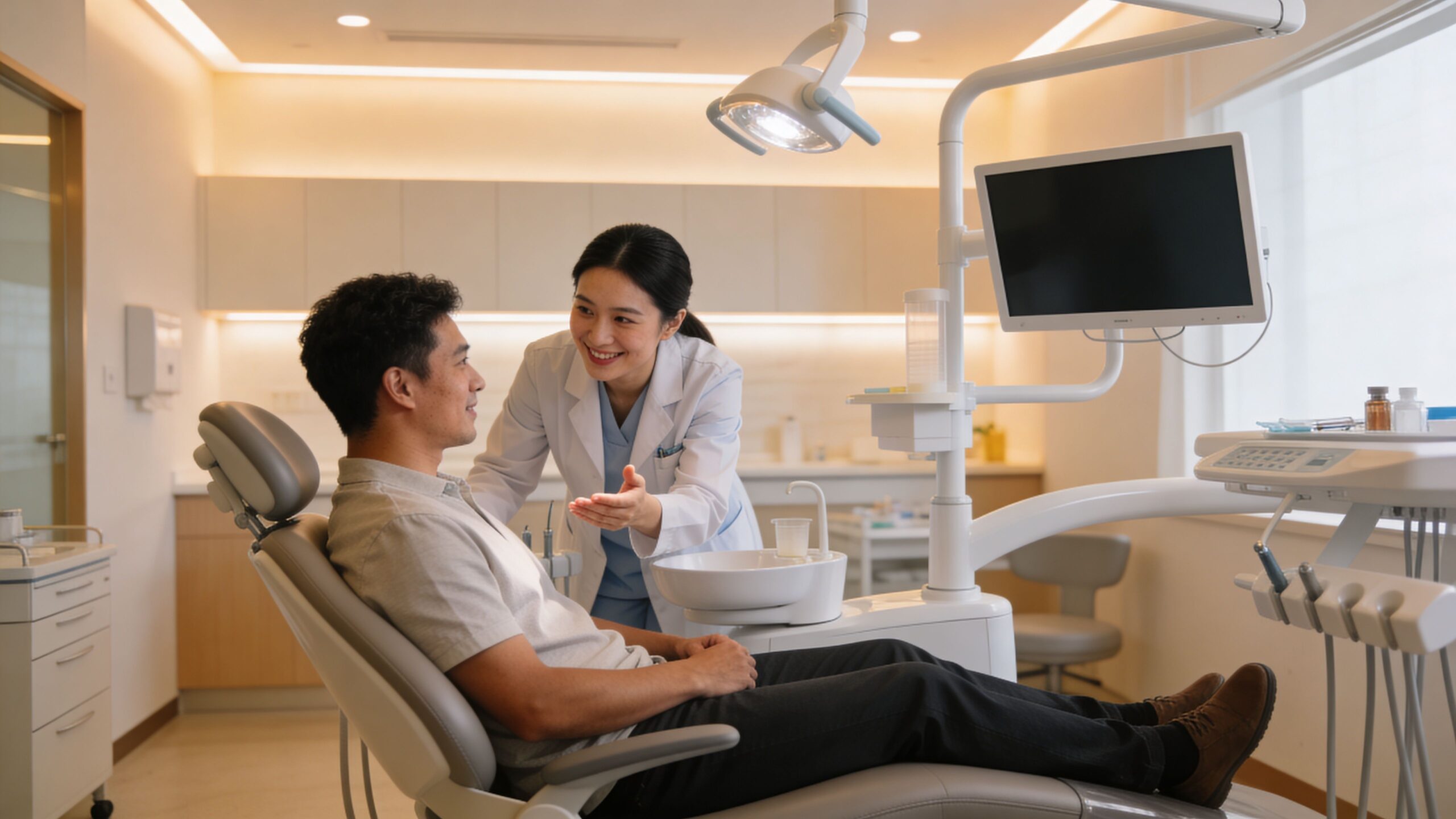
The first part of the visit
Expect a brief check-in and a rapid review of what's hurting, when it started, and whether swelling, trauma, or bite changes are involved. The appointment usually moves quickly into diagnosis because time matters when you're in pain.
During emergency dental visits, treatment acceptance reaches 93.3%, and the process typically includes rapid triage, digital imaging, and immediate stabilization, according to this same-day emergency treatment review. Patients tend to accept care at high rates in emergencies because prompt treatment makes sense when the problem is obvious and relief is the priority.
Why imaging and bite analysis matter
A painful tooth isn't always the tooth causing the problem. Referred pain, cracked cusps, sinus pressure, inflamed ligaments, and jaw imbalance can create overlapping symptoms. That's why digital x-rays and a focused exam matter so much.
In a Bellaire emergency visit, that may include:
- Digital x-rays to identify decay, infection, fracture, or bone changes
- A close visual exam with magnification and strong lighting
- Percussion and bite testing to narrow down the painful tooth or bite interference
- TMJ and muscle evaluation when symptoms point toward a jaw joint or clenching issue
The best emergency diagnosis is specific. "Your mouth hurts" isn't enough to guide treatment. The visit should identify what structure is injured or inflamed and why.
What treatment may happen the same day
Not every emergency ends with a final restoration. Many do include same-day relief measures such as smoothing a broken edge, placing a temporary restoration, adjusting a bite, draining an infection when appropriate, prescribing needed medication, or performing an extraction when that is clearly the best option.
If a tooth has been knocked out, speed is especially important. The same source notes that reimplantation has strong success when care happens quickly, particularly within the recommended time window after the injury.
For anxious patients, clear communication makes a major difference here. Knowing what will happen, what won't happen, and what can wait often lowers stress before treatment even begins.
Comfort First Sedation Options for Anxious Patients
Pain and anxiety often show up together. That's one reason some people delay calling, even when they know they need help. They aren't only worried about the tooth. They're worried about the sounds, the numbness, the feeling of losing control, or the fear of hearing bad news.
For emergency care, it has to be more than fast. It has to be comfortable enough for a distressed patient to follow through.
Why this matters more than most emergency guides admit
A notable gap in emergency dentistry content is the lack of guidance for fearful patients who may need sedation or extra comfort support during an urgent visit. Many pages talk about symptoms and scheduling but say little about what happens if a patient is panicked, embarrassed, or prone to dental anxiety, as discussed in this sedation-focused emergency dentistry perspective.
That gap matters for adults in Bellaire, West University, and Houston who have postponed care before. A patient with swelling and an abscess may still hesitate if they believe the visit will feel overwhelming.
What a comfort-focused emergency visit can include
Sedation dentistry isn't only for long cosmetic visits or complex procedures. It can also help in urgent care when anxiety is a real barrier to treatment.
A comfort-first approach may involve:
- A calm pre-visit conversation so you know what to expect before you arrive
- Extra time for numbing and explanation instead of rushing into treatment
- Sedation options when appropriate for patients with significant fear, gagging, or treatment-related panic
- A phased plan that focuses first on pain relief, then on complete restorative care later
Patients who want to understand that part of care in more detail can review sedation dentistry safety information.
For many anxious patients, the biggest relief is hearing this: you don't have to "tough it out." A same-day emergency visit can be structured around both the dental problem and the emotional reality of the moment.
Navigating Insurance and Costs for Your Urgent Care
Cost worries can make people hesitate even when they know they shouldn't. That's common. Dental emergencies are stressful enough without trying to guess what an exam, x-rays, treatment, or a tooth extraction might involve financially.
The best approach is direct communication early. Ask what the emergency exam includes, whether imaging is likely needed, and what the immediate treatment options may be. In many offices, the team can explain benefits, collect insurance information, and help you understand the likely first-step costs before treatment begins.
Questions worth asking when you schedule
These questions are practical and easy to answer:
- Do you accept my insurance plan?
- What is included in the emergency visit?
- Will digital x-rays be taken if needed?
- If I need a tooth extraction or temporary restoration, how is that priced?
- Are payment options available if treatment starts today?
Patients looking for a dentist near me, tooth extraction, or urgent restorative dentistry in Bellaire often feel less overwhelmed once the financial process is broken into steps. Emergency care usually starts with diagnosis and stabilization. More complete treatment, such as crowns, implants, cosmetic work, or long-term TMJ therapy, can often be planned more deliberately afterward.
Why price clarity helps people get treated sooner
When patients know what's happening financially, they make decisions faster and with less fear. That's especially important in emergencies, because delay tends to make treatment more complex, not simpler.
If you'd like a better sense of how dental visit fees are commonly explained, this page on dentist appointment price information is a useful starting point.
Don't let uncertainty keep you in pain. If you need an emergency dentist same day appointment in Bellaire, Houston, or West University, call as early as possible, describe your symptoms clearly, and ask for immediate guidance.
If you're in pain and need prompt, compassionate dental care, contact Charles E. Boren. Same-day emergency appointments are designed to help you get answers quickly, relieve discomfort, and move forward with a clear treatment plan.