
If you're searching for dentist appointment price in Bellaire, TX, you're probably trying to answer a simple question that doesn't always feel simple at all. How much is this going to cost, and am I going to be surprised once I get to the office?
That worry is common. Many people put off booking a visit not because they don't care about their teeth, but because they don't want to walk into an unclear financial situation.
A better dental experience starts with clear expectations. Patients in Bellaire, West University, and nearby Houston neighborhoods deserve to understand what affects cost, what common services usually range from, and how to weigh price against quality, comfort, and long-term results.
- Understanding Your Dentist Appointment Price in Bellaire TX
- A Breakdown of Common Dental Service Prices
- What Factors Influence Your Final Dental Bill
- Using Insurance and Financing to Manage Dental Costs
- Smart Ways to Save on Your Dental Care
- What to Expect at Your Appointment with Dr. Boren
- FAQ About Dental Appointment Prices
Understanding Your Dentist Appointment Price in Bellaire TX
A new patient often starts in the same place. They have a tooth that's been sensitive for a few weeks, or they're overdue for a cleaning, or they want to improve their smile and finally look into veneers or teeth whitening. Before they call, they search for one thing first: dentist appointment price.
That search usually isn't just about numbers. It's about uncertainty.

Patients generally don't want the cheapest dentistry. They want care that feels fair, explained, and worth it. They want to know why one office charges more than another. They want to know whether a higher fee means better materials, more experience, more precise diagnosis, or just a different location.
Why price feels confusing
Dental fees can vary because visits aren't all the same. One patient may need a routine exam and digital X-rays. Another may need a tooth extraction, emergency dentist care, a crown, or a consultation for cosmetic dentistry or dental implants near me.
Even a "simple appointment" can involve different parts, such as:
- Evaluation: Examining teeth, gums, bite, and any pain concerns.
- Imaging: Dental X-rays or digital images when needed.
- Preventive care: Cleaning and screening for early problems.
- Planning: Discussing treatment options, timing, and payment choices.
A clear treatment plan should answer two questions before care begins. What needs to be done, and what will it likely cost?
Why local context matters in Bellaire
Bellaire patients aren't just comparing prices. They're comparing value. In a community where people often look for a cosmetic dentist near me, emergency dentist services, restorative dentistry, or sleep-related oral appliance care, the right office should explain fees in plain language and connect those fees to the quality of care being provided.
That's especially important when you're choosing between quick, basic care and more detailed, technology-driven care designed for precision and comfort. If you've been delaying an exam, looking for a dentist in Bellaire, TX, or trying to budget for treatment, understanding the reason behind the fee helps you make a confident decision instead of a rushed one.
A Breakdown of Common Dental Service Prices
When patients ask about dental costs, they're usually asking for a starting point. That's reasonable. Even though every mouth is different, national and Texas pricing benchmarks can help you understand what common services often cost without insurance.
In 2025, routine dental exams including cleaning and X-rays averaged $203 nationally, with a range of $50 to $350 across states. In Texas, the average was $227. More complex procedures had broader ranges, including fillings at $100 to $400, crowns at $800 to $1,800, and dental implants at $1,500 to $4,000, based on 2025 dental cost benchmarks.
Typical starting ranges
The table below gives a practical reference point for patients in Bellaire who want a general sense of what common care may cost without insurance.
| Typical Dental Service Price Ranges in Bellaire (Without Insurance) | |
|---|---|
| Dental Service | Typical Price Range |
| Routine exam, cleaning, and X-rays | $50 to $350 |
| Texas average for routine exam, cleaning, and X-rays | $227 |
| Fillings | $100 to $400 |
| Crowns | $800 to $1,800 |
| Dental implants | $1,500 to $4,000 |
These figures are useful for planning, but they aren't a personalized quote. A routine visit may stay close to the exam benchmark, while restorative or cosmetic care depends on the condition of the tooth, the material selected, and whether additional diagnostics are needed.
How to read price ranges without getting overwhelmed
A range doesn't mean the office is being vague. It usually means the final cost depends on what the dentist finds during the exam.
For example:
- A filling can vary based on the size and location of the cavity.
- A crown may depend on material choice and how much tooth structure needs support.
- A dental implant often involves multiple clinical steps, not just one appointment.
- A cosmetic visit may begin with a consultation, photos, digital imaging, or discussion of goals before a final treatment plan is created.
Patients looking for details on common procedure fees can review this overview of dental procedure cost before scheduling.
Practical rule: Use online price ranges as a budgeting tool, not as a final diagnosis. Your actual fee depends on your oral health, your goals, and the treatment approach chosen for you.
Services that often need a custom quote
Some treatments don't fit neatly into a simple fee list. That's especially true for:
- Cosmetic dentistry near me searches: Veneers, whitening, and smile design depend on how many teeth are being treated and what result you want.
- TMJ and bite-related care: Evaluation may include bite analysis and appliance planning.
- Sleep apnea oral appliances: These are customized and often coordinated around medical and dental findings.
- Emergency dentist visits: The cost depends on whether the problem needs an exam only, imaging, temporary relief, or immediate treatment such as a tooth extraction.
If you've ever felt frustrated by broad online estimates, you're not alone. The useful question isn't just "What's the price?" It's "What does this appointment include, and why?"
What Factors Influence Your Final Dental Bill
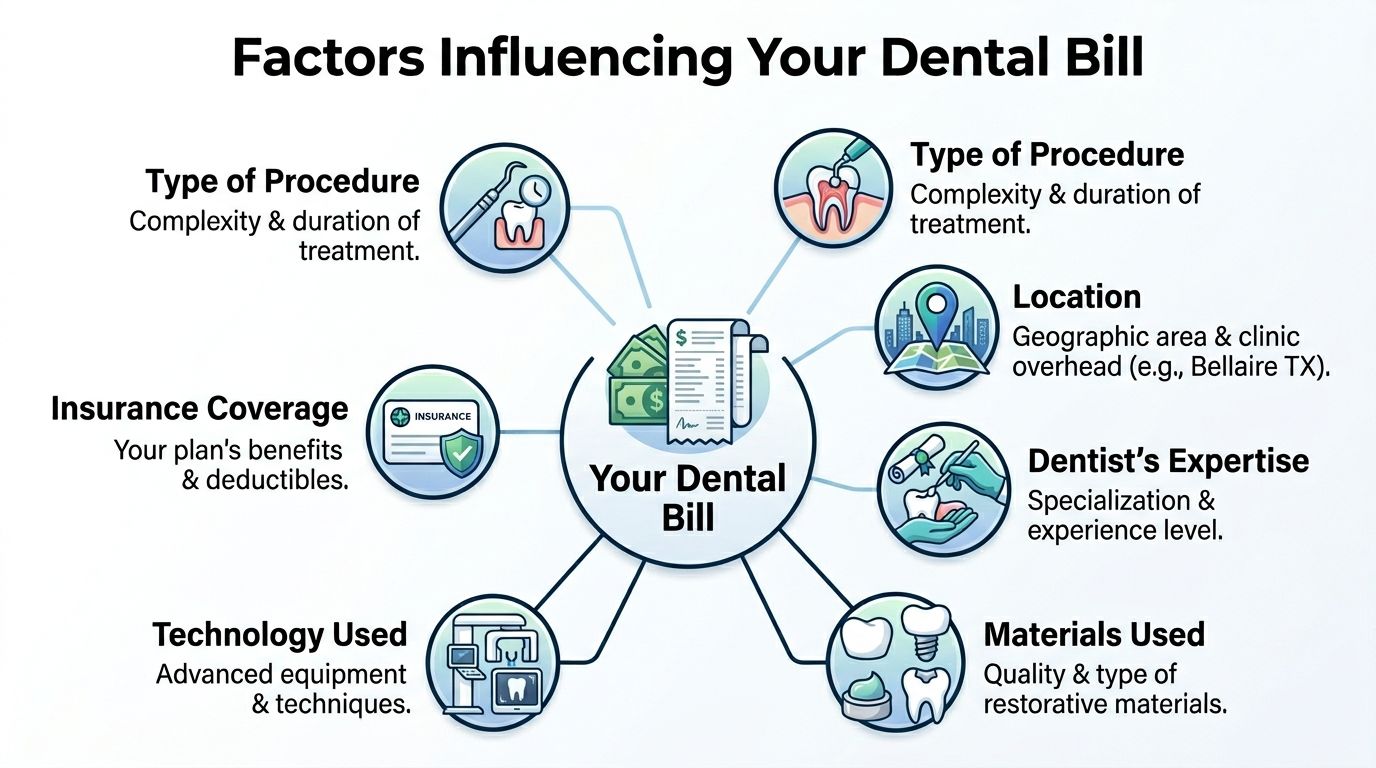
Two patients can come in for what sounds like the same problem and leave with different estimates. That doesn't automatically mean one office is overpriced. It usually means the bill reflects several real factors behind the care.
Location affects pricing
Where a practice operates matters. Guardian Life's overview of geographic dental pricing notes that suburban and rural practices often charge 10% to 20% less than urban counterparts.
That helps explain why a dentist in Bellaire, TX may price services differently than an office in a lower-overhead market. It doesn't automatically mean better or worse care. It means local costs, staffing, equipment, and facility expenses shape fees.
The procedure itself matters
A preventive cleaning and exam is different from a cracked tooth evaluation. A whitening consultation is different from planning crowns or dental implants. A tooth extraction may be straightforward in one case and more involved in another.
The final bill often reflects:
- Complexity: How difficult the problem is to diagnose and treat.
- Time: How long the appointment takes.
- Customization: Whether a restoration or appliance must be made specifically for you.
- Follow-up needs: Whether more than one visit is required.
Technology changes both the experience and the cost
Modern dentistry uses tools that can improve precision, comfort, and communication. Digital imaging, fiber optics, magnification, and minimally invasive techniques can help the dentist see more clearly and plan treatment more carefully.
That technology isn't free to maintain, but it can add value for patients who want a more thorough diagnosis and a more predictable result.
For example, advanced imaging can help a patient understand why a crown is recommended instead of a filling. Better visualization often means fewer surprises and clearer decision-making.
Expertise and materials matter too
There is also a difference between paying for a procedure and paying for judgment. Experience affects how a dentist diagnoses, how conservatively they treat, and how well they match the treatment to the patient's long-term goals.
Materials matter in the same way. A restoration isn't just a fee on paper. It's something that has to function, look natural, and fit properly in your mouth.
If two treatment plans have different prices, ask what's included in each one. The lower fee may leave out imaging, higher-grade materials, comfort options, or the detail needed for a more durable result.
Patients looking for a cosmetic dentist near me or considering restorative dentistry in Bellaire often benefit from asking these questions:
- What technology is being used to diagnose the issue?
- What material is being placed in my mouth?
- How long is the appointment, and what is included?
- Is this the most conservative option that still solves the problem?
Those questions turn pricing into something much easier to understand. You're not just paying for a chair time slot. You're paying for diagnosis, planning, materials, skill, and the quality of the experience.
Using Insurance and Financing to Manage Dental Costs
Once you understand the fee, the next question is usually how to fit it into your budget. Insurance and financing can help, but many patients have never had anyone explain them clearly.
How dental insurance usually works
Most dental insurance plans share costs between you and the office. The exact details depend on your plan, but the common moving parts are familiar:
- Deductible: What you may need to pay before certain benefits begin.
- Co-pay or patient share: The portion you pay yourself.
- Annual maximum: A limit on what the plan may contribute during the year.
- Network status: Whether the office is in-network or out-of-network with your plan.
An in-network office agrees to the insurer's contracted fees. An out-of-network office may still help you use benefits, but your share can differ depending on the plan.
If you're comparing coverage before booking, it can help to review a current list of top dental insurance companies so you can better understand the types of plans available and the questions to ask your carrier.
Why offices discuss payment options early
Payment conversations aren't just administrative. They help patients move forward with care instead of delaying treatment because the numbers feel unclear.
Dental practice overhead averages 60% to 65% of total collections, which is one reason offices use efficient insurance coordination and patient financing systems to stay sustainable while continuing to invest in staff, technology, and patient care, according to this summary of average dental office overhead.
That matters to patients because a well-run office can often explain benefits more clearly, submit claims more efficiently, and offer structured payment options when treatment isn't fully covered.
Questions worth asking before treatment
If you're planning a visit for cleaning and exams, cosmetic dentistry, restorative dentistry, or an emergency dentist appointment, ask these questions up front:
- What is my estimated out-of-pocket amount?
- Will you file insurance claims for me?
- Do you offer third-party financing for larger treatment plans?
- Can treatment be phased over time if needed?
A good financial conversation should leave you feeling informed, not pressured. When the team explains your benefits, timelines, and payment choices in plain language, it's easier to focus on getting the care you need.
Smart Ways to Save on Your Dental Care
The most effective way to lower long-term dental costs usually isn't hunting for the lowest fee. It's avoiding bigger problems while they're still small.

Preventive care protects your budget
Many people delay checkups because they want to avoid spending money right now. The problem is that postponing a modest visit can lead to a much larger bill later.
Guardian Life's cost comparison for untreated dental problems shows why. Preventive care may cost $100 to $300, while a neglected cavity can turn into a root canal averaging $1,165 plus a crown averaging $1,399, for a total of more than $2,500.
That isn't just a clinical issue. It's a budgeting issue.
Small problems are usually less expensive to treat, less stressful to fix, and less likely to interrupt your work or family schedule.
Better savings habits for patients in Bellaire
If you're trying to keep dental spending manageable, focus on habits that reduce the chance of bigger treatment:
- Keep routine visits on schedule: Regular cleaning and exams help catch issues before they become painful or complex.
- Ask for a written treatment estimate: Seeing the plan in advance makes it easier to prioritize care.
- Don't ignore small symptoms: A minor sensitivity or chipped tooth can become more involved if you wait.
- Use your benefits before they expire: If you have dental insurance, timing matters.
Patients who want clearer budgeting can also ask whether the office offers transparent pricing or phased treatment planning. Charles E. Boren provides personalized care that may include digital imaging, cosmetic dentistry, TMJ therapy, sleep-related oral appliances, and sedation options when appropriate, which can help patients understand both the problem and the treatment path before moving forward.
A short explanation of prevention can make the point even clearer:
Saving money doesn't always mean choosing the lowest quote
A low upfront price can be appealing, especially if you're searching for dentist near me during a busy week. But lower-cost treatment isn't always lower-cost in the long run if it skips careful diagnosis, uses lower-grade materials, or doesn't address the underlying issue.
For families and adults in Bellaire, West University, and Houston, the smartest savings strategy is usually simple. Stay consistent with preventive care, act early when something feels off, and choose treatment based on long-term value rather than the shortest quote.
What to Expect at Your Appointment with Dr. Boren
A first visit feels easier when you know how it usually unfolds. For many new patients, the biggest relief comes from realizing the appointment isn't rushed and the conversation isn't one-sided.
Your visit starts with listening
When you arrive, the first goal is understanding why you're there. Some patients want a routine cleaning and exams visit. Others come in because of jaw pain, headaches, snoring, a damaged tooth, or an interest in cosmetic dentistry.
That first conversation matters because your goals shape the exam. If you've been searching for a dentist in Bellaire, TX, emergency dentist care, tooth extraction help, or a cosmetic dentist near me, the office should understand both the symptom and the reason it's bothering you.
Diagnostics that help you see what the dentist sees
A thorough visit often includes digital X-ray imaging and a close visual evaluation. Tools such as magnification and modern imaging can reveal details that are easy to miss with a quick glance alone.
Practices that use advanced technology and patient engagement tools see 15% to 20% increases in case acceptance, and the reason is practical. When patients can clearly see their oral health and understand their options, they usually feel more confident in their decisions, according to Dentrix data on patient engagement and profitability insights.
If you'd like to understand the types of tools used in modern care, this page on dental technology advancements offers a helpful overview.
Seeing the image of a cracked filling or worn bite surface often changes the conversation. Patients don't feel sold to. They feel informed.
A treatment plan built around your priorities
After the exam, the discussion turns practical. What needs attention now. What can wait. Which options are preventive, restorative, cosmetic, or urgent.
That planning may involve:
- Routine care: Cleanings, exams, and monitoring.
- Restorative dentistry: Fillings, crowns, or treatment for damaged teeth.
- Cosmetic services: Whitening, veneers, or smile improvements.
- Specialized care: TMJ support, sleep apnea oral appliances, or comfort options such as sedation when appropriate.
For anxious patients, this part of the visit can be especially important. A calm explanation, clear images, and a written estimate can make the whole process feel much more manageable.
The goal is confidence, not confusion
A good appointment doesn't leave you guessing what happened or what comes next. You should leave knowing the condition of your mouth, what options exist, and what the next step would be if you choose to move forward.
For patients near Bellaire, West University, and Houston, that kind of clarity often matters as much as the treatment itself.
FAQ About Dental Appointment Prices
How much is a first dental visit usually?
It depends on what the visit includes. A routine exam, cleaning, and X-rays may fall near the Texas benchmark discussed earlier, but a first visit can cost more if you need additional imaging, emergency evaluation, or treatment planning for restorative or cosmetic concerns.
Are treatment estimates exact?
They're usually best understood as careful estimates based on the exam findings at that time. If the dentist discovers something additional during treatment, the office should explain the change before moving forward whenever possible.
Is preventive care really the cheaper option?
In most cases, yes. Preventive visits are often far less expensive than waiting until a tooth needs more advanced treatment. That's why regular cleanings and exams are one of the most practical ways to protect both oral health and your budget.
Can I use insurance for all dental services?
Not always. Many plans help with preventive and basic restorative care, but coverage for cosmetic procedures, certain appliances, or upgraded materials may be limited. The best approach is to ask for a benefit review before treatment begins.
What if I don't have insurance?
You can still get dental care. Many patients pay directly, use financing, or phase treatment over time based on priority. If you're worried about cost, say so early. The financial discussion is part of planning, not something you should have to figure out alone.
Why might one Bellaire dentist charge more than another?
Fees often reflect location, materials, technology, and the dentist's training and experience. A higher quote isn't automatically better, but it should come with a clear explanation of what's included and why that approach was recommended.
If you're looking for a clear, honest conversation about your dental needs and your dentist appointment price, contact Charles E. Boren. Whether you need cleaning and exams, cosmetic dentistry, restorative care, help with jaw pain, or an emergency dental visit, the next step is scheduling a consultation and getting answers specific to you.