
Why Does Your Jaw Click or Pop? What Bellaire Patients Should Know About TMJ Symptoms
If your jaw makes a clicking or popping sound when you chew, yawn, or open wide, you’re not imagining it — and you’re not alone. A lot of patients in Bellaire and the surrounding areas of West University Place and Meyerland mention this to us almost as an afterthought, the way you might mention a squeaky door hinge. But that sound is your jaw joint sending a message. It doesn’t always mean something serious is wrong, but it does mean something is worth paying attention to.
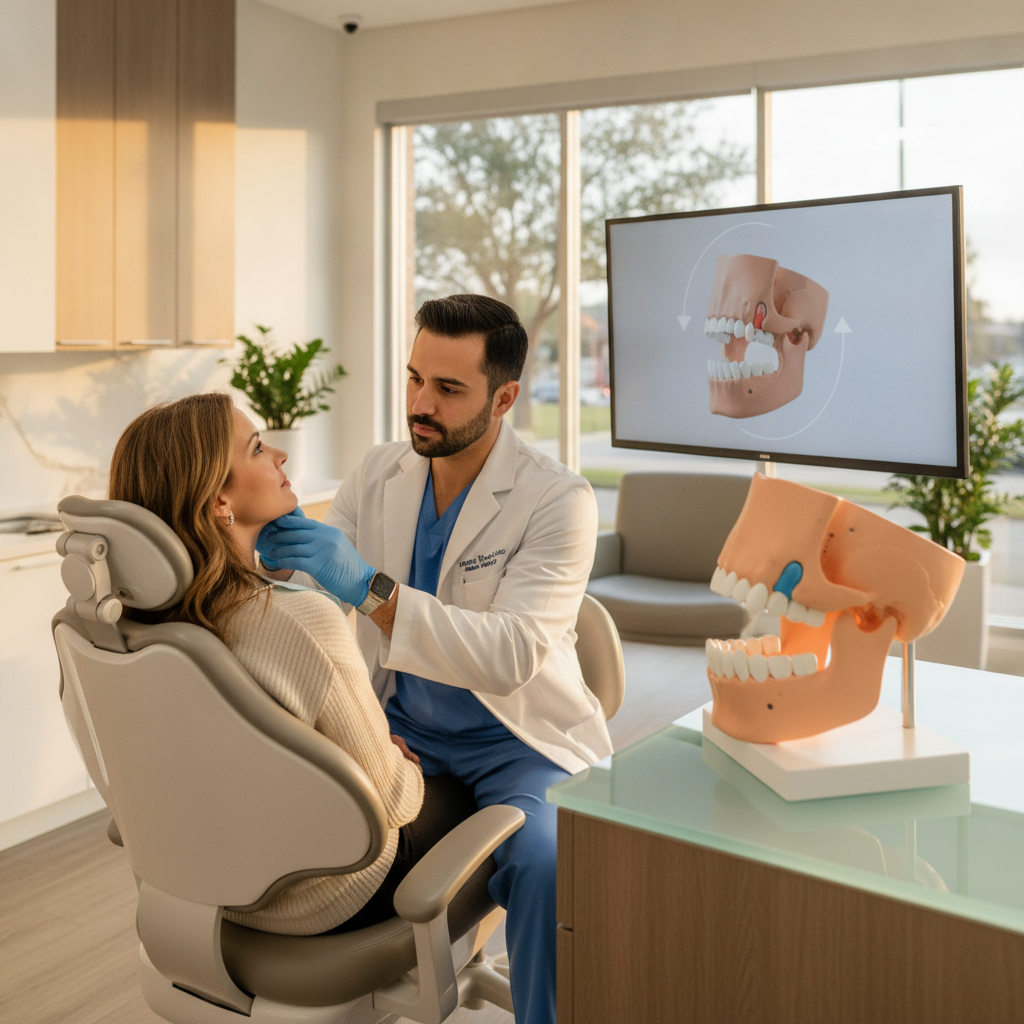
The joint responsible for all of this is called the temporomandibular joint — the TMJ — and it connects your lower jaw to the base of your skull, just in front of each ear. It’s one of the most complex joints in your body because it moves in multiple directions at once. When it’s working well, you never notice it. When it’s not, it can affect everything from how you eat to how you sleep to whether you wake up with a headache.
- What's Actually Causing That Click or Pop?
- When Is a Clicking Jaw Actually a Problem?
- The TMJ-Headache Connection Most People Miss
- What TMJ Treatment Actually Looks Like in a Dental Office
- What to Expect at a TMJ Evaluation in Bellaire
- Frequently Asked Questions About Jaw Clicking and TMJ in Bellaire
- Ready to Stop Guessing What's Causing Your Jaw Pain?
What’s Actually Causing That Click or Pop?
The most common reason a jaw clicks is that the small disc of cartilage inside the joint has shifted slightly out of its normal position. When you open your mouth, the disc snaps back into place — and that’s the sound you hear. In many cases, it’s painless and doesn’t get worse. In others, it’s the first sign that the joint is under ongoing stress.
A few things that commonly contribute to TMJ problems include:
- Teeth grinding or clenching (bruxism) — Often happens at night without you realizing it. The repeated pressure overloads the joint and surrounding muscles.
- Bite misalignment — When your upper and lower teeth don’t meet evenly, your jaw compensates. Over time, that compensation creates strain.
- Stress — Stress causes many people to clench their jaw without thinking about it, especially during long workdays or while sitting in traffic on the Southwest Freeway.
- Injury — A blow to the jaw or chin, even a minor one from years ago, can shift the joint.
- Arthritis — Less common, but the TMJ can develop arthritic changes just like other joints.
None of these causes are things you can diagnose on your own, which is exactly why a professional evaluation matters. At our Bellaire practice, we take the time to look at the whole picture — your bite, your jaw movement, your symptoms — before drawing any conclusions.
When Is a Clicking Jaw Actually a Problem?
Not every jaw click needs treatment. Some people have minor disc displacement that never causes pain and never gets worse. But there are clear warning signs that what you’re experiencing has moved beyond something you can just live with:
- Pain or tenderness around your jaw, ear, or temple
- Headaches — especially in the morning or after meals
- Soreness in your neck or shoulders that seems unrelated to posture or exercise
- Difficulty opening your mouth all the way, or a feeling that your jaw “locks”
- The click getting louder, more frequent, or more painful over time
- A change in how your bite feels — teeth that used to fit together now feel slightly off
If any of these sound familiar, it’s worth having a conversation with a dentist who understands how the jaw, bite, and muscles all work together. Dr. Boren’s practice offers a range of services that address the root causes of TMJ discomfort, not just the symptoms.
The TMJ-Headache Connection Most People Miss
This is where a lot of patients in Houston and Southside Place are surprised. They’ve been managing recurring headaches for months — sometimes years — without ever connecting them to their jaw. They’ve tried over-the-counter pain relievers, adjusted their sleep position, and blamed their desk setup. And their headaches keep coming back.
The muscles that control your jaw run across your temples, along the sides of your head, and down into your neck. When those muscles are chronically tight — from clenching, grinding, or a bite that forces your jaw into an uncomfortable position — they can trigger tension headaches that feel indistinguishable from stress headaches or even migraines.
This is a gap that many dental practices simply don’t address. They treat teeth. They clean and fill and crown. But they don’t always ask whether that headache you mentioned has anything to do with how your jaw is functioning. At this practice, we do ask. It’s part of how we look at the whole patient, not just the individual tooth.
What TMJ Treatment Actually Looks Like in a Dental Office
If you come in with jaw pain, clicking, or headaches that may be connected to your bite, the first thing we do is listen. You’ll describe what you’re experiencing, when it started, and what makes it better or worse. From there, we’ll evaluate your bite, the movement of your jaw, and any signs of wear on your teeth that might point to grinding.
Treatment depends on what we find, but for many patients, the most effective and least invasive option is a custom oral appliance — sometimes called a night guard or occlusal splint. It’s a small, comfortable device worn over your teeth, usually at night, that prevents clenching, repositions the jaw slightly, and takes pressure off the joint. Patients are often surprised by how much of a difference something this simple makes.
For patients whose bite misalignment is more significant, other options — including bite adjustment, restorative work like crowns, or orthodontic treatment — may be part of a longer-term plan. We don’t rush to the most complex solution. We start with what’s least invasive and work from there.
What to Expect at a TMJ Evaluation in Bellaire
Coming in for a TMJ evaluation isn’t scary, and it doesn’t automatically mean you’re committing to a complicated or expensive treatment plan. It means we’re going to take a thorough look at what’s happening and talk through your options honestly.
Here’s roughly what to expect:
- A detailed conversation about your symptoms and how long they’ve been present
- An examination of your jaw movement, bite, and the muscles around your face and neck
- X-rays if needed to check the joint itself and the surrounding bone structure
- A clear explanation of what we find — in plain language, not dental jargon
- A discussion of your options, with no pressure to decide anything on the spot
If you’re someone who feels anxious about dental visits in general, that’s something we take seriously too. This office has been in Bellaire for decades, and a big part of what’s kept patients here that long is knowing they’ll be heard and treated like a person, not a problem to be solved.
Frequently Asked Questions About Jaw Clicking and TMJ in Bellaire
Is a clicking jaw always a sign of TMJ disorder?
Not necessarily. Some jaw clicking is harmless and doesn’t progress. But if the click is accompanied by pain, stiffness, headaches, or a change in how your bite feels, it’s worth having it evaluated by a dentist who understands the TMJ.
Can TMJ problems go away on their own?
Sometimes mild cases improve with rest, stress reduction, and avoiding hard or chewy foods. But if symptoms have been present for more than a few weeks or are getting worse, waiting usually just allows the problem to compound. Early treatment is almost always easier than late treatment.
Do I need to see a specialist, or can my regular dentist treat TMJ?
Many general dentists — including those with experience in bite analysis and oral appliance therapy — are well-equipped to diagnose and treat most TMJ cases. Referral to an oral surgeon or specialist is occasionally needed for severe joint damage, but the majority of patients can be treated in a general practice setting.
Will my insurance cover TMJ treatment?
It depends on your plan and what’s causing the problem. Some TMJ treatments are covered under dental insurance; others may fall under medical insurance. We recommend calling your insurance provider before your visit and asking specifically about TMJ evaluation and appliance coverage. Our team can also help you understand what to expect.
How is TMJ different from just having a sore jaw?
A sore jaw after eating something tough is pretty common and usually short-lived. TMJ disorder is a persistent problem involving the joint, the disc inside it, and the surrounding muscles — often with symptoms that show up in unexpected places, like your temples, ears, or neck. The pattern and duration of your symptoms are usually what tell us whether this is something that warrants attention.
Ready to Stop Guessing What’s Causing Your Jaw Pain?
If you’ve been putting up with a clicking jaw, morning headaches, or facial discomfort — and you’re not sure where to turn — we’d genuinely love to help you figure out what’s going on. Dr. Boren has been treating patients in Bellaire, West University Place, Meyerland, and across the Houston area for many years. Our approach is thorough, unhurried, and focused entirely on what’s right for you.
Reach out to schedule a consultation and let’s start with a real conversation. No pressure, no guesswork — just straightforward answers and a clear path forward.