

You go to bed at a reasonable time. You wake up after what should have been a full night of sleep. By midmorning, you're already thinking about coffee, and by afternoon you're asking the same question many people in Bellaire ask to themselves: why am i always tired even after sleeping?
That frustration is real. It also isn't always about needing more time in bed. About 1 in 3 adults in the U.S. do not get the recommended 7 to 9 hours of sleep regularly, according to GoodRx’s review of sleep and daytime fatigue. But even when the clock says you got enough hours, poor-quality sleep can still leave you feeling drained.
As a dentist serving Bellaire, West University, and Houston, I talk with patients who come in for jaw pain, headaches, worn teeth, or grinding and don't realize those problems may connect to their sleep. Sometimes the mouth, jaw, and airway tell us why the body never feels restored. That’s why a search for a dentist near me can turn into something more important than a routine cleaning. It can be the first step toward understanding why you feel exhausted all the time.
- Your Local Bellaire Dentist on Waking Up Exhausted
- Common Reasons You Feel Tired After a Full Night's Sleep
- The Hidden Dental Connection to Your Fatigue
- How Dental Sleep Medicine Provides Lasting Relief
- Your First Step to Better Sleep and More Energy in Bellaire
- Schedule Your Consultation with a Trusted Bellaire Dentist
Your Local Bellaire Dentist on Waking Up Exhausted
Many people describe the same pattern. They sleep what seems like enough. They don’t stay up all night. They aren’t pulling all-nighters. Yet they still wake up feeling like their battery never charged.
That can be confusing, because most of us were taught to think about sleep only in terms of hours. Sleep doesn't work like parking a car in the garage. It works more like charging a phone with a damaged cable. The phone may stay plugged in all night, but if the connection keeps breaking, the battery is never completely full by morning.
When enough sleep still doesn't feel like enough
A lot of readers who look for a dentist in Bellaire, TX are really looking for answers, not just dental care. They may be dealing with:
- Morning headaches that make it hard to start the day
- Jaw soreness that feels like clenching happened overnight
- Foggy thinking at work or while driving
- Irritability and low energy even after a full night in bed
Those symptoms don't always begin in the bedroom alone. Sometimes they begin with the airway. Sometimes they begin with the bite and jaw muscles. Sometimes they begin with both.
Practical rule: If you routinely sleep a full night and still wake up exhausted, don't assume it's normal or something you just have to push through.
Why a dentist may be part of the answer
People usually think of dental visits in terms of fillings, cleanings and exams, dental x-rays, cosmetic dentistry, or restorative dentistry. Those services matter. But your dentist also sees the structures that affect breathing, clenching, grinding, and jaw strain.
In a Bellaire practice like ours, that means looking beyond the teeth alone. It means asking whether your fatigue might connect to sleep-disordered breathing, nighttime grinding, or muscle tension that disrupts restful sleep. For some patients, the path to more energy begins in a dental chair, not because dentistry replaces medical care, but because it can uncover problems that are easy to miss.
Common Reasons You Feel Tired After a Full Night's Sleep
Feeling worn out after sleep can come from several different directions. Some are simple. Some are more layered. The key is not guessing too quickly.
Quick Guide to Potential Fatigue Causes
| Potential Cause | Key Symptoms | What to Check First |
|---|---|---|
| Poor sleep habits | Irregular sleep schedule, late-night screen use, restless sleep | Look at your bedtime routine and consistency |
| Stress and mental overload | Racing thoughts, light sleep, waking tense | Notice whether your mind stays “on” at night |
| Medication side effects | Grogginess, slower mornings, daytime sleepiness | Review timing and side effects with your physician |
| Low-quality sleep environment | Too much light, noise, heat, or an uncomfortable mattress | Adjust your bedroom setup and sleep environment |
| Low movement during the day | Sluggishness, stiffness, poor sleep drive at night | Consider whether your day is mostly sedentary |
| Mood-related concerns | Low motivation, poor focus, restless nights | Talk with a medical professional if symptoms linger |
| Underlying medical issues | Ongoing fatigue despite habit changes | Ask your physician whether further evaluation is needed |
| Sleep-disordered breathing or jaw-related sleep disruption | Snoring, headaches, dry mouth, jaw pain, unrestful sleep | Consider evaluation from a sleep professional and dentist |
Start with the obvious, but don't stop there
Sleep quality is more than total hours. If you fall asleep with the television on, scroll your phone until your eyes close, or keep an unpredictable bedtime, your body may spend less time in the deeper stages of sleep that help you feel restored. A simple change in routine can matter.
Your bedroom setup can also work for you or against you. Temperature, noise, bedding, and mattress comfort all shape how restful sleep feels. If you want practical ways to improve that side of sleep, Giorgi Bros.' expert bedroom tips offer useful ideas for making your sleep environment more supportive.
Some causes sit outside the bedroom
Stress doesn't always keep people awake in an obvious way. Sometimes it lets them fall asleep, then pulls them into lighter, more fragile sleep. They wake up tired, tense, and already behind.
Other times, fatigue has a medical explanation that needs attention from a physician. Medication timing, mood changes, and general health issues can all play a role. If you’ve already tightened up your routine and still feel unwell, it makes sense to broaden the conversation.
The most common mistake I see is assuming fatigue has one cause. Often, several small problems stack together and make mornings feel much harder than they should.
Why many people overlook the dental piece
People often separate “sleep problems” from “dental problems.” In real life, the line isn't always that clean. The mouth, jaw, and airway are physically connected, so strain in one area can disturb sleep in another.
That’s especially important if your tiredness comes with clenching, headaches, facial soreness, snoring, or dry mouth. At that point, it’s worth considering whether the problem isn't just sleep duration. It may be disrupted sleep.
The Hidden Dental Connection to Your Fatigue
Some of the most overlooked causes of morning exhaustion show up in the same place your dentist examines every day. Two of the most important are obstructive sleep apnea and TMJ-related grinding or clenching.
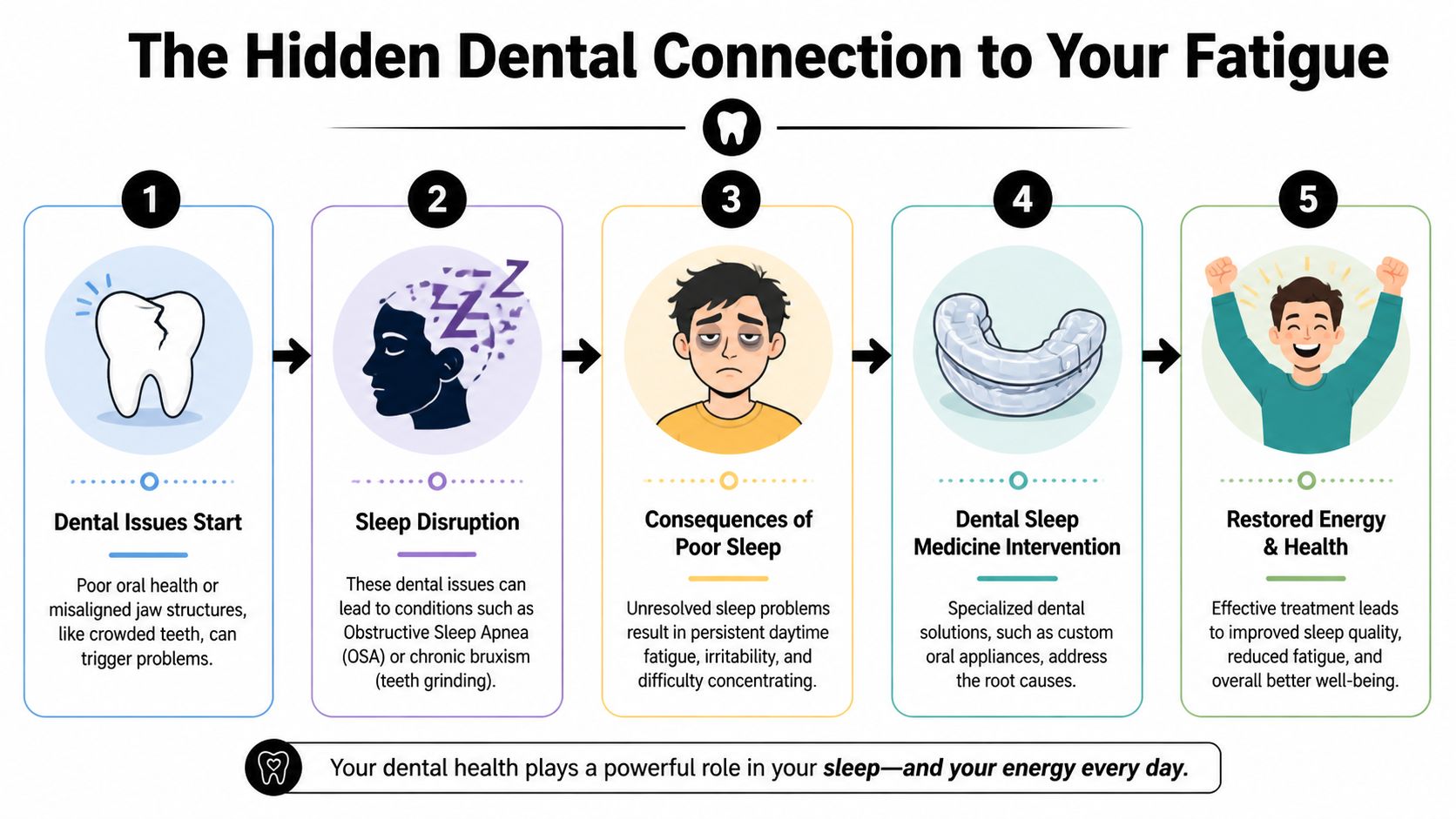
Obstructive sleep apnea can steal rest without waking you fully
A lot of people assume sleep apnea only affects loud snorers or older adults. In practice, it can be much less obvious. Obstructive sleep apnea affects up to 20 to 30% of adults in major U.S. markets like Houston, and it can cause repeated breathing pauses that keep sleep shallow and unrefreshing, according to Cleveland Clinic’s explanation of waking up tired after 8 hours.
It's like trying to read while someone keeps flicking the lights on and off. You may never fully leave the room, but you also never settle into a steady rhythm. With sleep apnea, the body keeps interrupting sleep to protect breathing. You may not remember those interruptions in the morning, but your brain and body do.
Common clues include:
- Morning headaches that feel dull or pressure-like
- Dry mouth on waking
- Snoring or gasping reported by a partner
- Brain fog and daytime sleepiness
- Feeling unrested after plenty of time in bed
TMJ and teeth grinding can keep your body on guard
Not every exhausted patient has an airway problem. Some are clenching all night. The jaw muscles never really let go, so the face, temples, neck, and head stay under tension. That can create the feeling that you slept, but never relaxed.
If you wake with a sore jaw, sensitive teeth, temple tension, or frequent headaches, nighttime grinding deserves a closer look. Our guide on what causes teeth grinding at night explains the patterns we often see in dental patients.
Sometimes fatigue isn't caused by too little sleep. It's caused by sleep that is constantly interrupted by breathing strain or muscle tension.
Why this matters in a dental office
A dentist who pays attention to worn teeth, bite changes, jaw tenderness, tongue position, airway clues, and headache patterns can help connect symptoms that seem unrelated. A patient may book for general dental care, a new patient exam, or even cosmetic concerns and end up discovering that the underlying issue is nighttime grinding or disordered breathing.
That’s the hidden connection. Your teeth may show the evidence of what your body has been fighting through every night.
How Dental Sleep Medicine Provides Lasting Relief
When the problem is sleep-disordered breathing, treatment has to do more than help you fall asleep. It has to help you stay in restorative sleep. That’s where dental sleep medicine can be useful.

What a custom oral appliance actually does
A custom oral appliance is worn during sleep and is designed to support the jaw in a position that helps keep the airway more open. It’s small, quiet, and made to fit your mouth rather than using a one-size-fits-all approach.
For the right patients, this can make a meaningful difference. Custom oral appliances for OSA can reduce the apnea-hypopnea index by 50 to 70% in mild-to-moderate cases by advancing the mandible 5 to 10 mm, improving sleep efficiency by 15 to 20%, according to Henry Ford Health’s discussion of fatigue and sleep apnea treatment.
Why some patients prefer this route
Not everyone does well with a CPAP device. Some patients find it hard to tolerate the mask, the pressure, or the overall setup. An oral appliance is different.
Here’s why people often ask about it:
- It’s compact and easier to travel with
- It’s silent, which matters for many couples
- It’s custom-fit, so it isn’t a generic night guard
- It supports the airway, not just the teeth
For patients dealing with clenching or TMJ-related symptoms, treatment may also involve a different type of appliance aimed at reducing muscle overload and bite-related strain. The exact approach depends on the source of the problem.
Treatment works best when dentistry and sleep medicine work together
Dental sleep medicine isn't guesswork. It works best when a dentist coordinates with a sleep physician or specialist so the diagnosis is clear and the appliance is customized to the condition being treated.
One option patients in Bellaire may explore is dental sleep medicine at Charles E. Boren, where custom oral appliance therapy is part of a broader evaluation of jaw position, symptoms, and sleep concerns. That kind of care can fit alongside routine dental services such as cleanings and exams, restorative dentistry, and cosmetic dentistry when needed.
Here’s a short look at how this treatment is discussed for patients considering their options:
Relief tends to come when the treatment matches the reason you're tired. A mouthguard for grinding and an oral appliance for airway support may look similar to a patient, but they solve different problems.
Your First Step to Better Sleep and More Energy in Bellaire
For many people, the hardest part is starting. They know something feels off, but they aren’t sure whether to call a physician, a sleep clinic, or a dentist in Bellaire, TX. If jaw symptoms, headaches, worn teeth, or clenching are part of the picture, a dental visit is a sensible place to begin.

What to expect at your visit
A thorough first appointment should feel calm, clear, and practical. You should have time to talk about what’s happening, not just point to one sore tooth and move on.
That visit may include:
- A symptom conversation about fatigue, headaches, snoring, clenching, jaw pain, and how you feel in the morning
- A bite and jaw evaluation to look for strain, imbalance, or signs of grinding
- Digital imaging and dental x-rays when needed to understand oral structures and wear
- A discussion of next steps if the pattern suggests TMJ issues, bruxism, or sleep-disordered breathing
Why this helps reduce uncertainty
People often worry they’ll be told to “just get more sleep.” A careful dental evaluation can do something more useful. It can identify whether your teeth and jaw show signs of stress that match what you’re feeling every morning.
If the signs point in a different direction, that’s valuable too. Good care narrows the possibilities. It helps you stop guessing.
This can fit into broader smile and health goals
Patients who come in for fatigue concerns often discover other needs along the way. Some need restorative dentistry because grinding has damaged teeth. Some ask about cosmetic dentistry, teeth whitening, or smile improvements once pain and fatigue are under better control. Some are looking for a dependable local office for new patient exams, preventive dental care, and emergency dentist needs when problems come up.
A good first visit should leave you with a clearer map. You may not solve everything in one appointment, but you should understand what the next step is and why it matters.
For patients in Bellaire, West University, and Houston, convenience matters too. When care is nearby and the process feels understandable, people are more likely to follow through.
Schedule Your Consultation with a Trusted Bellaire Dentist
If you keep asking, why am i always tired even after sleeping, your body is giving you a message worth taking seriously. The answer may involve sleep habits, stress, medical concerns, or something many people miss entirely. Your jaw, your teeth, and your airway.
That’s why an experienced dentist near me search can lead to more than a cleaning appointment. It can help uncover signs of obstructive sleep apnea, nighttime grinding, TMJ strain, and other issues that affect how rested you feel each day.
If you live in Bellaire, West University, or Houston and you’re tired of waking up tired, it may be time to have the problem evaluated with fresh eyes. A dental consultation can help determine whether your fatigue connects to oral health, whether you need a sleep-focused appliance, or whether another path makes more sense.
Patients also often appreciate having one local office that can support both health and smile goals, whether that means sleep-related care, restorative treatment, cosmetic dentist services, or ongoing preventive dental care.
If you’re ready to talk with a local office that can evaluate fatigue-related dental issues along with your broader oral health needs, schedule a consultation with Charles E. Boren. It’s a practical next step for patients in Bellaire, TX who want clearer answers, healthier sleep, and a more comfortable smile.