
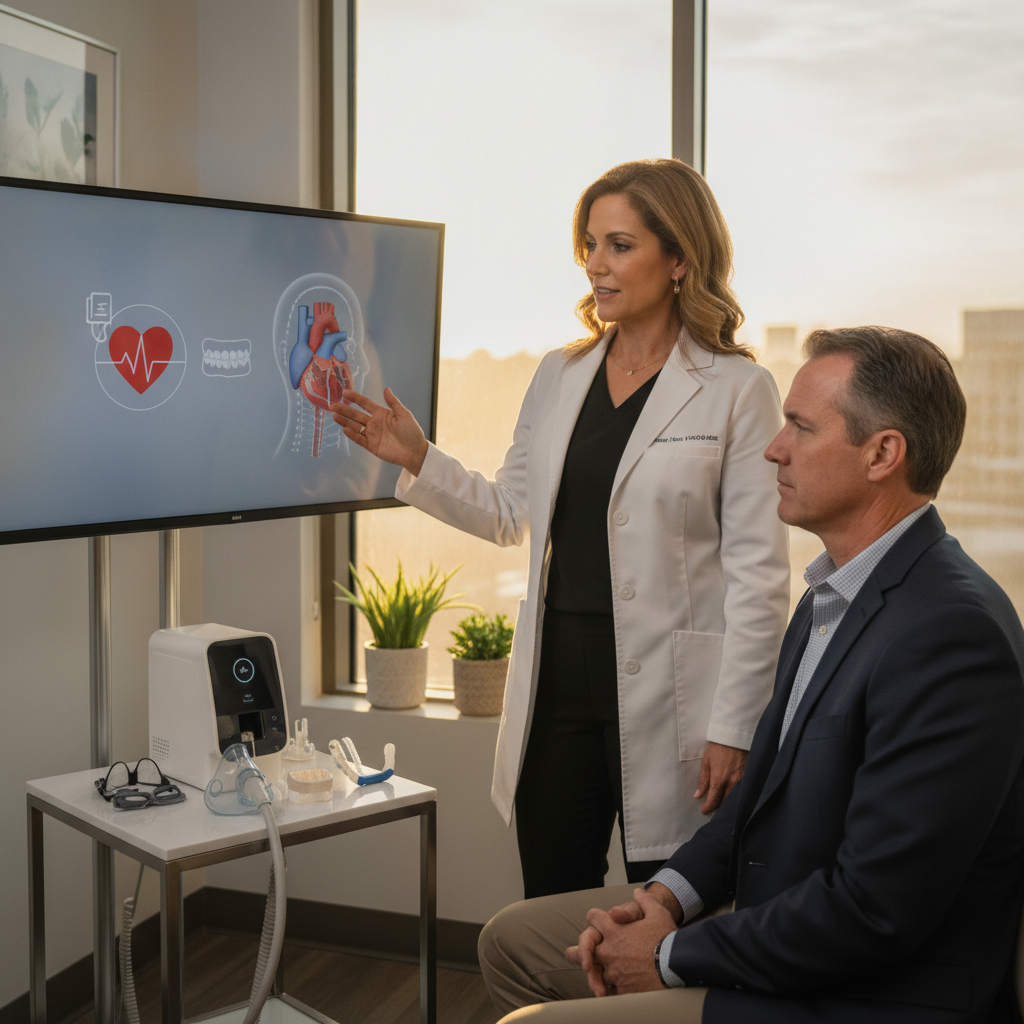
What Happens When You Stop Treating Sleep Apnea? A Bellaire Dentist Explains the Long-Term Health Risks
If you live in Bellaire and you’ve been diagnosed with obstructive sleep apnea — or you suspect you have it but haven’t pursued treatment — this is worth a few minutes of your time. Untreated sleep apnea isn’t just about snoring or feeling groggy in the morning. Over time, it puts real, measurable strain on your heart, your blood pressure, your teeth, and your brain. And if you tried a CPAP and gave up on it, that’s not unusual — but it does mean your sleep apnea is still happening every night, unaddressed.
The good news is that this is a treatable condition, and for many patients, a custom oral appliance worn while you sleep is a far more comfortable alternative to a CPAP machine. But first, let’s talk honestly about what’s at stake when sleep apnea goes unmanaged for months or years.
- What Sleep Apnea Actually Does to Your Body Over Time
- What Untreated Sleep Apnea Does to Your Teeth and Jaw
- Why So Many Patients Stop Using Their CPAP — and What That Actually Means
- What a Dental Sleep Medicine Consultation Actually Looks Like
- The Gap Most Dental Websites Don't Fill on This Topic
- Frequently Asked Questions About Untreated Sleep Apnea
- Ready to Talk About Your Sleep Health?
What Sleep Apnea Actually Does to Your Body Over Time
Obstructive sleep apnea happens when the soft tissues at the back of your throat partially or fully collapse during sleep, briefly cutting off your airway. Your brain registers the drop in oxygen and jolts you awake just enough to resume breathing — sometimes hundreds of times per night. You rarely remember these episodes. But your body does.
Each time your airway closes, your oxygen levels dip and your body responds with a surge of stress hormones. Night after night, that cycle creates chronic inflammation and places enormous strain on your cardiovascular system. Research has consistently linked untreated obstructive sleep apnea to:
- High blood pressure — Sleep apnea is one of the most common secondary causes of hypertension, and it can make blood pressure medications less effective
- Increased risk of heart disease and stroke — The repeated oxygen drops stress the heart muscle and promote arterial inflammation over time
- Type 2 diabetes complications — Sleep disruption affects insulin sensitivity and glucose regulation
- Cognitive decline and memory problems — Fragmented sleep prevents the brain from completing the deep-sleep cycles it needs to consolidate memory and clear metabolic waste
- Chronic daytime fatigue — Not just tiredness, but the kind of exhaustion that affects your concentration, reaction time, mood, and judgment throughout the day
These aren’t hypothetical risks. They’re documented, cumulative, and they worsen the longer sleep apnea goes untreated.
What Untreated Sleep Apnea Does to Your Teeth and Jaw
Here’s the angle that most sleep apnea conversations miss — and it’s one that a dentist is uniquely positioned to spot. Obstructive sleep apnea and teeth grinding (bruxism) are closely linked. Many patients with untreated sleep apnea unconsciously clench or grind their teeth during apnea episodes as the body tries to reopen the airway by tensing the jaw.
Over time, that grinding wears down enamel, cracks teeth, flattens cusps, and stresses the temporomandibular joints. Patients often come in complaining of jaw soreness, morning headaches, tooth sensitivity, or teeth that look shorter than they used to — without ever connecting it to what’s happening at night. If you’ve already been told you grind your teeth, sleep apnea may be a contributing factor worth investigating.
During a routine dental exam, a dentist trained in dental sleep medicine can often spot the signs of nighttime grinding and airway issues before a patient has any idea sleep apnea is involved. That’s one reason regular dental visits matter for more than just cavity checks.
Why So Many Patients Stop Using Their CPAP — and What That Actually Means
Studies suggest that somewhere between 30 and 50 percent of people prescribed a CPAP machine either stop using it within the first year or don’t use it consistently enough to get real benefit. The reasons are familiar: the mask is uncomfortable, the noise keeps a partner awake, wearing it feels claustrophobic, it’s hard to travel with, or it simply disrupts sleep rather than improving it.
If this sounds like your experience, you’re in good company. But here’s what matters: not using your CPAP doesn’t mean your sleep apnea went away. It means you’re back to experiencing those airway interruptions every night — and all the downstream health effects that come with them.
For mild to moderate obstructive sleep apnea, a custom-fitted oral appliance is a well-established alternative. It works by gently repositioning your lower jaw forward during sleep, which keeps the airway open without a mask, a motor, or a hose. Most patients find it far easier to tolerate and wear consistently. For some patients with more severe sleep apnea, an oral appliance is used alongside a CPAP at reduced pressure settings — a combination that improves compliance for many people who couldn’t manage CPAP alone.
What a Dental Sleep Medicine Consultation Actually Looks Like
If you’ve been diagnosed with sleep apnea by a sleep physician, or if you’re waking up with chronic headaches, your partner says you stop breathing at night, or you’re exhausted despite what feels like a full night in bed, it’s worth having a conversation with a dentist who understands airway health.
At our Bellaire practice, a dental sleep medicine consultation starts with listening. We’ll talk through your sleep history, your symptoms, and any prior diagnosis or treatment you’ve tried. If you haven’t had a formal sleep study, we can help coordinate that referral — treatment should be guided by a proper diagnosis, not guesswork. If you already have a diagnosis in hand, we can move into evaluating whether an oral appliance is appropriate for your case, take impressions, and fit a custom device that’s made specifically for your bite and jaw anatomy.
This isn’t a one-size-fits-all product. The appliance is calibrated to your measurements, and it’s adjusted over time to find the position that opens your airway effectively while keeping you comfortable. Follow-up matters too — we want to make sure the appliance is working, not just that you’re wearing it.
Patients in West University Place, Meyerland, and across the surrounding Houston area have found that having a dentist who handles both the dental and sleep health sides of the equation — in one familiar office — makes follow-through a lot more manageable than bouncing between specialists.
The Gap Most Dental Websites Don’t Fill on This Topic
If you’ve spent time reading content on local dental websites about sleep apnea, you’ve probably noticed that most of it covers the basics — what sleep apnea is, what a CPAP is, what an oral appliance is — and stops there. Very few sites talk honestly about what happens when treatment lapses, or about the real-world connection between untreated sleep apnea and what your dentist sees in your mouth every year.
That gap matters, because a lot of people in the greater Houston area have been diagnosed, tried a CPAP, given up, and assumed they’ve run out of options. They haven’t. Dr. Boren has worked with patients in this exact situation — people who wanted a solution that actually fit their life, not just a prescription they couldn’t stick with.
Frequently Asked Questions About Untreated Sleep Apnea
Can sleep apnea get worse if you ignore it?
Yes. Obstructive sleep apnea tends to progress over time, particularly with weight changes, aging, or changes in muscle tone. Ignoring it doesn’t stabilize it — and the health consequences accumulate with each year it goes unaddressed.
Is an oral appliance covered by insurance?
Many medical insurance plans — including Medicare — cover oral appliance therapy for obstructive sleep apnea when it’s prescribed following a formal sleep study. Dental insurance typically does not cover it, since it’s medically coded. We can help you understand what your coverage looks like before you commit to anything.
Do I need a new sleep study if I was diagnosed years ago?
Not always, but it depends on how much time has passed and whether your symptoms or weight have changed significantly. Your sleep physician will guide that decision. What we need to fit an oral appliance is a current diagnosis and some information about the severity of your apnea.
Can teeth grinding really be connected to sleep apnea?
Yes — and it’s more common than most people realize. Bruxism and obstructive sleep apnea frequently occur together. If you’ve been told you grind your teeth and you also wake up tired or with headaches, it’s worth discussing both issues with a dentist who understands the connection.
What if my sleep apnea is severe — am I still a candidate for an oral appliance?
Severe sleep apnea typically requires a CPAP as the primary treatment. However, for patients who truly cannot tolerate CPAP, an oral appliance may still be an option — ideally in coordination with your sleep physician. Combination therapy (oral appliance plus CPAP at lower pressure) is another route that works well for some patients with severe apnea who struggle with compliance.
Ready to Talk About Your Sleep Health?
If you’re in Bellaire, West University Place, or the surrounding Houston area and you’ve been putting off dealing with sleep apnea — whether because a CPAP didn’t work out or because you’re not sure where to start — we’d be glad to have that conversation with you. There’s no pressure and no one-size-fits-all treatment plan here. Just an honest look at what’s going on and what options make sense for your situation.
Contact our Bellaire office to schedule a consultation and let’s talk about what better sleep could actually look like for you.