

If you're dealing with jaw clicking, persistent pain, or headaches in the Bellaire or West University area, you’ve probably asked yourself: what happens if I just ignore this? The honest answer is that TMJ symptoms almost always get worse over time. Ignoring the pain and hoping it goes away can lead to more serious issues that impact your overall health and smile.
At our Bellaire, TX dental practice, we see patients every day who are looking for a trusted "dentist near me" to solve their jaw pain. We understand your concerns and are here to provide the expert dental care you need to find lasting relief.
What starts as a minor annoyance can spiral into chronic pain, serious dental damage, and a major hit to your quality of life.
The Escalating Cost Of Ignoring TMJ
That nagging click in your jaw or the dull ache that greets you some mornings might seem like a small thing you can just push through. Many people right here in Houston do exactly that, hoping the discomfort will magically disappear on its own.
But temporomandibular joint (TMJ) disorder isn't just a minor inconvenience; it's a progressive condition. Ignoring the early warning signs is like driving on a tire with a slow leak—sooner or later, you'll find yourself stranded with a much bigger, more complicated problem. This is why seeking professional dental care from a local dentist you can trust is so important.
At our Bellaire practice, Dr. Charles E. Boren has seen firsthand how untreated TMJ can escalate. With over 30 years of focused experience, he helps patients stop the cycle of pain before it leads to irreversible damage. We firmly believe you don't have to live with this discomfort and are committed to helping our Bellaire community achieve healthy, pain-free smiles.
The Predictable Path of TMJ Progression
When TMJ disorder is left to its own devices, the symptoms rarely stay put. They tend to follow a predictable, escalating path. Think of it like a row of dominoes—one small problem triggers the next, leading to more severe issues down the line.
The journey often starts with things many people brush off as minor annoyances:
- An occasional popping or clicking sound when you chew or open your mouth wide.
- Mild tenderness in the jaw muscles, especially after a long day of talking or eating.
- Brief moments where your jaw feels stiff or like it's not quite lining up right.
These early symptoms are your body's alarm system, warning you that something is wrong with your jaw's mechanics. They are your cue to seek a new patient exam with a knowledgeable dentist.
Untreated TMJ is a journey from mild annoyance to major disruption. What begins as a simple click can evolve into chronic pain that affects your teeth, your head, and your overall well-being. Addressing it early with proper dental care is the key to preventing long-term damage.
This timeline shows just how quickly a "small" problem can spiral into chronic pain and lasting dental damage if it isn't managed.
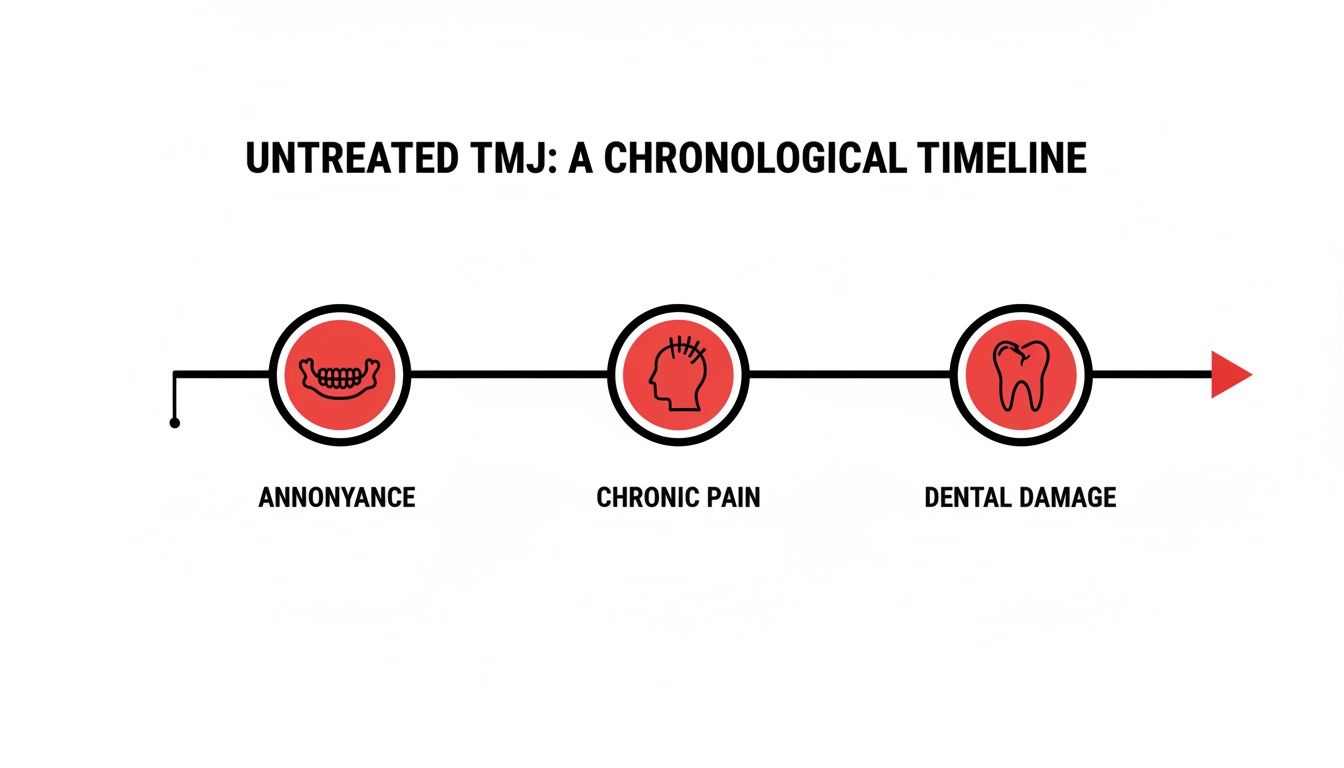
The visual makes it clear: ignoring those initial signs just gives the condition more time to cause serious harm, impacting your daily life in profound ways.
As the condition progresses, the symptoms become harder to ignore. The table below illustrates how these issues can build on one another over time.
The Escalation of Untreated TMJ Symptoms
| Stage | Common Symptoms | Potential Long-Term Impact |
|---|---|---|
| Early | Occasional clicking/popping, mild muscle soreness, temporary stiffness. | Minimal impact if treated promptly. |
| Intermediate | More frequent pain, locking jaw, headaches/migraines, earaches. | Beginning of cartilage wear, muscle dysfunction. |
| Advanced | Chronic pain, grinding sounds (crepitus), visible tooth wear/damage. | Significant joint damage, bite changes, sleep apnea. |
| Severe | Constant debilitating pain, difficulty eating/speaking, permanent bite changes. | Irreversible joint damage, reduced quality of life. |
This progression from mild to severe underscores why early intervention from a qualified dentist is so critical for protecting your long-term health.
You Can't Afford to Wait
Putting off treatment allows the underlying dysfunction to get worse. The constant strain on your jaw joint and the surrounding muscles creates a cascade of new problems. This isn't just about worsening pain; it's about structural damage that can become permanent.
Those clicks can turn into grinding sounds as the joint deteriorates. Your teeth may start showing signs of excessive wear from grinding (bruxism), a common and destructive partner to TMJ.
This guide will walk you through the specific risks of leaving TMJ untreated, explaining how it impacts everything from your teeth to your sleep. More importantly, we'll show you how a dentist near you in Bellaire, TX, can provide real, lasting relief. Our goal is to give you the knowledge to make informed decisions and find a solution that restores comfort and function to your life.
The Escalating Cycle of Chronic Pain and Headaches
One of the most draining consequences of an untreated TMJ disorder is the descent into chronic pain. What often begins as a simple, localized jaw soreness can morph into a widespread, radiating ache that travels through your face, neck, and even down into your shoulders.
It’s a bit like driving a car with a tire that’s slightly out of alignment. At first, the vibration is barely noticeable. But if you ignore it, that small imbalance eventually wears the tire unevenly, puts stress on the axle, and can throw the whole suspension system out of whack. Your body’s attempt to compensate for a misaligned jaw works in much the same way, creating a cascade of muscle tension and dysfunction.
This is exactly why so many of our patients from across the Houston area come to us reporting that their TMJ issues are triggering frequent tension headaches or even debilitating migraines. If you're searching for an "emergency dentist" because of unbearable head or jaw pain, the root cause could be TMJ. This relentless cycle of pain can sabotage your sleep, sour your mood, and crush your productivity, turning simple acts like chewing or talking into exhausting ordeals.
From Minor Ache to Major Problem
The jump from occasional jaw discomfort to chronic, life-altering pain can happen surprisingly fast. This is far more than just a "sore jaw." We’re talking about a complex problem rooted in muscle strain and nerve irritation that requires professional dental care.
When the temporomandibular joint is out of balance, the muscles surrounding it—in your cheeks, temples, neck, and upper back—are forced to work overtime just to keep things stable. This constant state of overexertion leads to a few key problems:
- Muscle Fatigue and Spasms: Just like any other muscle in your body, your jaw muscles get exhausted. This leads to painful spasms and trigger points—those tight, sensitive knots that can refer pain to other parts of your head and neck.
- Nerve Irritation: The jaw area is a busy intersection for critical nerves, including the massive trigeminal nerve that handles sensation for most of your face. TMJ-related inflammation and muscle tension can compress this nerve, firing off pain signals that feel like headaches, toothaches, or sinus pain.
- Referred Pain: This is a tricky phenomenon where you feel pain in a location completely different from the actual source. A dysfunctional jaw joint is notorious for causing earaches, neck pain, and sinus-like pressure, even when those areas are perfectly healthy.
This is not a condition you just have to live with. Here at our dental practice in Bellaire, we see patients every single day who thought this pain was their new normal. With a proper diagnosis and the right dental care, we can break the cycle.
The Connection Between Untreated TMJ and Headaches
Many people spend years chasing the source of their chronic headaches, never suspecting a dental issue. But the link is strong and well-documented. If you're asking what happens if TMJ is left untreated, the arrival of persistent headaches is one of the most common and miserable answers. The constant strain on your jaw muscles creates a state of perpetual tension, a primary driver for both tension headaches and migraines.
Untreated TMJ can be a significant trigger for debilitating migraines, making the cycle of chronic pain even worse. For those looking for solutions that go beyond medication, it’s worth noting that physical therapy as a non-drug path to relief from migraines can be a powerful complementary approach. You can also explore our guide to learn more about how TMJ dysfunction can cause migraines.
The statistics are quite telling. TMJ affects a significant portion of the population, with estimates suggesting it impacts between 11 to 12 million adults in the U.S. When left unaddressed, what begins as occasional jaw discomfort often spirals into chronic pain that becomes a constant companion. Studies show that when TMJ disc problems are left without treatment, only about 43% of patients see symptoms resolve on their own over a 2.5-year period, while a notable 25% experience no improvement or eventually require intervention. You can discover more insights about the long-term effects of untreated TMJ at doctortmj.com.
Progressive Damage to Your Teeth and Jaw Joint

Beyond the daily grind of chronic pain and headaches, ignoring TMJ disorder causes direct, physical damage to your teeth and jaw. This isn't just about feeling uncomfortable—it's about the literal breakdown of your jaw joint and the precious enamel on your teeth, which requires expert dental care to manage.
When TMJ is left to its own devices, the constant stress and improper movement start to wear down the temporomandibular joint itself. Those clicking and popping sounds you might be hearing are often the first warning signs. They tell us the joint isn't gliding smoothly, creating friction where there should be none.
This ongoing mechanical problem can snowball into serious joint issues. Over time, the protective cartilage disc inside the joint can wear thin, slip out of place, or even tear. Without that crucial cushion, the bones can start grinding against each other, a painful condition called osteoarthritis. This leads to inflammation, grinding sounds (known as crepitus), and eventually, permanent joint damage.
The Destructive Link Between TMJ and Teeth Grinding
A major destructive habit that often goes hand-in-hand with TMJ disorder is bruxism—the medical term for chronic teeth grinding and clenching. Many people don't even know they're doing it, especially at night, as the body instinctively tries to find a stable resting position for an unbalanced jaw.
Think of bruxism as constantly rubbing sandpaper across your teeth. This relentless pressure causes a cascade of dental problems that are often expensive and time-consuming to fix. If you've been searching for a "cosmetic dentist near me" to repair mysterious chips or worn-down teeth, TMJ could be the secret saboteur. Our restorative dentistry services can repair this damage, but treating the underlying TMJ is essential.
Untreated TMJ wreaks havoc on your jaw joint, leading to inflammation and damage that can eventually demand surgery. Persistent inflammation erodes the temporomandibular joint, causing progressive degeneration where cartilage wears away. For many, this joint damage becomes chronic, and studies show that up to 25% of patients with untreated TMJ disc issues see no improvement after 2.5 years, facing long-term joint problems. Learn more about the risks of untreated TMJ disorder at sleepandtmjutah.com.
A Domino Effect of Dental Damage
The damage from untreated TMJ and bruxism sets off a destructive domino effect. It’s not a single problem but a chain reaction of issues that get progressively worse.
The initial damage usually includes:
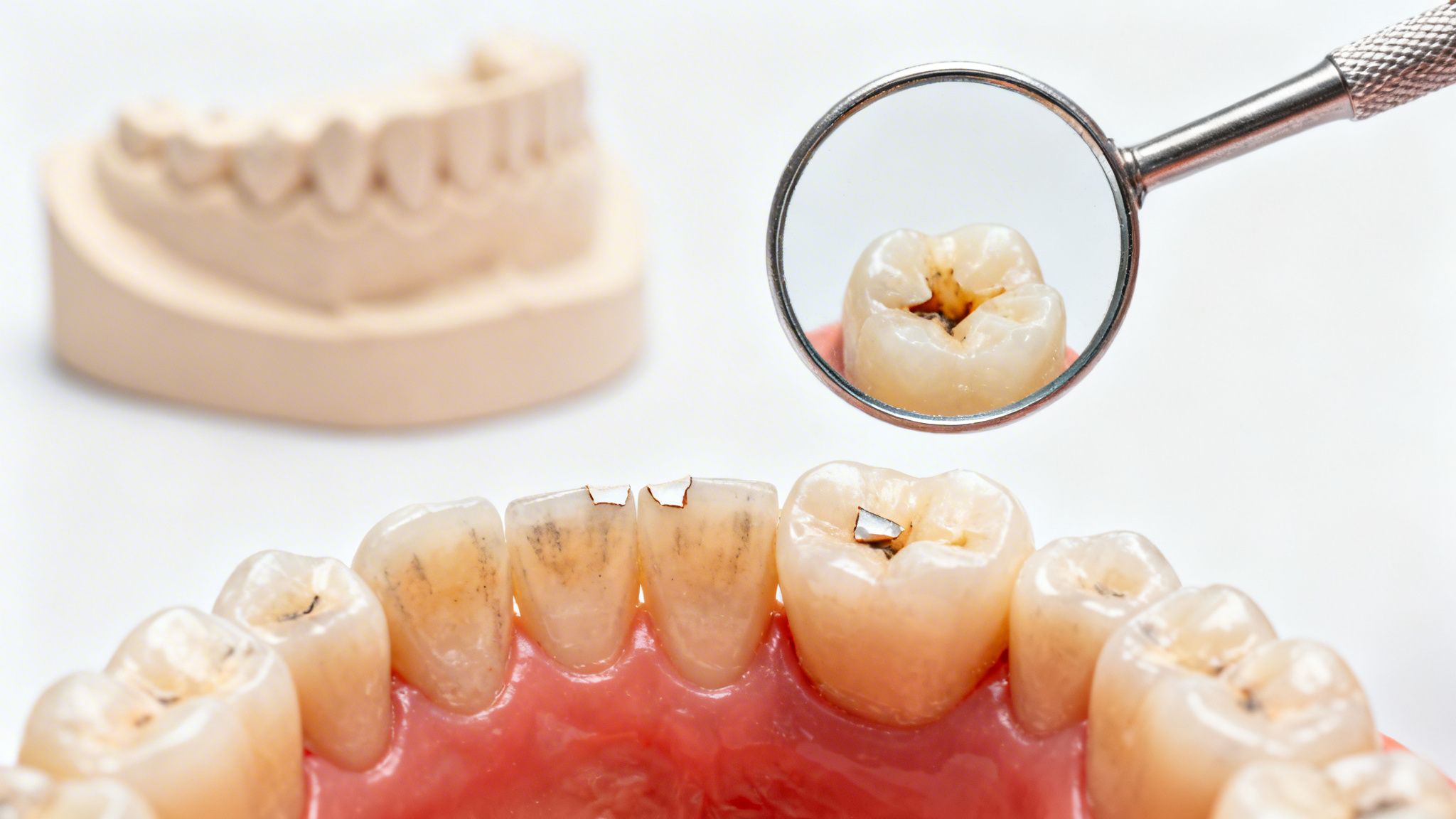
- Enamel Erosion: The hard, protective outer layer of your teeth gets worn away, leaving them vulnerable to cavities and sensitivity.
- Chipped or Cracked Teeth: The intense forces from grinding can cause teeth to chip, fracture, or develop tiny cracks called craze lines.
- Altered Bite: As your teeth wear down unevenly, your bite changes. This can actually make the TMJ disorder worse, creating a vicious cycle of dysfunction and damage.
This path of destruction often leads to the need for extensive and expensive restorative dentistry. Here at our Bellaire practice, we see patients who've put off treatment and are now facing significant dental reconstruction to repair the aftermath.
The High Cost of Waiting
What starts as a "minor" jaw issue can spiral into needing a full-mouth reconstruction. To undo the damage caused by years of untreated TMJ, you could be looking at:
- Dental Crowns: To cap and protect teeth that have been severely worn down or cracked.
- Dental Bridges or Dental Implants: To replace teeth that have fractured beyond repair or been lost due to issues like a necessary tooth extraction.
- Cosmetic Dentistry: Procedures like bonding or veneers to restore the appearance and shape of a smile that's been worn down.
These treatments are effective, but they are far more invasive and costly than treating the TMJ disorder at its source. That's why seeking care from an experienced dentist in Bellaire, TX is so critical. By intervening early, you can protect the long-term health of your jaw and smile, and prevent the need for more complex dental work down the road.
How Our Bellaire, TX Dentist Diagnoses and Treats TMJ
Knowing that untreated TMJ leads to serious problems is one thing. Finding a clear path to relief is something else entirely. Here at our Bellaire, TX practice, Dr. Charles E. Boren provides solutions that go beyond just masking the pain—they get to the real source of your discomfort.
We’ve seen too many patients come to us frustrated after years of chasing symptoms. Our entire approach is different. Instead of just treating the pain, Dr. Boren starts with a deep-dive diagnostic process to pinpoint why your jaw isn't functioning correctly. This commitment to finding the root cause is what sets our dental care apart for patients all over the greater Houston area.
Your Path to Relief Begins with a Precise Diagnosis
Lasting relief can only come from a truly accurate diagnosis. Dr. Boren’s process is built around a comprehensive bite analysis, a crucial evaluation that looks at how your teeth, muscles, and jaw joints work together as a complete system. This is about so much more than just your teeth; it’s about understanding the intricate mechanics of your jaw.
During your new patient exam, we’re looking at several key factors:
- The precise alignment of your bite and how your upper and lower teeth come together.
- The function, health, and tension levels of your jaw muscles.
- The actual movement and condition of the temporomandibular joint itself.
This detailed analysis, often supported by advanced digital imaging, allows Dr. Boren to identify the specific imbalance that’s causing the pain. By focusing on the source from day one, we can design a treatment plan that delivers real, sustainable results.
Non-Invasive Dental Care Tailored to You
For the vast majority of our patients in Bellaire and West University, the answer to TMJ pain doesn’t involve surgery or other invasive procedures. We focus on conservative, highly effective treatments designed to bring harmony back to your jaw system.
One of our most powerful tools is a custom-fitted oral appliance, sometimes called a splint. Don't think of this as a simple mouthguard you'd buy at a store. It’s a therapeutic orthotic for your jaw, meticulously designed to create a perfectly balanced surface that encourages your tense jaw muscles to finally relax into their natural, unstrained position. For a deeper look, you can learn more about how a custom oral appliance for TMJ works to bring relief.
This appliance accomplishes two critical goals at once:
- It Protects Your Teeth: The appliance provides a vital barrier against the destructive forces of nighttime clenching and grinding (bruxism), preventing further wear, chipping, and damage. This is a key part of restorative and cosmetic dentistry.
- It Relaxes Your Muscles: By gently guiding your jaw into its ideal resting state, it breaks the cycle of muscle strain that leads to chronic headaches, facial pain, and neck tension.
For patients whose main struggle is with TMJ-related headaches and migraines, we also specialize in the NTI-tss device. This small, FDA-approved appliance is specifically engineered to dramatically reduce clenching intensity, offering targeted relief for headache sufferers. It's another example of how we use precise tools to solve very specific problems.
Dr. Boren's approach is to find the most direct and least invasive path to relief. By using advanced diagnostics and personalized appliances, we can deprogram overactive jaw muscles and guide your bite back to a state of equilibrium, stopping the cycle of pain.
Thinking about the progressive damage to your jaw joint can feel overwhelming. While exploring general guides on how to relieve joint pain can offer broader insights, our focus is on correcting the specific mechanical issues driving your TMJ. Our goal is to provide a solution that not only eases your immediate symptoms but also protects your long-term dental and joint health.
What to Expect During Your TMJ Consultation in Bellaire
Taking the first step toward getting relief from jaw pain can feel intimidating, especially when you don't know what's next. We get it. That’s why we want to pull back the curtain and show you exactly what to expect when you schedule a TMJ consultation at our Bellaire, TX, dental practice.
Your journey with us begins with a warm welcome. Our team is here to make you feel comfortable and at ease from the moment you walk through our doors.
Your visit to our office, located conveniently for patients across Bellaire and the greater Houston area, is a partnership. It all starts with a conversation. Dr. Boren will sit down with you to listen—really listen—to what you've been experiencing. This isn't a rushed, five-minute check-in; it's dedicated time for you to share your symptoms, your health history, and what you hope to achieve.
Your Comprehensive Physical Evaluation
After our initial talk, Dr. Boren will conduct a detailed physical examination. This is a crucial step, as it helps us understand the unique mechanics of your jaw system and connect your symptoms to a physical cause. The entire exam is gentle and non-invasive.
During the physical evaluation, we will assess:
- Jaw Movement: We’ll watch your jaw’s range of motion as you open, close, and move it side-to-side. We’re looking for any clicking, popping, or deviations that point to an underlying issue.
- Muscle Palpation: Dr. Boren will gently press on the muscles of your head, neck, and face. This helps us pinpoint specific areas of tension, soreness, or trigger points that are contributing to your pain.
- Joint Health: We carefully listen to the sounds your temporomandibular joint makes during movement. These sounds can tell us a lot about friction or potential damage inside the joint itself.
This hands-on approach is how we begin to form a clear and accurate diagnosis, moving from symptoms to evidence.
Advanced Diagnostics for a Clearer Picture
Sometimes, a physical exam alone doesn’t tell the whole story. When needed, we can use modern digital imaging and dental X-rays right here in our Bellaire office. These images give us an unobstructed view of your jaw joint's bone structure, allowing us to rule out or confirm problems like arthritis or physical damage.
These diagnostic tools are incredibly valuable, but they’re just one piece of the puzzle. The most important part is combining this technical data with what you are personally experiencing. Regular cleaning and exams also help us monitor your overall oral health.
Your TMJ consultation is a collaborative process. Our top priority is to connect the dots between your symptoms, our clinical findings, and a treatment plan that makes sense for you. We explain everything in clear, simple terms, ensuring you feel confident and informed every step of the way.
We believe that understanding your condition is the first step toward overcoming it. Throughout the consultation, we’ll explain our findings as we go, demystifying the process and empowering you with knowledge about your own health.
From flexible scheduling to sedation options for anxious patients, every detail of your visit is designed to feel safe, supportive, and focused on your relief. We’re not just treating a condition; we’re caring for a person.
Answers to Your Questions About TMJ Treatment
When you're dealing with jaw pain, it’s only natural to have a lot of questions. We find that many of our patients in Bellaire and Houston come in with similar concerns, so we’ve gathered our answers to the most common ones right here.
Our hope is to clear up any confusion and give you the confidence you need to take that first step toward relief.
Will My TMJ Pain Go Away on Its Own?
It's tempting to cross your fingers and hope the discomfort will simply fade away, but that’s rarely the case. While some mild symptoms might come and go, the underlying mechanical problem in the jaw joint doesn't usually fix itself.
More often than not, leaving TMJ untreated allows the issue to slowly get worse, leading to more intense pain, progressive joint damage, and other long-term problems. The only way to know for sure what’s happening—and to stop it from escalating—is to get a professional diagnosis from a dentist.
Is TMJ Treatment Painful?
Absolutely not. In fact, our entire approach to TMJ therapy is designed to do one thing: relieve your pain, not cause more of it. We focus exclusively on non-invasive, gentle therapies that help bring your jaw system back to a comfortable, functional state.
Think of it this way: our treatments, from custom-designed oral appliances to targeted muscle relaxation techniques, are all about breaking the cycle of strain and discomfort. The goal is to give your body the support it needs to heal itself, naturally and comfortably.
How Long Does TMJ Treatment Take?
Every patient’s journey is different because every case of TMJ is unique. The timeline for your treatment really depends on the root cause of your disorder and how severe it is.
That said, many of our patients start feeling a significant difference within just a few weeks of using a custom-fitted oral appliance. When you come in for your consultation, Dr. Boren will create a personalized treatment plan and give you a much more specific timeline based on your individual needs and goals.
Don't let unanswered questions keep you from finding relief. The team at Charles E. Boren, DDS, is here to provide the clear answers and compassionate dental care you deserve. Schedule your personalized TMJ consultation in Bellaire today.