
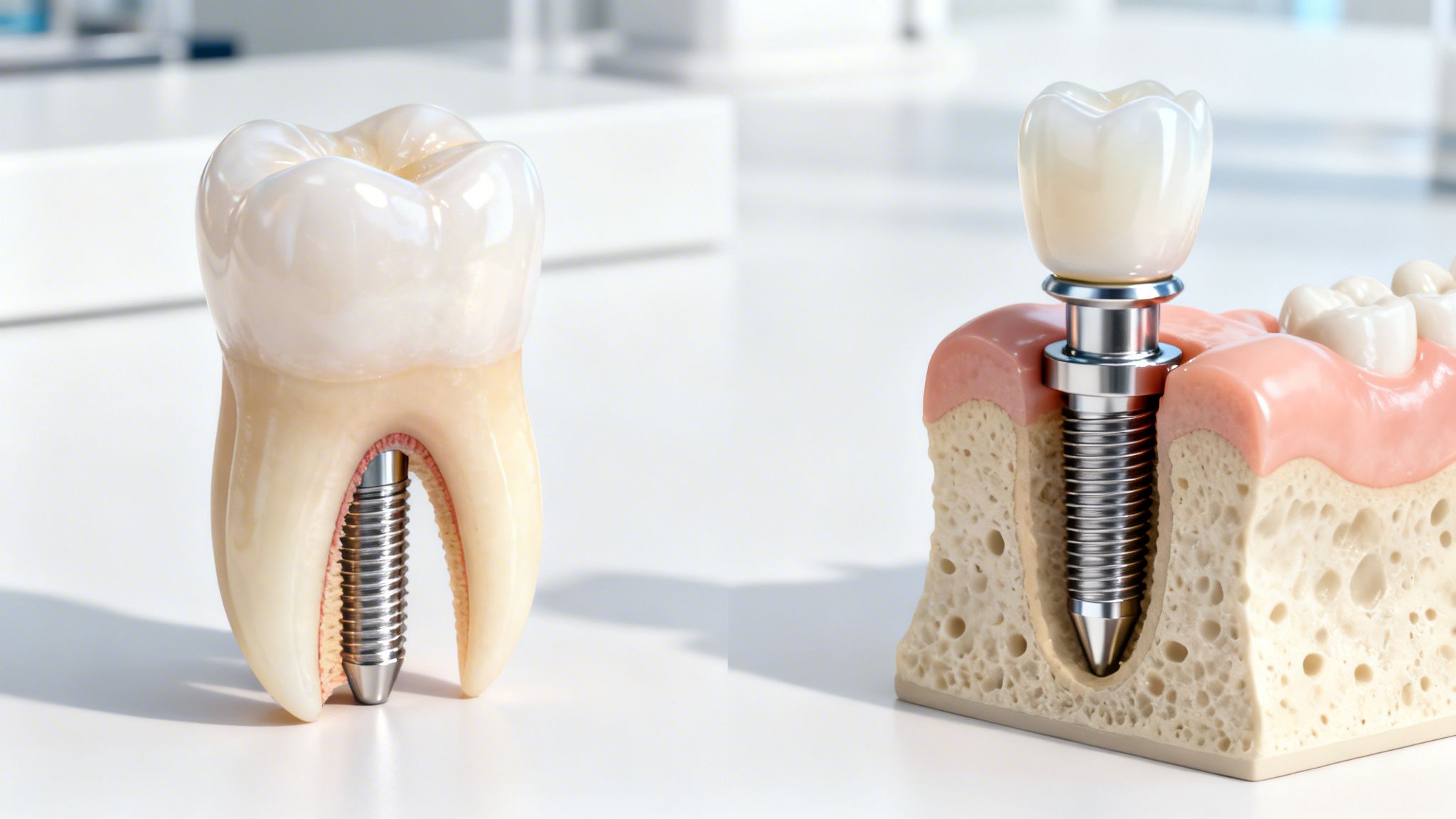
When a tooth is severely damaged, choosing between a post and crown vs implant is a common decision our patients in Bellaire face. The main difference is simple: a post and crown works to save your natural tooth root, while a dental implant is designed to replace it entirely. Making the right choice depends on the health of your existing tooth and your long-term goals for a healthy, confident smile.
- Your Trusted Guide to Tooth Restoration in Bellaire, TX
- What Is A Post And Crown And When Is It Used?
- Understanding Dental Implants: The Gold Standard Solution
- How To Choose The Right Option For Your Smile
- Comparing Long-Term Success And Durability
- Your Patient Experience At Our Bellaire Dental Practice
- Frequently Asked Questions About Tooth Restoration
Your Trusted Guide to Tooth Restoration in Bellaire, TX
Facing a decision about a severely damaged or missing tooth can feel stressful. Many of our patients in Bellaire, TX, and the greater Houston area come to us with this exact question, wondering which path is best for their oral health. At the practice of Charles E. Boren, DDS, we believe in providing clear, patient-focused guidance to help you navigate your options with confidence. As your local dentist, we are here to relieve pain and restore your smile.
Whether you're dealing with the aftermath of a root canal or a tooth that simply can't be saved, understanding the fundamental differences is the first step. A post and crown is a restorative procedure designed to rebuild a compromised tooth from its existing foundation. In contrast, a dental implant is a comprehensive replacement solution that creates a new foundation from scratch, often the best choice for a tooth extraction.
Key Treatment Differences at a Glance
The right choice is highly personal and depends entirely on your specific dental condition. Dr. Boren uses advanced diagnostic tools, including digital dental x-rays during your new patient exam, to get a clear picture of your tooth's structure and surrounding bone. This ensures his recommendation is not just effective, but perfectly aligned with your health needs.
To help you compare, we've put together a quick side-by-side summary of these two premier restorative dentistry options.
Quick Comparison: Post And Crown Vs Dental Implant
Use this side-by-side summary to quickly understand the fundamental differences between these two premier restorative options available at our Bellaire dental practice.
| Feature | Post And Crown | Dental Implant |
|---|---|---|
| Primary Goal | To save and rebuild a natural tooth after a root canal. | To completely replace a missing or non-restorable tooth. |
| Foundation | Uses the healthy, natural tooth root as an anchor. | Uses a surgically placed titanium post fused to the jawbone. |
| Procedure | Non-surgical; involves placing a post in the root canal and fitting a crown. | A surgical procedure to place the implant, followed by healing and crown attachment. |
| Tooth Requirement | Requires a healthy, structurally sound tooth root to be present. | Does not require any part of the original tooth to remain. |
This table highlights the "what," but it's the "why" that often guides the decision.
When it comes to long-term reliability, the clinical evidence often favors dental implants for their predictability. Global studies have shown that dental implants can achieve a success rate of over 97% within five years, even in complex scenarios. By comparison, teeth restored with a post and crown have historically shown success rates ranging from 68% to 85%. You can explore the detailed clinical data on implant success rates to learn more about these findings.
Ultimately, our goal as your trusted "dentist near me" is to help you achieve a healthy, functional, and beautiful smile that lasts. We will work with you to weigh the pros and cons of each treatment, ensuring you feel empowered to make the best decision for your oral health for years to come.
What Is A Post And Crown And When Is It Used?
When a tooth is severely damaged by decay or trauma, our first priority is always to see if we can save it. A post and crown is a fantastic restorative option we use here in our Bellaire office, but it’s reserved for a very specific scenario: a tooth that has already had a root canal. This procedure helps restore function and relieve the pain associated with a broken tooth.
Let's clarify one common point of confusion. A post and crown is not an alternative to a dental implant. They serve completely different purposes. A post and crown is a technique to save your natural tooth root, while an implant, like the one shown below, is designed to replace a tooth root that has been lost or requires a tooth extraction.
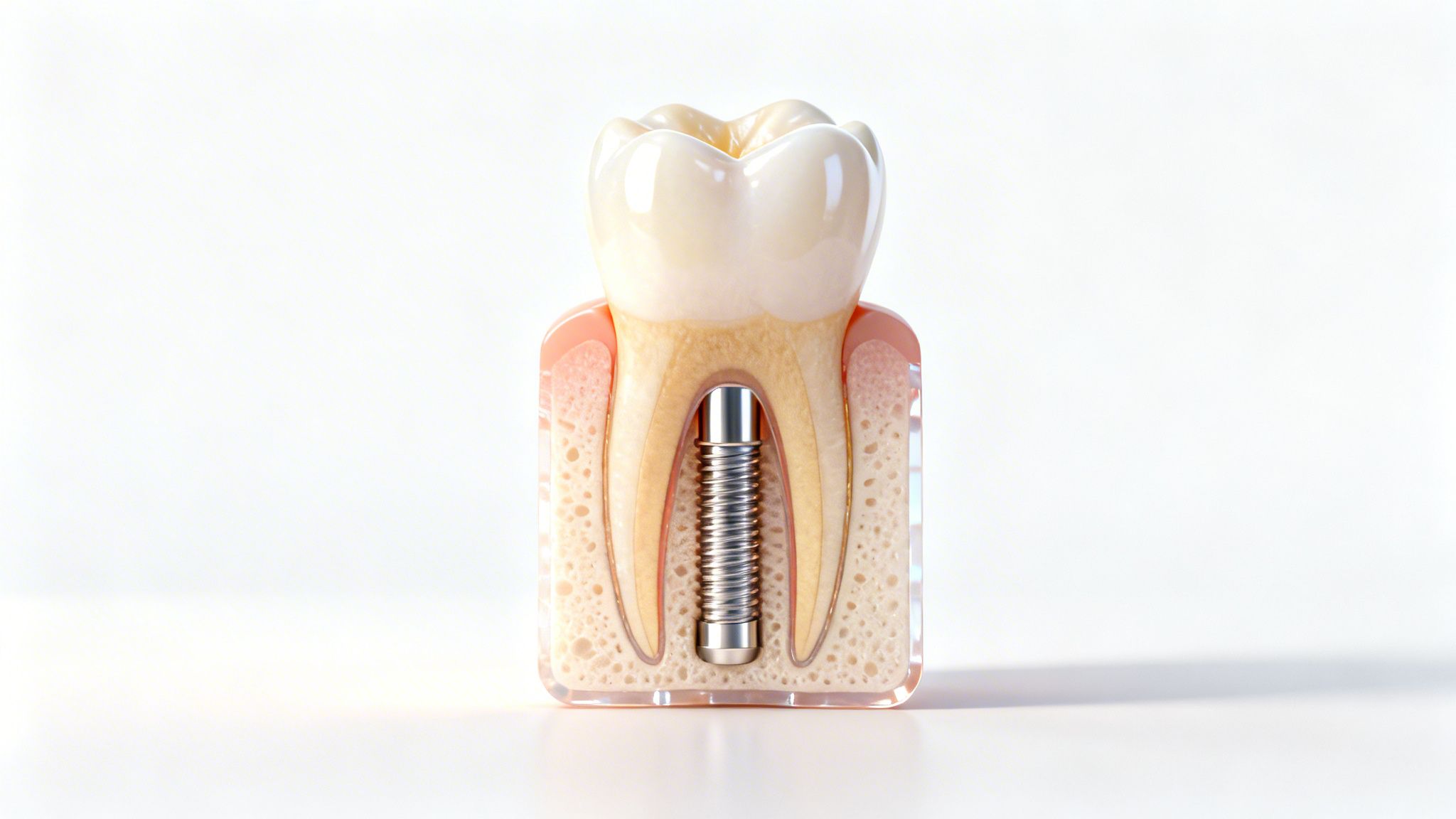
Think of a post and crown as a reinforcement system for a tooth that's become too weak to stand on its own. After a root canal, the tooth’s nerve and blood supply are gone, and a lot of its internal structure has been removed. This leaves the tooth hollow and brittle—too fragile to simply place a crown on top.
The Role Of The Post And Core
This is where the post and core system comes in to rebuild the tooth from the inside out, making it strong enough to support a final crown. This is a common part of restorative dentistry that helps you keep your natural tooth.
The Post: First, a tiny rod made of metal or a strong fiber is inserted and bonded deep inside the cleaned-out root canal. It acts like rebar in concrete, creating an internal anchor that provides strength and stability from within the root.
The Core: Next, a durable, tooth-like material is packed around the top of the post. This "core buildup" reconstructs the body of the tooth, creating a solid foundation for the new crown to grip onto.
Once the core is in place, we can fit a custom-made crown over it. The crown is what everyone sees, restoring the tooth’s natural shape, function, and appearance. It also protects the weakened tooth underneath from further damage.
Benefits of a Post and Crown
Choosing a post and crown helps preserve what you already have, improving your overall mouth health and relieving pain from a damaged tooth.
- Preserves Natural Tooth: Keeps your original tooth root in place, which helps maintain jawbone and gum tissue.
- Restores Function: Allows you to chew and speak normally again.
- Less Invasive: The procedure is non-surgical and works with your existing tooth structure.
When Is a Post and Crown the Right Choice?
A post and crown is an excellent solution, but it's not right for every situation. In our Bellaire practice, Dr. Boren will only recommend this procedure after a thorough new patient exam and detailed dental x-rays confirm a few key things.
The decision to use a post and crown depends entirely on the health of the remaining tooth root. The root must be free of fractures and have sufficient length and thickness to securely hold the post and withstand chewing forces.
This procedure is the ideal solution for our patients when:
- The tooth has already had a successful root canal.
- More than 50% of the original tooth structure is missing, leaving too little to support a crown alone.
- There's a healthy, solid rim of tooth structure above the gum line for the crown to wrap around, which dramatically increases long-term success.
In short, a post and crown allows our patients in Bellaire and West University to hold onto their natural tooth root. However, if the root itself is cracked or too decayed, an emergency dentist may recommend a tooth extraction, making a dental implant the more predictable and durable long-term solution.
Understanding Dental Implants: The Gold Standard Solution
While a post and crown is designed to save a natural tooth, a dental implant is the definitive answer when a tooth is already gone or simply can't be salvaged. It's widely considered the gold standard for tooth replacement because it mimics a natural tooth from root to crown, offering unmatched stability and longevity. This cosmetic dentistry solution provides a beautiful and functional result.
Unlike a post and crown, which needs an existing tooth root, a dental implant creates an entirely new foundation. The process starts with the surgical placement of a small, biocompatible titanium post directly into your jawbone where the tooth is missing. This post serves as the new, artificial root.
The Science Of Osseointegration: How Dental Implants Work
What happens next is a remarkable biological process called osseointegration. Over the following months, the living bone in your jaw fuses with the titanium implant post, creating an incredibly strong, durable bond that makes the implant a permanent part of your body. This fusion is what allows dental implants to feel and function just like natural teeth.
This is the most critical difference in the post and crown vs implant debate. This fusion with the bone provides a level of stability that no other tooth replacement can replicate. It is vital for preventing bone loss and preserving your facial structure.
Once osseointegration is complete and the foundation is rock-solid, the final restoration is a two-step process:
- Abutment Placement: A small connector, known as an abutment, is attached to the implant post. This piece sits at the gum line and serves as the secure docking point for your new tooth.
- Crown Attachment: Finally, a beautiful, custom-milled dental crown is permanently secured to the abutment. We meticulously design this crown to match the color, shape, and size of your other teeth, ensuring it blends seamlessly with your smile.
For our patients looking for "dental implants near me" in Bellaire, this complete tooth replacement offers a permanent solution that restores not just your smile, but your full chewing function and confidence. If you're weighing the financial side, our guide on what to expect for dental implant costs can provide valuable clarity.
Benefits of Dental Implants
Choosing a dental implant is an investment in your oral health for decades to come, improving your mouth health and overall quality of life.
- Prevents Bone Loss: The implant stimulates the jawbone like a natural root, preventing the bone deterioration that occurs when a tooth is lost.
- Cavity-Proof: The implant itself is made of titanium and is completely immune to cavities.
- Looks and Feels Natural: Dental implants are designed to be indistinguishable from your natural teeth, restoring a bright and healthy smile.
- Highly Durable: With proper care, dental implants can last a lifetime, making them a predictable and worry-free solution.
When you need a trusted cosmetic dentist in Bellaire, TX, for this precise work, Dr. Boren's expertise ensures an outcome that is both beautiful and built to last.
How To Choose The Right Option For Your Smile
The decision between a post-and-crown and a dental implant boils down to a single, critical question: can we reliably save your natural tooth? The answer sets the course for your treatment. At our Bellaire dental office, Dr. Boren’s recommendation is always grounded in a careful, evidence-based assessment of your tooth's health and its chances for long-term survival.
A post-and-crown is a conservative treatment designed to preserve your natural tooth root after a root canal. It's the best option when enough healthy tooth structure remains. Think of it as reinforcing what you already have.
A dental implant is the definitive solution when a tooth is already gone, broken below the gumline, or too compromised to save. This modern approach replaces the entire tooth from the root up, but it requires enough healthy jawbone for a stable foundation.
Assessing Your Candidacy
Dr. Boren uses advanced digital imaging to get a precise look at your tooth and the surrounding jawbone. This gives us the data we need to offer a clear, practical recommendation that fits your specific oral health situation and what you want for your smile long-term.
To help simplify things, here are the primary factors and ideal scenarios for each treatment.
Decision Factors: Post And Crown Vs. Implant
This table outlines the primary considerations and ideal scenarios for each treatment to guide your decision-making process at our Bellaire, TX practice.
| Decision Factor | Ideal for Post And Crown | Ideal for Dental Implant |
|---|---|---|
| Tooth Status | Your tooth is present but weakened by a root canal. | Your tooth is missing or needs extraction. |
| Root Health | The natural root is healthy, intact, and free of fractures. | The natural root is gone, fractured, or too damaged. |
| Bone Condition | Jawbone health is not a primary concern since the natural root is used. | You need adequate jawbone density and volume for support. |
| Goal | The main goal is to preserve your natural tooth and its root. | The goal is to build a completely new, independent tooth. |
| Longevity | Its lifespan is tied to the health of the underlying natural tooth. | It's designed as a permanent solution that can last for decades. |
While this table offers a solid overview, the final decision always comes down to the unique details of your case, which Dr. Boren will discuss with you.
The Implant Process: A Visual Guide
The journey to getting a new, permanent tooth with a dental implant is a multi-stage process designed for maximum strength and stability. This guide breaks down the main phases: placing the implant, healing the bone, and attaching the final crown.
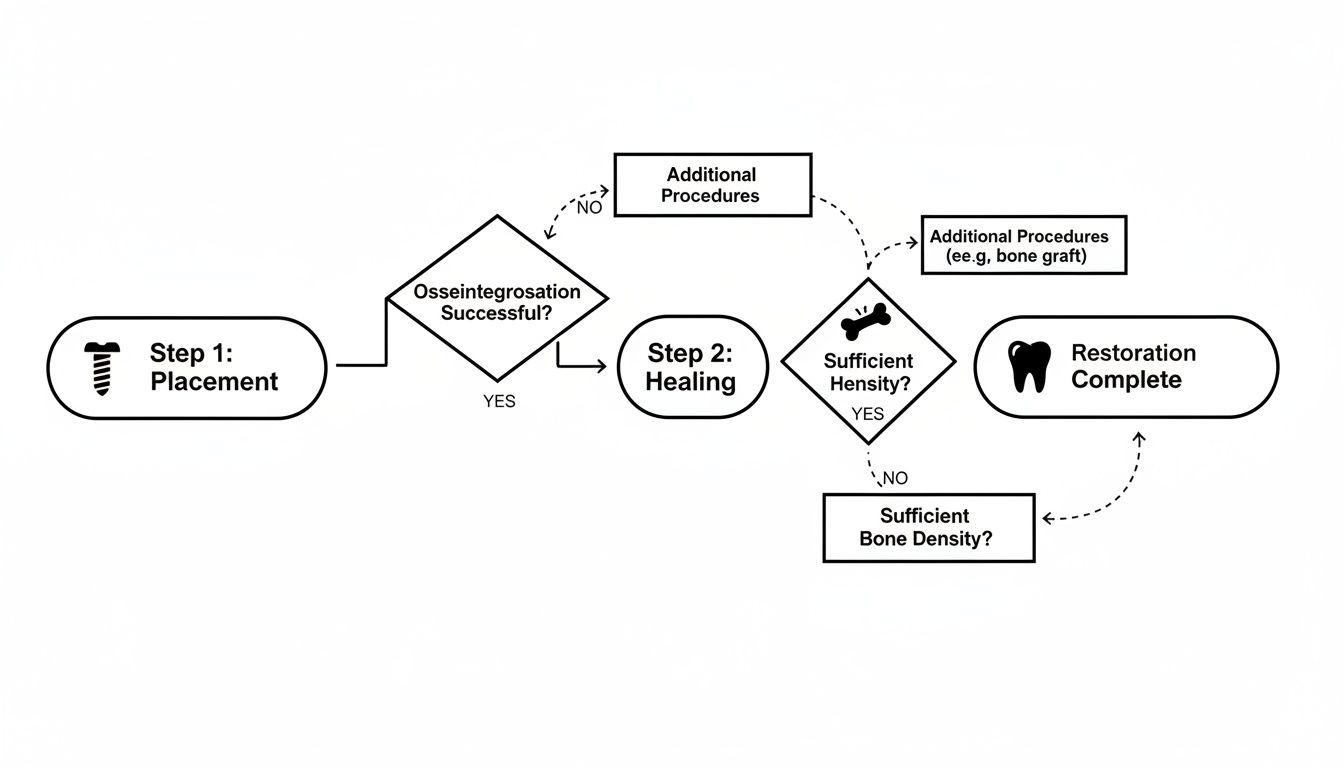
This flowchart shows how the implant becomes a permanent part of your jaw before the visible tooth is attached, ensuring a foundation that's truly built to last.
The Critical Role Of The Crown-To-Root Ratio
One important technical factor we consider is the crown-to-root ratio. This compares how much of the tooth is visible above the gumline to how much is anchored in the bone. With natural teeth, a high ratio—a large crown on a short root—creates dangerous leverage that often leads to fractures. This is a major limitation for post-and-crown restorations.
Dental implants, however, completely change this equation. Their ability to succeed even with a poor crown-to-root ratio is a major advantage, making them a much more predictable choice in many complex situations.
One key study drives this point home. It looked at 309 single-tooth implants with an average crown-to-implant ratio of 2:1—a proportion where natural teeth would almost certainly fail. Amazingly, the implants showed no significant bone loss over a five-year period. This resilience is in sharp contrast to post-and-crown teeth, where those same forces dramatically increase the risk of fracture. You can read more about how implants succeed with less root than crown in the detailed research findings.
This is why an implant is often the more durable long-term solution. When you need an emergency dentist in Bellaire for a failing tooth, Dr. Boren's expert evaluation will determine if this superior stability makes an implant the right choice for you.
Comparing Long-Term Success And Durability
When you decide to restore a damaged tooth, one of the most important questions is: how long will it last? You're investing in your health and your smile, so you want a solution that stands the test of time. For our Bellaire patients, understanding the long-term durability of a post-and-crown versus a dental implant is a critical part of making a confident choice.
The lifespan of a post-and-crown is completely tied to the health of the natural tooth it’s built upon. While it’s a great way to salvage a tooth, that original root structure remains the weak link. It’s still vulnerable to future problems, like decay around the crown’s edge or, more seriously, a fracture in the root itself. These are the most common reasons a post-and-crown eventually fails.
A dental implant, on the other hand, is engineered from the ground up for permanence. Crafted from biocompatible titanium, the implant post is completely immune to cavities. It physically fuses with your jawbone, creating a new, rock-solid foundation that is designed to last a lifetime with proper dental care.
Success Rates Backed By Data
The clinical evidence consistently points to dental implants as the superior choice for long-term survival. Comprehensive scientific reviews show that dental implants have a survival rate of over 99% per year, with minimal bone changes over time.
In stark contrast, studies analyzing teeth restored with a post, core, and crown find success rates that can fall as low as 68% to 85%. The data is clear: for patients weighing their options, single-tooth implants outperform endodontically treated teeth in both survival and long-term success.
This difference is why we so often see patients at our Bellaire practice choose "dental implants near me" for their sheer predictability. A well-placed implant boasts a 95-98% five-year success rate, far surpassing the longevity of other restorative methods.
Factors That Influence Longevity
Several key factors determine how long your restoration will really last. Thinking through them can help clarify why one option might be a better fit for your situation.
- Foundation Integrity: A post-and-crown depends on your natural tooth root. If that root ever cracks or gets new decay, the whole restoration is compromised. An implant’s foundation is the jawbone itself—a far more stable and predictable base.
- Material Strength: While modern porcelain crowns are incredibly tough, the natural tooth beneath them will always be the potential point of failure. A titanium implant post is exceptionally resistant to fracture and is completely cavity-proof.
- Maintenance Needs: Both options demand excellent oral hygiene, including regular cleaning and exams. However, a post-and-crown requires you to be extra diligent about cleaning the gum line to prevent decay on the exposed root surface. Implants need good gum care, but the risk of failure from decay is zero.
For our patients in Bellaire, TX, who are looking for a definitive, 'set it and forget it' solution, the superior durability of a dental implant is a powerful advantage. It provides peace of mind that is hard to put a price on.
Ultimately, when you're looking for a reliable "dentist near me" to discuss tooth replacement, Dr. Boren's focus is on providing a solution that delivers lasting, predictable results. The remarkable durability and high success rates of dental implants make them a dependable investment in the future of your smile.
Your Patient Experience At Our Bellaire Dental Practice

At the practice of Charles E. Boren, DDS, we believe that making a big dental decision should feel empowering, not overwhelming. From the moment you call our Bellaire office, you’ll notice our entire focus is on you—your concerns, your comfort, and your goals for a healthy smile.
We know that choices like a post and crown vs implant can feel complicated. That’s why we’ve built a practice where you can feel at ease, heard, and respected. We’re proud to be the trusted "dentist in Bellaire, TX" for families across our community and West University, and we treat every person who walks through our doors like a neighbor.
What To Expect During Your Consultation
Your first visit is a conversation, not a lecture. Dr. Boren will start with a thorough new patient exam, using advanced tools like digital dental X-rays to get a crystal-clear picture of your oral health. Most importantly, he listens. He’ll take the time to hear your concerns and explain his findings in a way that makes sense.
During your appointment at our Bellaire practice, you can expect:
- Comprehensive Evaluation: We’ll look at everything—the health of the tooth in question, your gums, and the surrounding jawbone—to determine which restorative option truly fits your unique situation.
- Personalized Treatment Plan: Dr. Boren will explain the real-world pros and cons of each procedure as they apply to you, giving you all the information you need to make a choice you feel great about.
- Clear Financial Discussion: No surprises here. Our team will provide a transparent cost breakdown and go over your insurance benefits with you, helping you plan your dental care with total clarity.
A Commitment To Your Comfort And Trust
We get it. Dental anxiety is real for many of our patients, and we’ve designed every part of our practice with your comfort in mind.
Your peace of mind is our top priority. For patients who feel anxious, we proudly offer sedation dentistry options to ensure your treatment is a completely calm and stress-free experience from start to finish.
This patient-first mindset is the bedrock of our practice. Beyond clinical skill, our commitment to earning your trust is why we also focus on effective dentist reputation management, ensuring what people find online is a true reflection of the care we provide. We want you to feel confident in our restorative dentistry and in the compassionate support you receive every step of the way.
Frequently Asked Questions About Tooth Restoration
When you’re faced with restoring a damaged tooth, it’s natural to have questions. Choosing between a post and crown or a dental implant is a significant decision, and we want you to feel completely confident. We’ve compiled answers to the most common concerns we hear from our Bellaire patients to help you prepare for your consultation with Dr. Boren.
Which Procedure Is More Painful?
This is often the first question on a patient's mind, and the answer is reassuring. Thanks to effective local anesthesia, both procedures are performed with your comfort as the top priority. We ensure you are completely numb and at ease before we begin, so you shouldn't feel pain during the treatment itself.
Post-procedure discomfort is also very manageable. Most patients compare the mild soreness after an implant placement to what you'd feel after a simple tooth extraction, which is easily handled with over-the-counter pain relievers. Since a post and crown is done on a tooth that has already had a root canal, the nerve is gone, making the procedure itself quite comfortable. And for anyone feeling anxious, we offer safe and effective sedation dentistry options to ensure a calm and relaxed experience.
How Do The Costs And Timelines Compare?
The initial investment and the time commitment for these two restorations are quite different, which is a major factor for many patients.
- Post and Crown: This approach is generally faster and involves a lower upfront cost. The entire process, from preparing the tooth to seating the final crown, can often be wrapped up in just a few weeks.
- Dental Implant: A dental implant requires a larger initial investment and a longer timeline. It typically takes 3-6 months for the implant post to fully integrate with the jawbone before the final, permanent crown can be attached.
Although a dental implant has a higher upfront cost, its exceptional durability often makes it more cost-effective over a lifetime. Because implants are immune to decay and designed for permanence, they help you avoid the potential costs of replacing a failing post and crown in the future.
Do I Have Enough Bone For A Dental Implant?
This is a critical question, as the success of a dental implant hinges on having a solid foundation. An implant needs adequate jawbone density and volume to lock securely in place. When a tooth has been missing for some time, the bone in that area naturally begins to shrink.
However, having bone loss doesn't automatically mean an implant is off the table. If you don't have enough bone, a bone grafting procedure may be the perfect solution. This is a safe and predictable treatment that rebuilds the bone structure, creating the solid support needed for long-term implant success. During your new patient exam, Dr. Boren will use advanced 3D imaging to precisely measure your bone and map out the best course of action for a predictable, lasting result.
Ready to explore the best solution for your smile and find a "dentist in Bellaire, TX" you can trust? At Charles E. Boren, DDS, we provide personalized, data-driven recommendations to help you make a confident decision. Schedule your consultation with Dr. Boren in Bellaire today to find out which restorative option is right for you.