
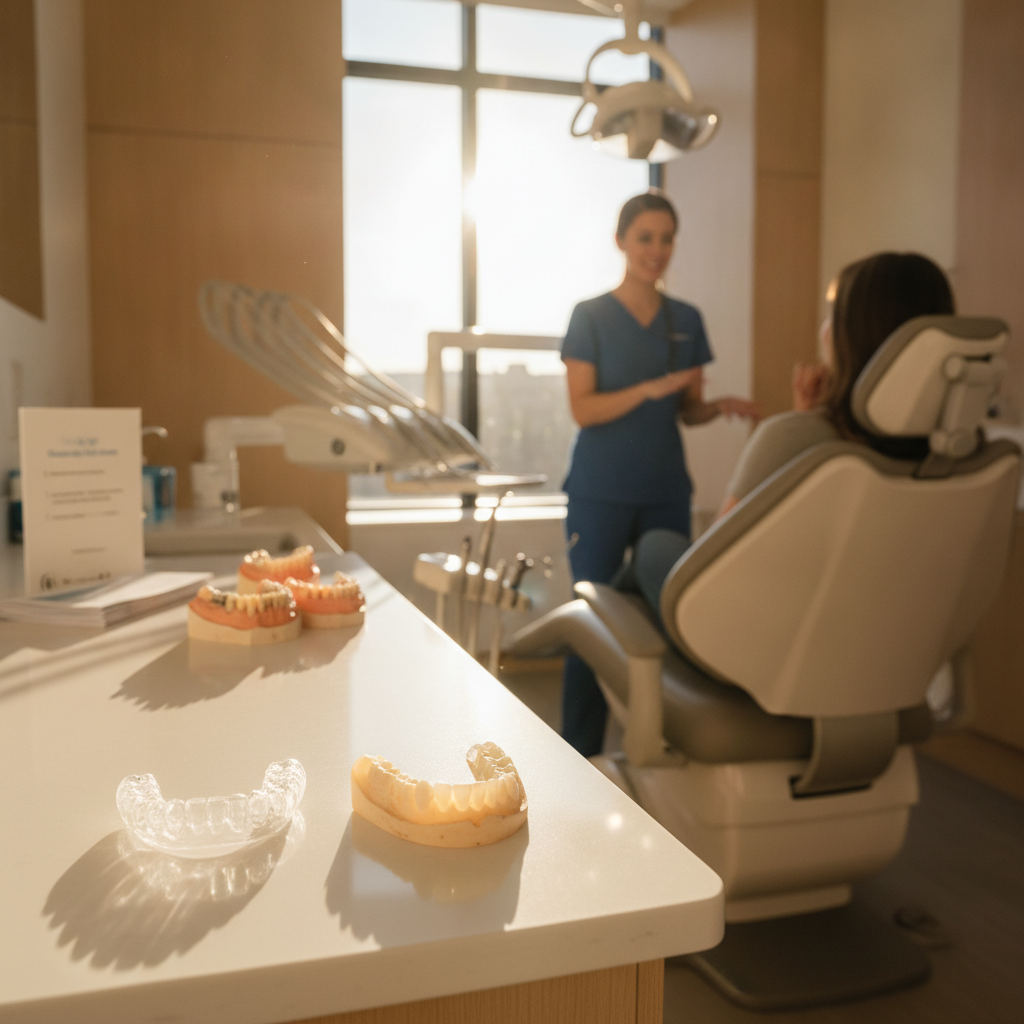
What Is a Night Guard for Teeth Grinding — and Are Bellaire Patients Getting the Right Kind or Just Any Kind?
If you grind your teeth at night, you probably already know a night guard exists — but there’s a good chance no one has explained why the one you bought at the pharmacy may not actually be protecting you. For patients in Bellaire, West University Place, and the surrounding Houston neighborhoods, teeth grinding (the clinical term is bruxism) is one of the most underdiagnosed and undertreated sources of long-term dental damage. And the difference between the right guard and any guard can be thousands of dollars in restorative work down the road.
- What Teeth Grinding Actually Does to Your Mouth Over Time
- Why a Store-Bought Guard Often Isn't Enough
- What a Custom-Fitted Night Guard Actually Does Differently
- When Grinding Is About More Than Just Stress
- What Grinding Looks Like for Different Patients
- How to Know If You Need a Guard — or Something More
- Frequently Asked Questions About Night Guards in Bellaire
- Ready to Find Out What Your Teeth Actually Need?
What Teeth Grinding Actually Does to Your Mouth Over Time
Most people who grind their teeth have no idea they’re doing it. It happens during sleep — sometimes so quietly that a partner never notices — and the damage builds slowly over months and years. What you might notice first is that your teeth look flatter than they used to, or that your back molars have developed small cracks or chips. You might wake up with a tight, sore jaw or a dull headache that seems to live behind your eyes and temples.
Left unaddressed, grinding wears down the enamel in ways that can’t be reversed. It can also fracture teeth that were otherwise healthy, loosen existing dental work like crowns and fillings, and put sustained pressure on the jaw joint in ways that lead to more serious TMJ problems. The frustrating part is that by the time the damage becomes obvious on an X-ray or in the mirror, it’s already significant.
This is one reason why regular dental visits matter — a dentist can spot the early signs of grinding long before you’d notice them yourself. If you’ve been putting off establishing care with a local practice, it’s worth knowing what’s quietly happening between appointments.
Why a Store-Bought Guard Often Isn’t Enough
Walk into any pharmacy and you’ll find boil-and-bite guards that cost anywhere from $15 to $50. They’re soft, pliable, and designed to fit a generic mouth shape. For occasional mild grinding, they might offer some cushioning. But for most people who actually have a significant bruxism habit, they create as many problems as they solve.
Here’s the thing: a soft, squishy guard often gives your jaw muscles something to bite into — and that can actually encourage more grinding, not less. It’s counterintuitive, but the comfort of a soft guard can trigger the chewing reflex and make the habit worse over a night. They also tend to fit loosely, which means they move around, don’t protect evenly, and often end up on the nightstand by 2 a.m.
More importantly, a store-bought guard doesn’t account for your specific bite. If your upper and lower teeth don’t meet symmetrically on the guard surface, you may be putting uneven pressure on your jaw joint — which is exactly what contributes to TMJ discomfort and morning headaches.
What a Custom-Fitted Night Guard Actually Does Differently
A custom night guard starts with precise impressions of your teeth — either traditional molds or a digital scan, depending on the practice. Those impressions go to a dental lab where the guard is fabricated specifically to your bite. The result fits snugly, stays in place through the night, and is designed so that when your upper and lower teeth contact the guard surface, the pressure is distributed evenly across your entire bite.
Depending on how severe your grinding is, the material and thickness will vary. Some patients do well with a hard acrylic guard. Others — particularly those with significant TMJ involvement — may need something with a different design that positions the jaw slightly forward or redistributes bite forces in a specific way. This is where a dentist’s evaluation matters: there’s no single guard that’s right for every grinding patient, and the right recommendation depends on what’s actually driving the habit.
Custom guards typically range in cost, and many dental insurance plans cover at least a portion of the fabrication as a preventive or restorative benefit. It’s worth asking your dental office to check your coverage before assuming it’s fully out-of-pocket.
When Grinding Is About More Than Just Stress
This is the angle that most local dental websites don’t address clearly enough — and it matters. Bruxism isn’t always just a stress response. In a meaningful number of patients, nighttime teeth grinding is connected to airway issues, including obstructive sleep apnea. When the airway becomes partially blocked during sleep, the body sometimes responds by clenching or grinding the teeth as a way of stimulating the jaw muscles and reopening the airway. If your grinding is persistent, happens even during periods when you’re not particularly stressed, and comes with symptoms like daytime fatigue or waking up unrefreshed, that’s worth a conversation with your dentist.
At our Bellaire practice, we look at grinding in context — including whether there are signs of airway involvement or TMJ dysfunction that go beyond a simple protective guard. For some patients, an oral appliance that also addresses jaw position may accomplish more than a standard night guard alone. Learn more about the full range of services available at our practice.
What Grinding Looks Like for Different Patients
Bruxism doesn’t look the same across every age group or lifestyle, and patients in Bellaire and Meyerland often come in with very different presentations:
- Younger adults and professionals under significant work stress often clench more than grind — meaning they hold jaw tension without the back-and-forth movement, which can be harder to detect but still damaging.
- Middle-aged patients sometimes discover grinding only when a dentist points out wear patterns they hadn’t noticed themselves — often after years of undetected damage.
- Patients with existing TMJ symptoms may find that grinding is both a cause and a consequence of jaw joint irritation, making the two problems reinforce each other.
- Patients who already have veneers or crowns face higher stakes — grinding can crack or dislodge cosmetic and restorative work that represents significant investment, and a well-fitted guard is often essential maintenance.
How to Know If You Need a Guard — or Something More
A good starting point is to pay attention to how you feel in the morning. Jaw soreness, tired facial muscles, or teeth that feel sensitive first thing are all signs worth mentioning at your next cleaning. So is noticing that your teeth look shorter or flatter in photos than they did a few years ago.
If you’re already wearing a store-bought guard and still waking up with discomfort, that’s a signal that what you have isn’t doing the job. And if you’ve been told by a previous dentist that you grind but never received a custom guard, it may be time to follow through — especially if you’ve had any restorative or cosmetic work that deserves protection.
Patients from West University Place and Southside Place who come to our Bellaire office often tell us they assumed grinding was just something they had to live with, or that any guard was good enough. Neither of those things is true. Dr. Boren has been helping patients in this neighborhood manage bruxism and jaw health for decades — the conversation is always worth having.
Frequently Asked Questions About Night Guards in Bellaire
Does a night guard actually stop grinding, or does it just protect the teeth?
Mostly the latter — a night guard doesn’t cure the grinding habit, but it creates a protective barrier so that the force is absorbed by the guard rather than your enamel and jaw joint. Some patients find that a properly fitted guard also reduces clenching intensity over time, but it’s primarily a protective device rather than a behavioral treatment.
How long does a custom night guard last?
For most patients, a well-made custom guard lasts two to five years with regular use and proper care. Heavy grinders may wear through one sooner. Rinsing it after each use and keeping it in a ventilated case helps significantly. Your dentist can check its condition at your regular visits.
Will my insurance cover a custom night guard?
Many dental plans do cover a portion of the cost, especially when grinding is documented and medically necessary. Coverage varies widely by plan. It’s worth asking your dental office to check before you assume it’s not covered — many patients are surprised to find they have a benefit they weren’t using.
I grind during the day too, not just at night. What helps with that?
Daytime clenching is common, especially for people in high-stress professions. Awareness exercises, stress management, and sometimes physical therapy for the jaw muscles are helpful. A dentist can also evaluate whether your bite needs any adjustment that may be contributing to the daytime habit. A night guard won’t be worn during the day, but addressing the overall bite and jaw health can reduce both nighttime and daytime tension.
Can a child wear a night guard?
Children do grind their teeth, particularly during developmental phases. Custom guards for kids require more frequent replacement as the mouth grows, so the recommendation depends on the child’s age and the severity of the grinding. Most pediatric grinding resolves on its own, but if it’s affecting teeth or causing discomfort, it’s worth discussing with your family dentist.
Ready to Find Out What Your Teeth Actually Need?
If you’ve been waking up sore, noticing wear on your teeth, or just wondering whether that drugstore guard is really doing anything, the most useful next step is a straightforward conversation with a dentist who can actually look at your bite and give you a real answer. At Charles E. Boren D.D.S., P.C. in Bellaire, we take the time to understand what’s behind your symptoms — not just hand you a generic solution. Reach out to schedule a visit or ask a question — there’s no pressure, just an honest evaluation of what your teeth need and what the best options are for you.