
What Is a Dental Implant Crown — and How Is It Different From a Regular Crown in Bellaire?
If your dentist has recommended a crown, or if you’re exploring options for a missing tooth, you’ve probably encountered two terms that sound similar but describe very different things: an implant crown and a traditional dental crown. In Bellaire and the surrounding Houston neighborhoods, patients ask about this distinction more often than you might expect — and understandably so, because the terminology can be genuinely confusing. Both involve a porcelain cap that looks like a tooth. But what’s underneath that cap, and how it got there, are completely different stories.
Here’s what you actually need to know — explained plainly, without the clinical runaround.
- The Basic Difference: What's Supporting the Crown?
- Why Does That Difference Matter for You?
- What the Crown Itself Is Actually Made Of
- The Gap Most Dental Websites Don't Address: Timing and What Happens In Between
- When a Traditional Crown Is the Right Call — and When It Isn't
- What Does an Implant Crown Actually Cost in the Bellaire Area?
- Frequently Asked Questions
- Ready to Talk Through Your Options?
The Basic Difference: What’s Supporting the Crown?
A traditional dental crown is a cap placed over a natural tooth that’s still in your jaw. The tooth has to be reshaped — filed down — so the crown fits snugly on top. The natural root stays in place. The crown protects what’s left of the tooth above the gumline. This is the right option when a tooth is cracked, badly decayed, or has had a root canal and needs structural reinforcement.
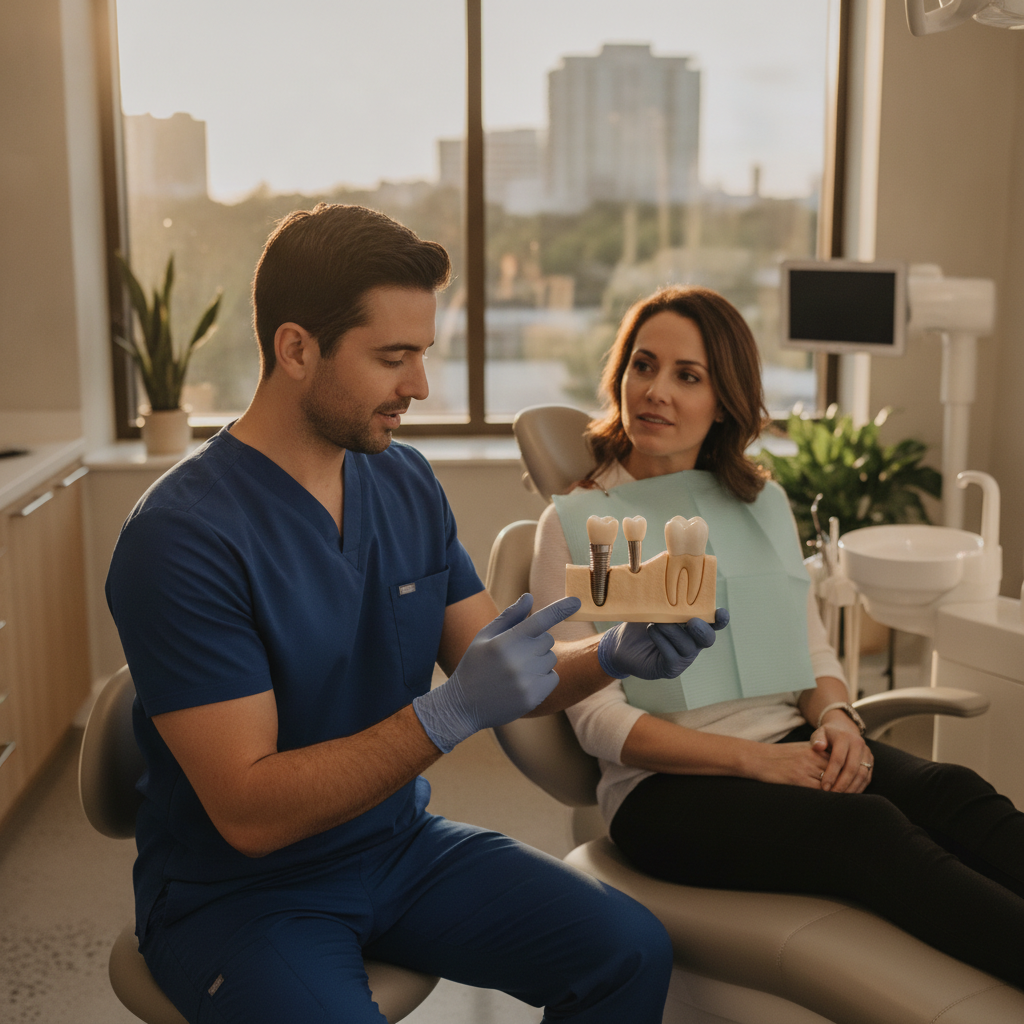
An implant crown is a cap placed on top of a titanium post that was surgically inserted into your jawbone. There’s no natural tooth underneath it at all — the tooth was either lost or extracted. The titanium implant acts as an artificial root. Once it fuses with the bone (a process called osseointegration), a connector piece called an abutment is attached, and then the crown goes on top of that.
Same-looking end result. Completely different foundation.
Why Does That Difference Matter for You?
It matters quite a bit, both in terms of what the process looks like and what you can expect long-term.
With a traditional crown, the timeline is relatively short. If you come in, we prepare the tooth, take impressions or digital scans, place a temporary crown, and fit the permanent crown a couple of weeks later. In some cases it can even be done more quickly. The whole thing is usually finished within a few appointments.
With an implant crown, you’re looking at a longer process — typically several months from start to finish. Here’s a simplified version of what that looks like:
- Evaluation and planning: X-rays, sometimes a cone-beam CT scan, to assess bone density and positioning. Not everyone is an immediate candidate — bone volume matters.
- Implant placement: The titanium post is placed surgically into the jaw. This is usually done under local anesthesia, and many patients tolerate it better than they expect.
- Healing period: The implant needs time to fuse with the bone — typically three to six months, though this varies by individual.
- Abutment and crown placement: Once the implant has integrated, the abutment is attached, impressions are taken, and the final crown is fabricated and placed.
So while a traditional crown might take a few weeks from consultation to completion, an implant restoration is a multi-month commitment. That’s not a drawback — it’s just what a properly done implant requires. Rushing osseointegration isn’t possible, and any practice that suggests otherwise deserves a second look.
What the Crown Itself Is Actually Made Of
Here’s one area where the two paths actually converge: the crown that goes on top — whether it’s sitting on a natural tooth or an implant post — is often made from the same materials. At our Bellaire practice, we use all-porcelain crowns that are designed to match the color, shape, and translucency of your surrounding teeth. They look natural. They don’t have the dark metal line at the gumline you might remember from older crowns.
For implant crowns specifically, the crown may be attached to the abutment in one of two ways — cemented in place (like a regular crown) or screw-retained from the inside. The method your dentist uses depends on the position of the tooth in your mouth and other clinical factors. Either way, you wouldn’t notice a difference from looking at it.
The Gap Most Dental Websites Don’t Address: Timing and What Happens In Between
One thing that’s genuinely underexplained across many dental websites — including several practices competing in this part of Houston — is what happens to patients during the healing period between implant placement and final crown delivery. That gap can be months long. Are you walking around with a visible gap? A temporary tooth? Something else?
The honest answer is: it depends on where the tooth is. For a missing back molar, the gap may not be visible at all and most patients simply leave it as-is during healing. For a front tooth, a temporary flipper (a removable partial) or a temporary crown can be placed so you’re not uncomfortable socially or professionally during the healing phase.
This is worth discussing at your consultation. If you’re a patient in West University Place or Meyerland and you have a visible gap you’re self-conscious about, ask specifically about what your provisional option looks like. A good dentist will factor your comfort and daily life into the treatment plan, not just the clinical steps.
When a Traditional Crown Is the Right Call — and When It Isn’t
A traditional crown makes sense when you still have a viable natural tooth root. If the tooth above the gumline is compromised — badly cracked, severely decayed, or weakened after a root canal — but the root is healthy and stable in the bone, there’s no reason to extract it. Protecting and preserving that tooth with a crown is almost always the better choice.
An implant becomes the conversation when the tooth is already gone, or when it’s so damaged at the root level that saving it isn’t realistic. In those cases, an implant crown is the closest thing dentistry has to replacing a tooth the way nature built one — root and all. The full range of restorative options available at our practice is designed to meet patients wherever they are in that spectrum.
What you want to avoid is letting a gap sit untreated for years. When a tooth is missing, the bone in that area gradually shrinks — a process called resorption. The longer you wait, the more bone you lose, and the more complex (and potentially costly) an implant placement becomes. In some cases, a bone graft becomes necessary to restore enough volume for an implant to succeed.
What Does an Implant Crown Actually Cost in the Bellaire Area?
This is one of the most searched questions locally, and it deserves a straight answer: implant restorations are a more significant investment than traditional crowns, and the total cost covers multiple components — the implant post itself, the abutment, and the crown. Insurance coverage for implants varies considerably. Some plans cover a portion of the crown but not the implant itself; others exclude implants entirely.
We work with patients on financing options including CareCredit, which can spread the cost over time in a way that makes a longer-term investment more manageable. What we won’t do is pressure you into a treatment plan that doesn’t fit your situation. If a bridge or another option is more practical for you right now, we’ll talk through that honestly.
Frequently Asked Questions
Can an implant crown ever fall off or come loose?
It’s uncommon, but it can happen — particularly if the crown is cemented rather than screw-retained. If you notice any movement or feel something change with a crown, come in as soon as you can. It’s almost always an easy fix when caught early.
Does getting an implant hurt more than a regular crown?
The implant placement surgery is done under local anesthesia, and most patients are surprised by how manageable the discomfort is afterward. It’s often compared to having a tooth extracted — a few days of soreness, then you’re fine. The crown placement itself is no more involved than a traditional crown procedure.
How long does an implant crown last compared to a regular crown?
A well-maintained implant crown can last 15 to 25 years or longer — often indefinitely. Traditional crowns typically last 10 to 15 years before needing replacement. Both depend heavily on your oral hygiene habits and whether you grind your teeth.
Can I get an implant crown if I’ve been missing a tooth for years?
Possibly, but it depends on how much bone has been preserved. A thorough evaluation — including imaging — will tell us whether you have enough bone volume for an implant or whether a bone graft would be needed first. Don’t let the uncertainty stop you from at least having the conversation.
Is an implant crown the same as a full dental implant?
The term “dental implant” can refer to the whole system (post, abutment, and crown) or just the titanium post itself depending on who’s using it. When a dentist quotes you for a dental implant, ask them to clarify what’s included — some quotes cover all three components; others break them out separately.
Ready to Talk Through Your Options?
Whether you’re missing a tooth, dealing with a damaged one, or just trying to understand what a previous dentist recommended, you deserve a clear conversation — not a sales pitch. Dr. Boren has been serving patients in Bellaire and the surrounding Houston area for decades, and his approach hasn’t changed: take the time to explain your options, answer every question, and let you decide what makes sense for your life and your health.
If you’d like to schedule a consultation, reach out to our office and we’ll find a time that works for you. There’s no pressure, no commitment, and no rush. Just a conversation about your teeth and what’s possible.