
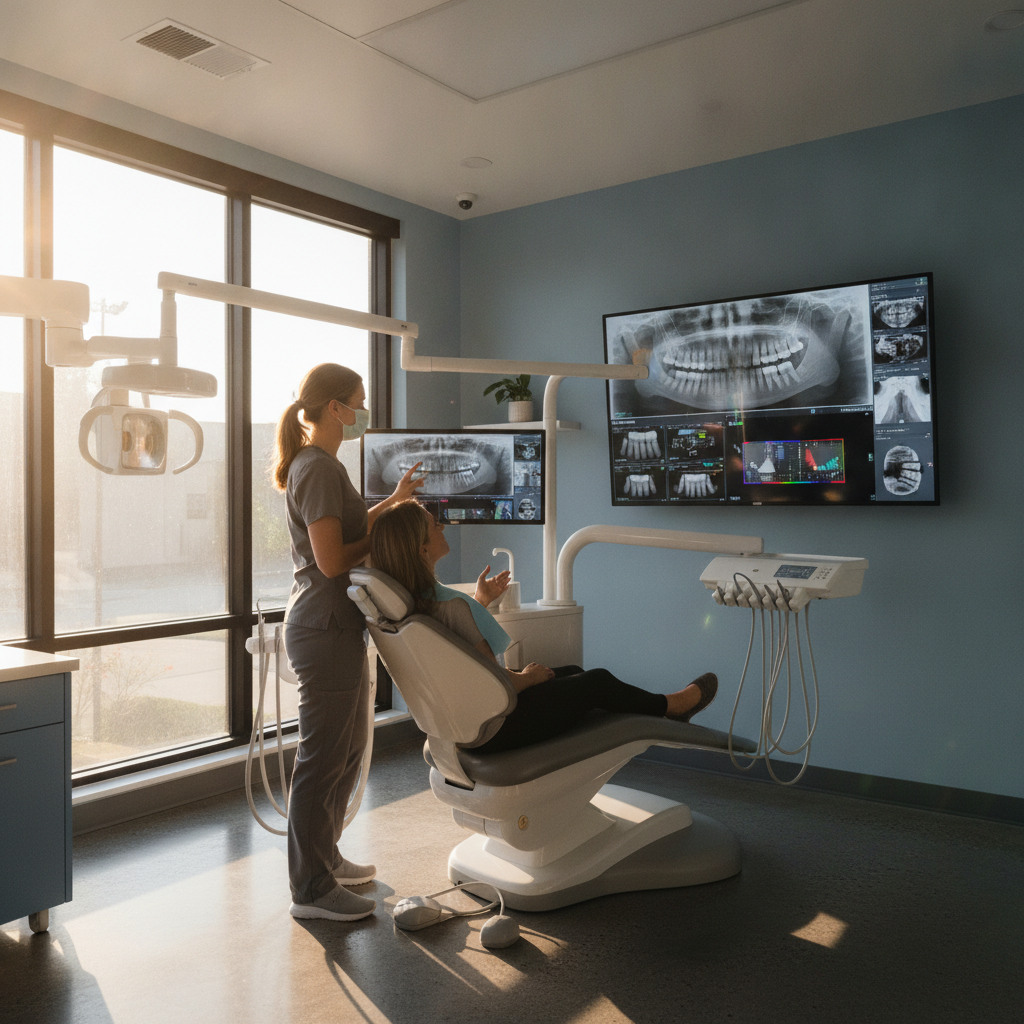
What Is a Dental X-Ray in 2025 — and Are Bellaire Patients Getting the Right Kind for Their Situation?
Dental X-rays are one of the most misunderstood parts of a routine dental visit. Patients in Bellaire and across the Houston area sometimes wonder why they’re needed at all, how often is really necessary, or whether the radiation is something to worry about. The honest answer is that modern dental imaging has changed dramatically — and the right X-ray at the right time can catch problems early enough to save you from much more complicated (and expensive) treatment later. But not every patient needs the same images, and a good dentist will explain exactly what they’re looking for and why before recommending any imaging.
- The Different Types of Dental X-Rays — and What Each One Actually Shows
- How Much Radiation Are We Actually Talking About?
- What a Gap in Competitor Content Reveals: Nobody Is Explaining Frequency Decisions
- What New Patients in Bellaire Should Expect at a First Visit
- When X-Rays Become Part of a Bigger Treatment Conversation
- Frequently Asked Questions About Dental X-Rays Near Bellaire
- Ready to Talk Through Your Dental Imaging Needs?
The Different Types of Dental X-Rays — and What Each One Actually Shows
Not all dental X-rays are the same image taken different ways. Each type serves a different purpose, and understanding what your dentist is actually looking at can help you feel more confident about your care.
Bitewing X-Rays
These are probably the most familiar. Bitewings show the upper and lower back teeth in the same image, and they’re excellent for catching cavities between teeth — the kind that can’t be seen with the naked eye, even with good lighting and a thorough visual exam. They also show early signs of bone loss from gum disease. For most healthy adults without active decay, bitewing X-rays are typically recommended once a year or every 18 months, though that can shift based on your history and risk factors.
Periapical X-Rays
These show the entire tooth from crown to root tip, plus the bone surrounding the root. They’re particularly useful when there’s a specific concern — tooth pain, a suspected infection, an old root canal that needs checking, or before placing a dental implant. A periapical image gives your dentist a detailed look at what’s happening beneath the gumline that a bitewing alone won’t capture.
Panoramic X-Rays
A panoramic X-ray sweeps around your entire head in a single image, showing all your teeth, your jaw joints (the TMJ), your sinuses, and the surrounding bone structure. This is typically recommended for new patients so the dentist can see the full picture at once. It’s also valuable when evaluating wisdom teeth, planning for implants, assessing jaw development, or investigating TMJ-related symptoms. Panoramic images aren’t a substitute for bitewings — they show the big picture, but they miss the fine detail between teeth that bitewings catch.
CBCT (Cone Beam CT) Scans
This is 3D dental imaging, and it’s become more common in practices that place dental implants or manage complex TMJ cases. A cone beam scan gives a three-dimensional view of the teeth, bone, nerves, and airway — far more detail than a standard X-ray provides. Not every patient or situation calls for one, but when it’s needed, it can make a significant difference in planning accuracy.
How Much Radiation Are We Actually Talking About?
This is one of the questions patients ask most often, and it’s a fair one. The short answer is that modern digital X-rays use a fraction of the radiation that older film-based systems did — typically 80 to 90 percent less. A full set of bitewing X-rays exposes you to less radiation than you’d receive on a short airplane flight, or from a day of normal background radiation just living in the Houston area.
That said, no dentist should be recommending X-rays on a rigid schedule without thinking about your individual situation. Pregnancy, recent imaging from another provider, and a history of low cavity risk are all reasons to adjust frequency. At our practice in Bellaire, we approach imaging the same way we approach every aspect of care — with your specific health history in mind, not a one-size-fits-all checklist.
What a Gap in Competitor Content Reveals: Nobody Is Explaining Frequency Decisions
Across many dental websites in the Houston area, X-ray content tends to fall into one of two categories: a vague mention that X-rays are taken at your new patient visit, or a brief reassurance that digital X-rays are safe. What’s almost never addressed is the clinical reasoning behind when X-rays are recommended and how that recommendation should change based on who you are as a patient.
A younger patient in West University Place with no history of decay and healthy gums may legitimately need bitewings less frequently than an adult in Meyerland who’s managing active gum disease or has several older restorations that need monitoring. Someone with a history of dry mouth — which is more common than most people realize and quietly accelerates decay risk — may need more frequent imaging than a peer with similar age and diet habits. These distinctions matter, and they should be part of the conversation at your dental visit.
What New Patients in Bellaire Should Expect at a First Visit
If you’re coming to see us for the first time, a panoramic X-ray along with a set of bitewings gives us the baseline we need to understand your oral health comprehensively. We’ll walk you through what we’re seeing in plain language — not dental shorthand — and explain what it means for your care going forward.
If you’ve had X-rays taken at another office recently, bring them or ask your previous dentist to send them digitally. There’s no reason to repeat imaging unnecessarily, and we’ll work with what you already have if the images are current and diagnostic quality. Our goal is to gather the information we need to take care of you — not to add steps to your visit that don’t serve a purpose.
You can learn more about the full range of services we offer when you visit our services page, including how imaging fits into treatment planning for everything from restorative work to TMJ therapy.
When X-Rays Become Part of a Bigger Treatment Conversation
Sometimes what shows up on a dental X-ray opens the door to a larger discussion about your oral health. Bone loss around the teeth can indicate gum disease that needs treatment. A shadow at the root tip might mean a tooth has an infection that requires a root canal or extraction. Changes in the jaw joint area on a panoramic image can be an early indicator of TMJ problems — something that often goes undiagnosed for years because patients don’t connect jaw discomfort, clicking, or headaches to a dental issue.
For patients in the Southside Place and Bellaire area who’ve been managing chronic headaches or jaw tension, this kind of imaging can actually be the first step toward finding real relief. TMJ-related problems don’t always announce themselves dramatically — they build gradually, and a thorough review of imaging alongside a clinical exam is often what finally connects the dots.
Frequently Asked Questions About Dental X-Rays Near Bellaire
Do I really need X-rays if I haven’t had any dental problems?
Yes — and that’s actually the point. Many problems, including cavities between teeth and early bone loss from gum disease, have no symptoms until they’ve progressed significantly. X-rays catch these early, when treatment is simpler and less costly.
Can I refuse dental X-rays?
You can, and no dentist should pressure you. But it’s worth having an honest conversation about what that means for your care. Without imaging, some problems simply can’t be diagnosed. Your dentist may ask you to sign a refusal form so both of you understand the limitations of your exam.
How often should I get dental X-rays in Bellaire?
It depends on your individual risk factors. Healthy adults with no history of decay or gum disease may only need bitewing X-rays every 18 to 24 months. Patients with active issues or a higher decay risk may need them more frequently. Your dentist should be able to explain the reasoning for your specific recommendation.
Are dental X-rays safe during pregnancy?
The American Dental Association considers dental X-rays safe during pregnancy when necessary, especially with a lead apron and thyroid collar. That said, most dentists in the Houston area will postpone non-urgent imaging until after delivery when possible. Talk with your dentist and OB together if you have concerns.
What’s the difference between digital X-rays and traditional film X-rays?
Digital X-rays use a sensor instead of film and produce an image almost instantly on a monitor. They require significantly less radiation than film, can be enhanced and zoomed for better diagnosis, and can be shared electronically with other providers. Most modern practices, including ours in Bellaire, have moved entirely to digital imaging.
Ready to Talk Through Your Dental Imaging Needs?
Whether you’re a longtime Bellaire resident due for a checkup or someone new to the area looking for a dentist who takes time to explain what they’re doing and why, we’d welcome the chance to meet you. At Charles E. Boren D.D.S., P.C., every visit starts with a conversation — not a rush to get through your appointment and move on to the next patient.
Reach out to our office to schedule a visit and we’ll make sure you leave with a clear picture of your oral health and a plan that makes sense for you.