
What Is a CPAP Alternative — and Can a Bellaire Dentist Actually Treat Your Sleep Apnea Without a Mask?
Yes — if you have mild to moderate obstructive sleep apnea, or if you’ve been prescribed a CPAP machine and simply cannot make yourself use it consistently, a dentist trained in dental sleep medicine may be able to help you breathe better at night without ever strapping on a mask. For many patients in Bellaire and across the southwest Houston area, a custom-fitted oral appliance has become a genuinely effective — and far more comfortable — path to real sleep apnea treatment.
This isn’t a workaround or a lesser option. Oral appliance therapy is recognized by the American Academy of Sleep Medicine as a first-line treatment for mild to moderate obstructive sleep apnea, and it’s an accepted alternative for patients with severe sleep apnea who cannot tolerate CPAP. The key is working with a dentist who understands sleep medicine — not just one who hands you a stock mouthguard and sends you on your way.
- Why So Many People Abandon Their CPAP — and What That Costs Them
- How Oral Appliance Therapy Actually Works
- What the Process Looks Like — From First Appointment to Sleeping Better
- The Gap Most Competitor Practices Don't Fill: Ongoing Management and Coordination
- Is Oral Appliance Therapy Covered by Insurance?
- Frequently Asked Questions
- Ready to Explore Your Options?
Why So Many People Abandon Their CPAP — and What That Costs Them
If you’ve tried CPAP and struggled with it, you’re not alone and you’re not being dramatic. Studies consistently show that a significant portion of patients prescribed CPAP either stop using it within the first few months or never reach the therapeutic hours per night needed to actually benefit from it. The reasons are familiar: the mask feels claustrophobic, the pressure makes it hard to exhale, the hose gets tangled, the machine is loud, or traveling with it is enough of a hassle that it stays home.
The problem is that untreated sleep apnea doesn’t just make you tired. It puts real strain on your cardiovascular system over time, disrupts the kind of deep sleep your brain needs to consolidate memory and regulate mood, and is closely linked to high blood pressure, metabolic issues, and chronic fatigue. So abandoning your CPAP and hoping for the best isn’t a neutral decision — it’s one that quietly compounds over years.
That’s exactly why the conversation about alternatives matters, and why more patients in Houston and the surrounding communities are asking their dentists about it.
How Oral Appliance Therapy Actually Works
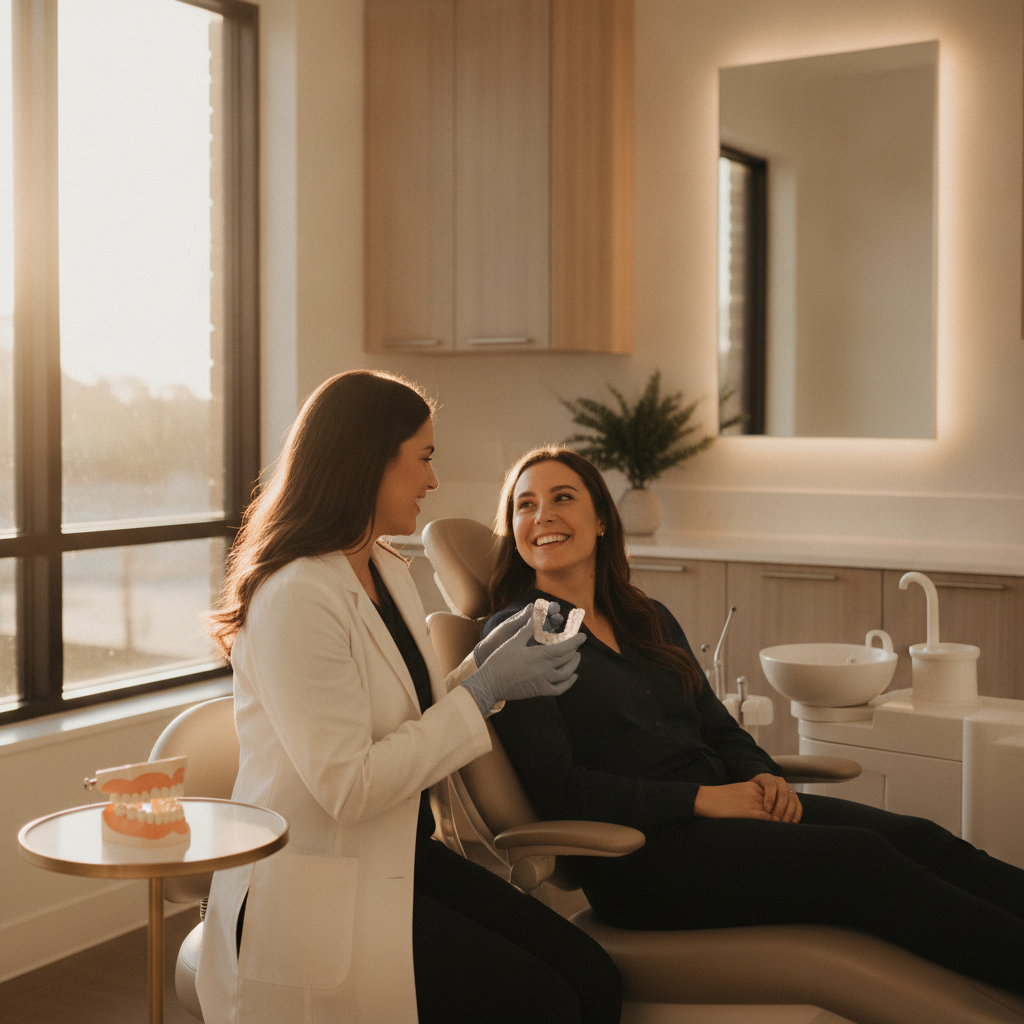
An oral appliance for sleep apnea looks somewhat like a sports mouthguard, but it’s precision-fitted to your teeth and engineered to do something specific: gently hold your lower jaw in a slightly forward position while you sleep. That subtle repositioning keeps the soft tissue at the back of your throat from collapsing inward — which is the physical mechanism behind most cases of obstructive sleep apnea and chronic snoring.
The device is small enough to fit in a shirt pocket, silent, and requires no electricity or distilled water. For people who travel frequently — and plenty of patients who work near the Texas Medical Center or commute across the 610 Loop corridor have unpredictable schedules — that portability alone makes a meaningful difference in whether they actually use the treatment consistently.
The appliance is custom-made from impressions of your teeth. It’s not something you pick up at a drugstore. The fit matters enormously, both for effectiveness and for comfort, and a properly fitted device from a trained dentist is a fundamentally different product from anything available over the counter.
What the Process Looks Like — From First Appointment to Sleeping Better
If you come in wondering whether oral appliance therapy might help you, the first step is a conversation about your symptoms, your sleep history, and whether you’ve already been evaluated by a sleep physician. If you haven’t had a formal sleep study, that’s typically where the process begins — because an accurate diagnosis of the type and severity of your sleep apnea is what shapes the treatment plan.
Once a diagnosis is in hand, impressions or digital scans of your teeth are taken so the appliance can be fabricated to fit precisely. You’ll come back for a fitting, and there’s usually a brief adjustment period — most patients find the device comfortable within a week or two. Follow-up visits allow for fine-tuning of the jaw position until the appliance is doing its job effectively.
Some patients need a follow-up sleep study after starting therapy to confirm that the appliance is adequately controlling their apnea events. This step is worth taking seriously, especially if your sleep apnea is on the more severe end of the spectrum. A good dental sleep medicine provider will coordinate with your physician rather than operating in isolation.
For patients in West University Place, Meyerland, Southside Place, and the broader Bellaire area, having a local dentist who can manage this process from fitting through long-term follow-up — rather than sending you to a sleep clinic across town for every adjustment — makes the whole experience significantly more manageable. You can read more about the full range of services offered at our Bellaire practice here.
The Gap Most Competitor Practices Don’t Fill: Ongoing Management and Coordination
Here’s something worth saying plainly, because it’s a genuine gap in how many dental practices — including several in the Houston area — approach sleep apnea treatment: fitting an oral appliance is only part of the job. Patients with sleep apnea need ongoing monitoring, periodic appliance adjustments as their bite or jaw position shifts over time, and coordination with their medical team when symptoms change.
Many practices that offer oral appliances handle the initial fitting and then essentially hand patients off. That approach leaves people without a clear path forward if the device stops feeling comfortable, if their apnea severity changes, or if they develop jaw soreness — which can happen if a device isn’t fitted or adjusted correctly.
What actually serves patients well is a relationship with a dentist who treats sleep apnea as an ongoing health concern, not a one-time product purchase. That means regular check-ins, attention to any jaw discomfort (since the lower jaw repositioning that makes these devices effective can occasionally aggravate existing TMJ issues), and clear communication with your primary care physician or sleep specialist.
Is Oral Appliance Therapy Covered by Insurance?
This is one of the most common questions patients ask, and the answer is: often, yes — but through medical insurance rather than dental insurance. Because sleep apnea is a medical condition, oral appliance therapy is frequently covered under medical plans when prescribed by a physician and when a documented sleep study supports the diagnosis. The specifics vary widely by plan, so verifying your coverage before moving forward is always the right call.
For costs that fall outside your coverage, options like CareCredit can make treatment more manageable by spreading payments over time. The goal is never to let cost uncertainty become the reason someone continues sleeping poorly night after night. Reach out to our office and we’re happy to walk through what your options might look like before you commit to anything.
Frequently Asked Questions
Can any dentist fit me for a sleep apnea oral appliance in Bellaire?
Not all dentists have training in dental sleep medicine. You want a provider who understands how to properly diagnose candidacy, coordinate with your physician, and manage follow-up care — not just take an impression and hand you a device. Ask specifically about their experience with sleep apnea patients and how they handle ongoing adjustments.
How do I know if I have sleep apnea in the first place?
Common signs include loud or chronic snoring, waking up gasping or choking, morning headaches, daytime fatigue that doesn’t improve with more sleep, and a partner noticing that you stop breathing briefly during the night. A formal sleep study — either in a lab or at home with a take-home device — is what confirms the diagnosis. Your dentist can help coordinate that process.
What if I have both sleep apnea and TMJ problems?
This combination is more common than people realize. A dentist experienced in both conditions can design an approach that addresses your airway without aggravating your jaw joint. It requires careful fitting and monitoring, but it’s manageable with the right provider. Trying to address one in isolation often makes the other harder to treat.
How long does a sleep apnea oral appliance last?
Most well-made custom appliances last three to five years with proper care, though this varies based on how much someone clenches or grinds their teeth overnight. Your dentist will assess the fit and condition at follow-up appointments and let you know when a replacement is warranted.
Can an oral appliance completely replace my CPAP?
For mild to moderate sleep apnea, oral appliance therapy is often fully effective on its own. For severe sleep apnea, it may be used in combination with CPAP at a lower pressure setting, or in cases where a patient genuinely cannot use CPAP at all. The right answer depends on your specific diagnosis, which is why working with both your physician and a trained dental sleep medicine provider matters.
Ready to Explore Your Options?
If you’ve been living with a CPAP you can’t tolerate — or if you’ve been told you have sleep apnea and haven’t started treatment yet — it’s worth having a real conversation about what oral appliance therapy might look like for you. Dr. Boren has been serving patients in Bellaire and the surrounding communities for decades, and dental sleep medicine is among the services he takes seriously as a health issue, not just a dental procedure.
There’s no pressure, no sales pitch, and no commitment required at a first visit. Contact our Bellaire office to schedule a consultation and find out whether an oral appliance might finally help you sleep the way you’re supposed to.