
What Is TMJ Oral Appliance Therapy — and How Do You Know If It Could Relieve Your Headaches in Bellaire?
If you’ve been living with chronic morning headaches, jaw soreness, or facial tension — and you’ve already tried everything from pain relievers to pillow changes — the answer may actually be sitting in your bite. For many patients in Bellaire and the surrounding Houston area, TMJ oral appliance therapy turns out to be the missing piece they never knew to ask their dentist about. It’s a straightforward, non-surgical treatment option that can bring meaningful relief when the source of those headaches traces back to how your jaw joints and muscles are functioning.
- Why Headaches and Jaw Problems Are So Often Connected
- What Oral Appliance Therapy for TMJ Actually Involves
- The Gap Most Local Dental Websites Don't Fill: What Happens at a TMJ Evaluation?
- Night Guard From the Store vs. a Custom TMJ Appliance: Why It Matters
- Who Is a Good Candidate for TMJ Oral Appliance Therapy?
- What to Expect Over Time With Treatment
- Frequently Asked Questions About TMJ Oral Appliance Therapy
- Ready to Find Out If Your Headaches Start in Your Jaw?
Why Headaches and Jaw Problems Are So Often Connected
Your temporomandibular joints — the two hinges that connect your lower jaw to your skull — do an enormous amount of work every day. They guide every bite, every word you speak, and every yawn. When something is off in that system, whether it’s muscle tension from clenching, a misaligned bite, or inflammation in the joint itself, the surrounding muscles can go into overdrive trying to compensate.
Those overworked muscles don’t stay quiet. The same muscle groups that control your jaw also connect to your temples, your neck, and the base of your skull. That’s why a jaw problem can produce headaches that feel exactly like tension headaches or even migraines. Patients often spend months or years treating the headache without ever addressing the source — which is why the headaches keep coming back.
This is an area where general dentists with specific training in bite and jaw therapy can offer something most physicians simply aren’t looking for when you come in with head pain.
What Oral Appliance Therapy for TMJ Actually Involves
A TMJ oral appliance — sometimes called a bite splint, occlusal splint, or TMJ night guard — is a custom-fitted dental device that you wear over your teeth, typically while you sleep. Unlike the generic night guards you’ll find at a pharmacy, a properly made appliance is designed specifically for your bite, your jaw position, and the pattern of muscle tension in your particular case.
The appliance works by gently repositioning your lower jaw into a more relaxed, neutral alignment. This reduces the strain on the jaw muscles and joints, gives overworked muscles a chance to recover, and prevents the kind of clenching and grinding that often intensifies TMJ symptoms overnight. Many patients notice a meaningful reduction in morning headaches within the first few weeks.
It’s worth being clear about one thing: oral appliance therapy isn’t a one-size-fits-all solution, and it isn’t always the first or only step. A thorough evaluation of your bite, your jaw range of motion, your muscle tenderness, and your symptoms is what determines whether an appliance is appropriate for you — and what type would serve you best.
The Gap Most Local Dental Websites Don’t Fill: What Happens at a TMJ Evaluation?
If you’ve tried to research TMJ treatment online or looked at what local dental practices in the Houston area describe, you’ve probably found a lot of general information about symptoms. What’s much harder to find is a clear explanation of what the evaluation process actually looks like — which leaves patients unsure whether to call a dentist, a neurologist, or a specialist.
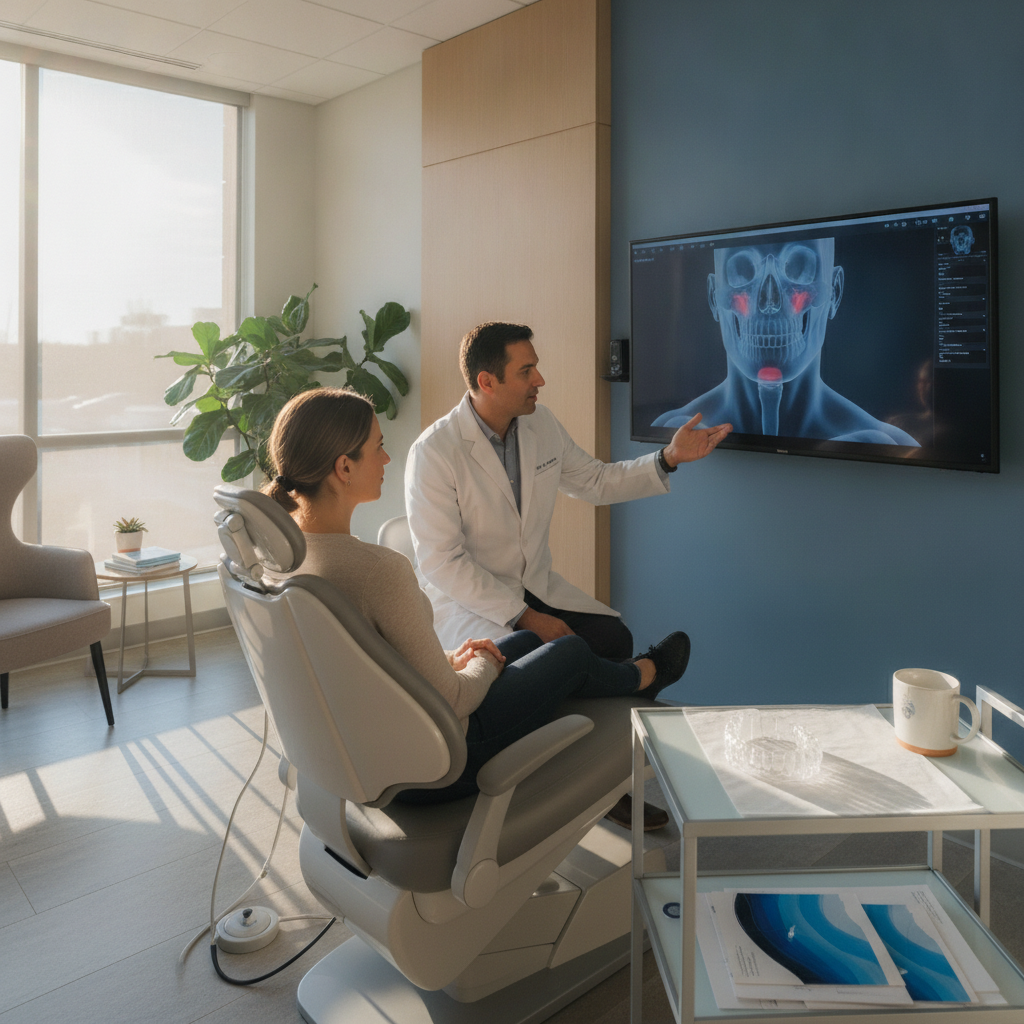
At a TMJ-focused dental evaluation, your dentist will typically review your symptoms and history in detail, examine how your teeth come together when you bite, assess the range and quality of your jaw movement, and palpate (gently press) the muscles around your jaw, temples, and neck to identify tension patterns or trigger points. In some cases, dental X-rays or a closer look at how your bite relates to your jaw joint position may be part of that picture too.
This is different from a standard cleaning appointment — it’s a diagnostic conversation. And for patients who have been bounced between their primary care doctor, a neurologist, and maybe a chiropractor without a clear answer, having a dentist take that kind of careful, systematic look at the jaw can feel like a genuine turning point. Dr. Boren has spent decades in the same Bellaire location developing exactly this kind of thorough, patient-centered approach to TMJ care.
Night Guard From the Store vs. a Custom TMJ Appliance: Why It Matters
This is a distinction worth spending a moment on. Drugstore night guards are made from soft, generic materials and are designed to fit loosely over any set of teeth. For someone who grinds mildly and just wants to protect their enamel, they can be better than nothing.
But for TMJ-related headaches, a generic appliance often falls short — and in some cases can make symptoms worse. Here’s why: if the appliance doesn’t position your jaw in the right place for your specific bite, it can actually increase the workload on your jaw muscles rather than reduce it. A custom appliance is fabricated from a precise impression of your teeth and is designed with your jaw’s ideal resting position in mind. That precision is what makes the difference between an appliance that helps and one that doesn’t.
The investment in a custom appliance is typically more than a store-bought guard, but it’s also a fraction of the cost of ongoing pain management, repeated specialist visits, or procedures that treat the symptom rather than the cause. Many patients in Meyerland, West University Place, and Southside Place find that this one treatment change finally gives them consistent relief after years of struggling.
Who Is a Good Candidate for TMJ Oral Appliance Therapy?
You may be a good candidate if you experience one or more of the following:
- Frequent morning headaches that improve as the day goes on
- Jaw soreness, stiffness, or fatigue — especially when you wake up
- Clicking, popping, or a catching sensation in your jaw joint
- Tension or tenderness around your temples, cheeks, or the sides of your neck
- A history of clenching or grinding your teeth, even if you don’t notice doing it
- Headaches that have been diagnosed as tension-type or migraines but don’t respond well to medication
None of these symptoms guarantee that TMJ is the cause, but all of them are worth discussing with a dentist who evaluates bite and jaw function as part of their practice. Dr. Boren’s practice offers comprehensive TMJ and headache therapy as part of a broader commitment to helping patients feel genuinely better — not just patching symptoms.
What to Expect Over Time With Treatment
For most patients, oral appliance therapy is a gradual process rather than an overnight fix. Many people notice a reduction in headache frequency and jaw soreness within the first two to four weeks. Full symptom improvement — meaning consistent mornings without pain — often develops over two to three months as the jaw muscles gradually relax and adapt to the new resting position.
Some patients wear their appliance long-term as a way to manage an ongoing tendency to clench or grind. Others find that after a period of therapy, their jaw settles into a more comfortable pattern and they no longer need to wear it nightly. Your response to treatment will guide what makes sense for you over the long run.
Frequently Asked Questions About TMJ Oral Appliance Therapy
Is a TMJ appliance the same as a night guard?
Not exactly. Both are worn over the teeth during sleep, but a night guard is primarily designed to protect tooth enamel from grinding. A TMJ appliance is specifically designed to reposition the jaw and reduce muscle tension. The design, materials, and fit are tailored to your bite and jaw function — not just the shape of your teeth.
Will my dental insurance cover TMJ treatment?
Coverage varies significantly depending on your plan. Some dental insurance policies cover a portion of a custom appliance when it’s related to a diagnosed TMJ disorder. Others treat it as elective. It’s worth calling your insurance provider before your appointment to ask about TMJ appliance coverage. The team at Dr. Boren’s office can also help you understand what to expect.
How long does it take to make a custom TMJ appliance?
After your evaluation and impressions are taken, most custom appliances are fabricated by a dental lab and ready within one to two weeks. You’ll return for a fitting appointment where your dentist makes sure the fit and jaw position feel correct before you take it home.
Could my headaches have a different cause — not TMJ?
Absolutely, and a good evaluation will take that into account. TMJ-related headaches are one possible source of chronic head and facial pain, not the only one. If your dentist doesn’t find strong evidence of a bite or jaw issue, they’ll say so clearly and help point you in a better direction. The goal is to find what’s actually causing your symptoms — not to push a treatment that isn’t right for your situation.
Do I need a referral from my doctor to see a dentist for TMJ therapy in Houston?
No referral is needed. You can contact Dr. Boren’s office directly to schedule a TMJ evaluation. If you’ve already seen other providers and have records related to your headaches, bringing that information to your appointment can be helpful — but it’s not required.
Ready to Find Out If Your Headaches Start in Your Jaw?
If you’re tired of waking up in pain and you haven’t had your bite and jaw evaluated, it may be time to take that step. Dr. Charles Boren has been helping patients in Bellaire, West University Place, Houston, and the surrounding neighborhoods find real, lasting relief from TMJ-related headaches and jaw pain for decades — from the same practice, with the same patient-first approach.
You don’t have to come in convinced you have TMJ. You just have to come in. A thorough evaluation will tell you whether your jaw is part of the picture, and if it is, what your options look like. Reach out to schedule a consultation — and start getting some real answers about where your pain is coming from.