

You wake up with a sore jaw. By lunchtime, there’s a click when you chew. By evening, the ache has climbed into your temple and now it feels like a headache too. That pattern is common with TMJ problems, and it’s frustrating because the pain seems to move around. Patients often describe it as jaw pain one day, ear pressure the next, then tightness in the face and neck after that.
The good news is that many cases respond well to conservative care. The right tmj pain relief exercises, paired with an accurate dental diagnosis, can calm irritated muscles, improve jaw motion, and reduce the daily tension that keeps the joint inflamed.
- Finding Local Relief for Jaw Pain and Headaches in Bellaire TX
- Understanding Your Jaw Pain What Is a TMJ Disorder
- Gentle Jaw Stretches and Mobility Exercises for Home
- Beyond the Jaw Posture Breathing and Relaxation Tips
- When Exercises Arent Enough Signs You Need a TMJ Dentist in Bellaire
- How Our Bellaire Dental Practice Provides Lasting TMJ Relief
Finding Local Relief for Jaw Pain and Headaches in Bellaire TX
If you’ve been searching for a dentist near me, an emergency dentist, or a dentist in Bellaire, TX because your jaw hurts every morning, you’re not overreacting. TMJ pain can interfere with eating, talking, sleeping, and concentrating at work. It can also mimic other problems, especially tension headaches and some migraine-like symptoms.
In Bellaire, many adults don’t realize their jaw discomfort is tied to how they bite, clench, posture their neck, or carry stress through the face and shoulders. They try softer foods, over-the-counter guards, or random stretches they found online. Sometimes that helps a little. Sometimes it makes things worse because the exercise doesn’t match the actual cause.
What patients usually notice first
For some people, the first sign is a click. For others, it’s fatigue in the jaw after chewing or waking up with clenched muscles. A few come in convinced they only have headaches until we examine the bite, jaw joints, and chewing muscles and find the source is much lower than the temples.
Many headaches that feel “up in the head” actually start with strain in the jaw muscles and bite pattern.
That overlap matters. If your symptoms blur the line between facial pain and headache pain, it can help to compare migraine relief options while also getting your jaw evaluated so the underlying driver isn’t missed.
Local dental care that looks beyond the joint
In Bellaire, TX, Dr. Boren sees TMJ discomfort as more than a sore hinge. The joint matters, but so do the muscles, the bite, daily clenching habits, and neck posture. That’s why conservative care often works best when it’s practical and individualized instead of generic.
Patients from Bellaire, West University, and nearby Houston neighborhoods often want one clear answer: “Can this be treated without surgery?” In many cases, yes. Non-invasive care is often the starting point, and that includes focused exercise, muscle relaxation strategies, bite evaluation, and when appropriate, appliance therapy.
Understanding Your Jaw Pain What Is a TMJ Disorder
Your temporomandibular joint, or TMJ, is the joint that connects the lower jaw to the skull. It functions as a small, busy hinge that doesn’t just open and close. It also has to glide, coordinate, and stay balanced while you chew, speak, yawn, and swallow. When that system gets irritated, the problem is called temporomandibular disorder, often shortened to TMD.
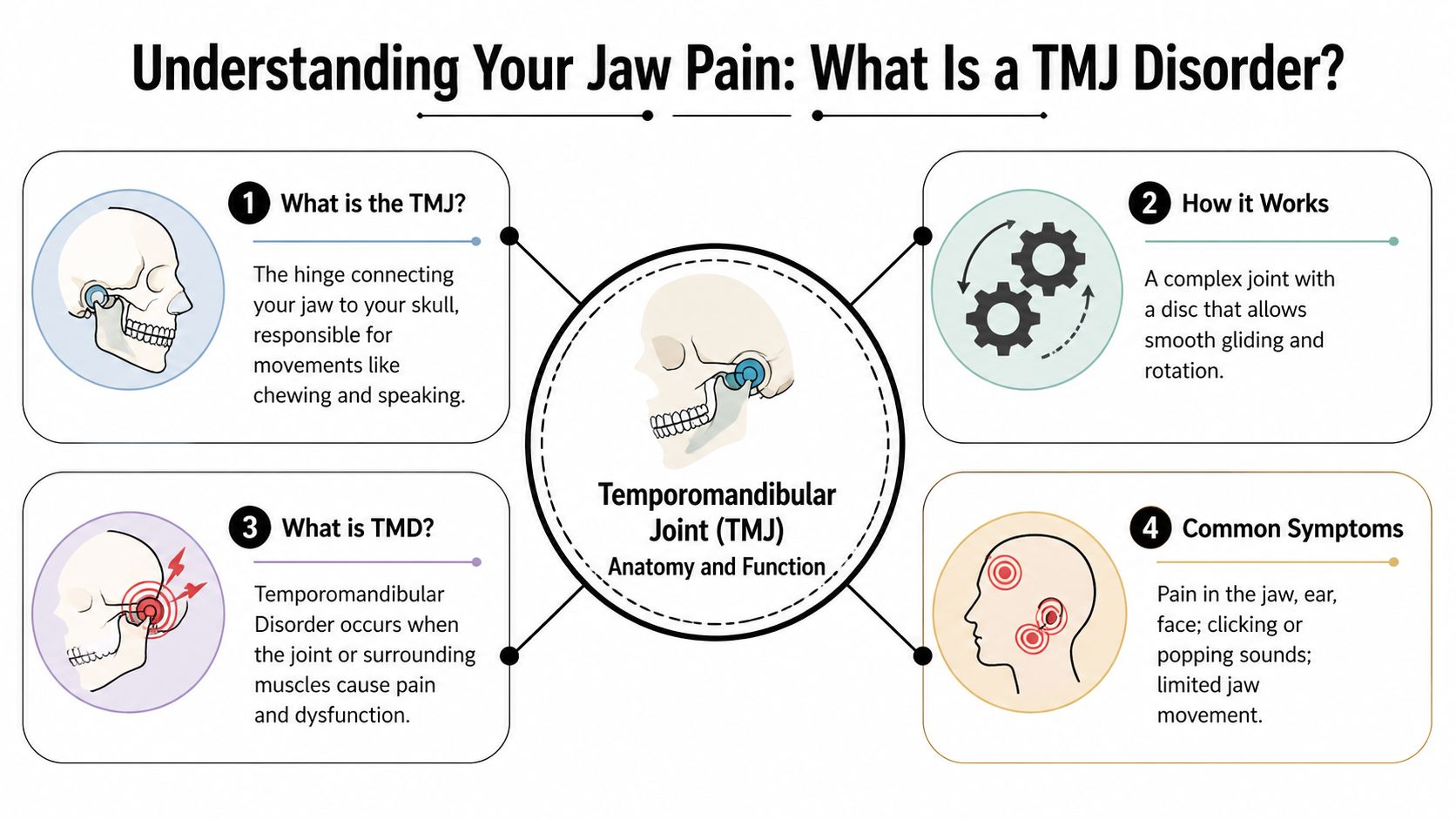
TMJ disorders are common. A review published in Frontiers in Oral Health notes that 5 to 12% of the general adult population is affected, with up to 35 million people in the US alone experiencing symptoms (Frontiers in Oral Health review).
What can trigger TMD
TMD isn’t one single diagnosis with one single fix. Several factors can contribute:
- Teeth grinding or clenching that overloads the jaw muscles
- Bite imbalance that makes the jaw work harder than it should
- Stress-related muscle tension in the face and neck
- Joint inflammation or arthritis
- Disc movement problems inside the joint
- Past injury to the jaw or surrounding muscles
A proper exam matters because jaw pain can overlap with tooth pain, sinus pressure, ear discomfort, or headaches. That’s one reason a focused evaluation is more useful than guessing based on symptoms alone. If you want to understand the underlying causes in more detail, Dr. Boren’s page on what causes TMJ disorder is a helpful next step.
Symptoms that fit the pattern
You don’t need every symptom on this list to have a TMJ disorder. Common signs include:
| Symptom | What it can feel like |
|---|---|
| Jaw pain | Soreness near the joint, cheeks, or temples |
| Clicking or popping | Noise or shifting when opening or chewing |
| Limited opening | A tight jaw, especially in the morning |
| Pain with chewing | Fatigue or sharp discomfort during meals |
| Headaches | Tension around the temples, forehead, or behind the eyes |
| Ear-area discomfort | Fullness, ache, or pressure without an ear infection |
The most important part of diagnosis is not just naming TMJ. It’s identifying whether the pain comes mostly from muscle, joint mechanics, bite strain, or a combination.
That distinction guides treatment. A person with muscular clenching won’t always respond the same way as someone with restricted opening from joint dysfunction. That’s why a new patient exam, dental imaging when needed, and a bite review can be so valuable in a Bellaire dental office.
Gentle Jaw Stretches and Mobility Exercises for Home
At-home care can help, especially when the movements are slow, controlled, and chosen for the right reason. The goal isn’t to force the jaw open. The goal is to restore smoother movement, reduce muscle guarding, and retrain the jaw to move without unnecessary strain.
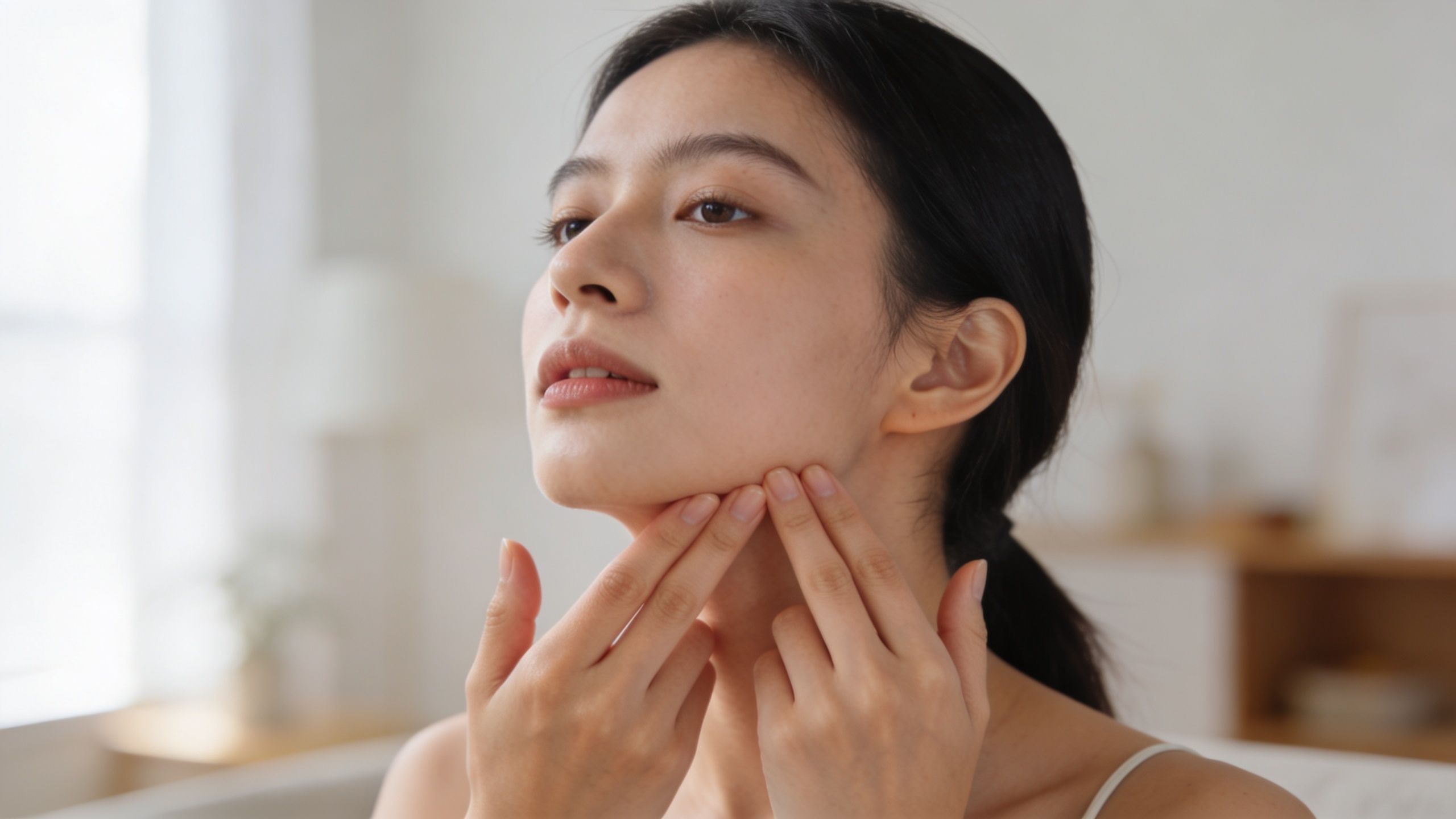
A major review of exercise therapy for painful TMD found significant pain reduction in the chewing muscles, and consistent coordination exercises such as the Goldfish exercise can reduce TMJ pain by 35 to 50% over an 8-week period (PMC review of TMJ exercise therapy). That’s why I usually tell patients to start with coordination and control rather than aggressive stretching.
Goldfish exercises for smoother opening
The Goldfish exercise is one of the most useful starting points because it trains the jaw to open in a more even path.
For the partial opening version, place one index finger lightly over the TMJ area just in front of the ear and another on the chin. Keep your tongue on the roof of your mouth. Let the jaw drop halfway, hold briefly, then close. The reviewed method uses 6 repetitions, done in 6 sets daily, up to 6 times per day when tolerated.
For the full opening version, use the same setup but lower the jaw fully within a comfortable range instead of only halfway. The emphasis is still smooth motion, not maximum range.
Practical rule: If the jaw tracks off to one side, catches, or gives you sharp pain, back off. Better movement beats bigger movement.
Relaxed jaw position and gentle stretch
Many people spend the whole day with their molars touching. That low-grade clenching keeps the muscles switched on. A better resting position is simple: lips together, teeth apart, tongue resting lightly on the roof of the mouth.
Try this for a few minutes several times a day. Then add a very gentle opening stretch from that relaxed posture. Open only to a mild stretch, pause, and close slowly. This isn’t a forceful stretch. Stretching alone didn’t show the same strength of pain relief as coordination work in the review, but it can still be useful when paired with better movement control.
Side-to-side control and light resistance
A stiff jaw often moves unevenly. Small side-to-side glides can help restore awareness and coordination. Open slightly, then move the jaw left and right within a pain-free range. Keep it small. If you hear a click, don’t chase it.
Light resistance can also help with control if the joint isn’t very inflamed. Use one or two fingers under the chin and apply mild pressure while you begin to open. For closing resistance, apply light pressure at the front of the chin while closing. The key word is light.
Here’s a simple way to think about which movement does what:
- Goldfish partial opening helps retrain a smooth opening path.
- Goldfish full opening works on motion once the partial pattern feels steady.
- Relaxed jaw posture reduces all-day clenching load.
- Side-to-side glides improve symmetry and awareness.
- Gentle resistance builds control, not brute strength.
Patients who spend long hours at a desk often do better when jaw work is paired with general movement breaks. If you need ideas for broader movement during the day, Sit Healthier's at-home workouts can fit nicely alongside a jaw routine because less overall tension usually helps the face and neck too.
Watch the technique, not just the schedule
A perfect routine on paper won’t help if the movement is sloppy. Move slowly. Keep the shoulders down. Don’t thrust the chin forward. Don’t “test” the jaw by opening wide after every repetition.
This walkthrough can help you visualize the pace and form:
What usually does not work well
People often stall because they pick the wrong strategy. These habits tend to flare symptoms instead of calming them:
- Pushing through sharp pain because you think more stretch must be better
- Doing random jaw movements without knowing whether the problem is muscular or joint-based
- Clenching during exercise without realizing it
- Trying to open as wide as possible every time
- Ignoring chewing habits, gum use, nail biting, or daytime tooth contact
If you’re dealing with mild tension, these tmj pain relief exercises can be a strong place to start. If the jaw locks, the pain escalates, or the bite suddenly feels off, home care alone isn’t enough.
Beyond the Jaw Posture Breathing and Relaxation Tips
Jaw pain rarely lives only in the jaw. The muscles that help position your head, neck, and shoulders influence how the jaw works all day. When your head drifts forward over a laptop and your shoulders round inward, the jaw muscles often tighten to compensate.
Physical therapy data shows that about 70% of people with TMJ disorders also have related cervical spine issues, and addressing posture can lead to 30 to 50% better long-term pain relief than focusing on the jaw alone (SARH TMJ exercise overview).
Chin tucks and shoulder blade squeezes
A chin tuck helps line the head up over the neck. Sit or stand tall, keep your eyes level, and draw the chin straight back as if making a gentle double chin. Hold briefly, then relax. You should feel length at the back of the neck, not strain in the throat.
A shoulder blade squeeze helps reverse the rounded-shoulder posture that keeps the jaw and neck tense. Pull the shoulder blades gently back and down, hold briefly, then release.

These don’t look like jaw exercises, but they often reduce the background tension that keeps the jaw irritated.
Breathing changes muscle tension
Stress doesn’t just affect mood. It changes muscle tone. Many people with TMJ discomfort hold their breath, breathe shallowly through the chest, or clench when concentrating.
Try a simple breathing reset:
- Sit with your feet flat and jaw relaxed.
- Rest the tongue lightly on the roof of the mouth.
- Inhale through the nose and let the belly expand.
- Exhale slowly and let the teeth stay apart.
- Repeat for a few quiet breaths.
A relaxed jaw is usually a byproduct of a calmer neck, better posture, and slower breathing.
If stress is feeding your clenching pattern, practical stress-reduction habits can make your exercises work better. A straightforward resource on that side of the problem is Axelrad Clinic's approach to stress, especially if you notice flare-ups during busy workdays or poor sleep.
Why this matters in real life
A patient can do jaw drills faithfully and still plateau if they spend the rest of the day leaning forward, tensing the shoulders, and pressing their teeth together during emails. Posture and breathing are not “extra credit.” They change the load on the joint.
That’s one reason a thorough dental diagnosis matters. If the bite is contributing, posture work alone won’t solve it. But if neck tension and clenching are driving the problem, these broader habits can make a meaningful difference.
When Exercises Arent Enough Signs You Need a TMJ Dentist in Bellaire
Home exercises are useful, but they’re not a substitute for diagnosis. Some TMJ cases are straightforward muscle tension. Others involve restricted opening, internal joint problems, or bite patterns that keep re-triggering the same pain. If you’re not improving, the next step should be a professional evaluation.
An international Delphi study found 80% agreement among TMD experts that jaw exercises are effective for certain cases, but they’re best delivered as part of a personalized program with verbal and written instruction (PubMed summary of the expert consensus). That expert consensus matches what we see in practice. Technique and case selection matter.
Warning signs that deserve an exam
You shouldn’t keep trying the same routine if any of these are happening:
- Pain worsens with exercise instead of settling afterward
- Your jaw locks open or closed
- Mouth opening stays restricted
- Chewing becomes difficult
- Clicking is joined by pain or catching
- Headaches or facial pain keep returning
- You suspect grinding or clenching is damaging teeth
Those symptoms suggest that the issue may be more than simple muscle tightness.
Why diagnosis changes treatment
Two patients can both say, “My jaw clicks,” and need different care. One may need movement retraining and habit changes. Another may need bite analysis, an appliance, or evaluation of damaged teeth and bite wear. If someone is also dealing with cracked teeth, worn edges, or unstable dental work, restorative dentistry may become part of the larger solution.
If your jaw problem changes how you eat, sleep, or speak, it’s time to stop self-treating blindly and get examined.
In Bellaire, that evaluation may include a review of symptoms, joint and muscle exam, bite assessment, and imaging when needed. If the pain is severe, sudden, or tied to a jaw that won’t open normally, it may feel urgent enough to seek an emergency dentist. Even when it’s not a true emergency, persistent TMJ pain deserves timely care.
How Our Bellaire Dental Practice Provides Lasting TMJ Relief
Long-term relief usually comes from matching the treatment to the cause. In our Bellaire dental practice, that starts with listening carefully to where the pain shows up, when it flares, what the bite feels like, and whether the symptoms point more toward muscle strain, joint dysfunction, or clenching.
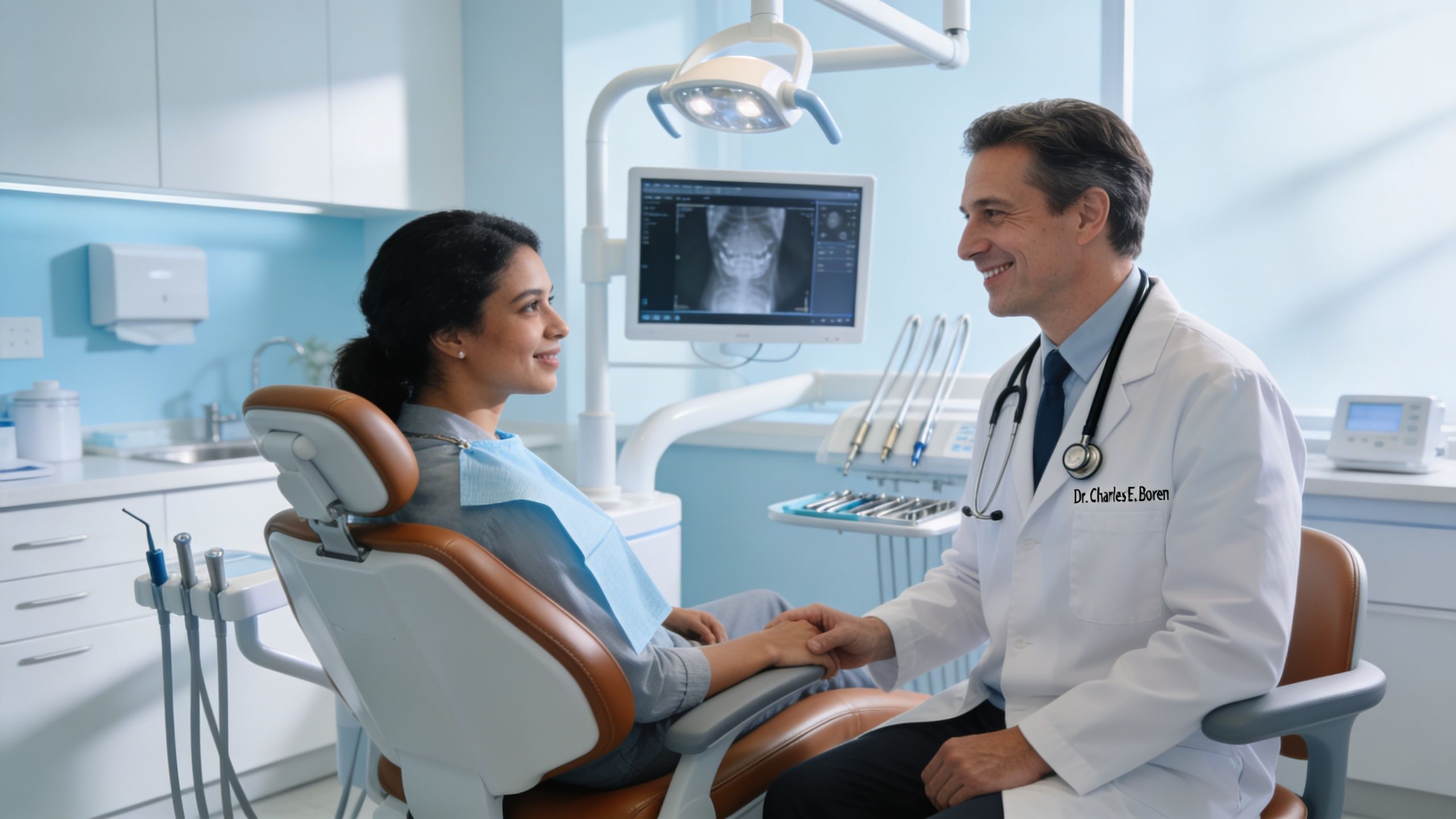
What your visit may include
A TMJ-focused visit can include:
- Bite analysis to see how the teeth meet and whether the jaw is being pushed into strain
- Digital imaging and exam findings to rule out other dental causes of pain
- Muscle and joint evaluation to identify whether the problem is more joint-based or muscle-based
- Review of posture and clenching habits because daily mechanics matter
- Customized home exercise guidance so you’re not guessing
If appliance therapy is appropriate, Dr. Boren may recommend a custom option rather than an over-the-counter guard. For patients considering this route, more detail is available on oral appliance therapy for TMJ.
Why integrated care often works better
Supervised TMJ therapy that combines exercises with professional treatment such as custom oral appliances and bite analysis has an 85% success rate, and integrated care can reduce headache frequency by over 50% compared with unsupervised home exercise alone (clinical summary on combined TMJ therapy). That’s why generic internet advice has limits. It may offer a useful movement, but it can’t tell you whether your bite, restorations, or nighttime clenching are keeping the problem active.
In selected cases, additional dental treatment matters too. Worn teeth, broken fillings, or bite changes may call for restorative dentistry such as crowns. Some patients also ask about smile changes, and cosmetic dentistry can sometimes overlap with bite planning when function and appearance both need attention. For anxious patients, comfort measures and sedation options can make treatment easier.
The practice serves adults and families in Bellaire, West University, and nearby Houston neighborhoods, including those searching online for a dentist in Bellaire, TX, cosmetic dentist near me, or help for chronic jaw pain that hasn’t improved with home care.
If jaw pain, headaches, clicking, or clenching are disrupting your day, schedule a consultation with Charles E. Boren. A careful diagnosis can show whether simple tmj pain relief exercises are enough or whether you need bite analysis, a custom appliance, or broader dental care to get lasting relief.